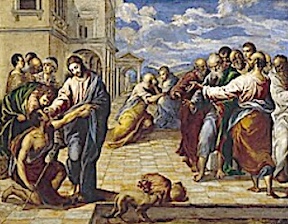
Illustration: Healing of the Man Born Blind, painted by El Greco in 1567
Pope Leo’s Angelus Reflection for 4th Sunday of Lent
St Peter’s Square – Sunday, 15 March 2026
“Faith is an invitation to “open our eyes,” especially towards the suffering of others
and the afflictions of the world as the Lord did“
Gospel Reading for 4th Sunday of Lent – short version (John 9:1,6-9,13-17,34-38)
As Jesus went along, he saw a man who had been blind from birth. He spat on the ground, made a paste with the spittle, put this over the eyes of the blind man, and said to him, ‘Go and wash in the Pool of Siloam’ (a name that means ‘sent’). So the blind man went off and washed himself and came away with his sight restored.
His neighbors and people who earlier had seen him begging said, ‘Isn’t this the man who used to sit and beg?’ Some said, ‘Yes, it is the same one.’ Others said, ‘No, he only looks like him.’ The man himself said, ‘I am the man.’
They brought the man who had been blind to the Pharisees. It had been a sabbath day when Jesus made the paste and opened the man’s eyes, so when the Pharisees asked him how he had come to see, he said, ‘He put a paste on my eyes, and I washed, and I can see.’ Then some of the Pharisees said, ‘This man cannot be from God: he does not keep the sabbath.’ Others said, ‘How could a sinner produce signs like this?’ And there was disagreement among them.
So they spoke to the blind man again, ‘What have you to say about him yourself, now that he has opened your eyes?’ ‘He is a prophet’ replied the man. ‘Are you trying to teach us,’ they replied ‘and you a sinner through and through, since you were born!’ And they drove him away.
Jesus heard they had driven him away, and when he found him
Jesus said to him, ‘Do you believe in the Son of Man?’ The man replied: ‘Sir, ’tell me who he is that I may believe in him.’ Jesus said, ‘You are looking at him; he is speaking to you.’ The man said, ‘Lord, I believe’, and worshipped him.
Pope Leo’s Angelus Reflection
Dear brothers and sisters,
The Gospel reading for the Fourth Sunday of Lent recounts the healing of a man who was born blind. Through this account’s symbolism, John the Evangelist speaks to us about the mystery of salvation. While we were in darkness and humanity walked in gloom (Isaiah 9:2 The people who walked in darkness
have seen a great light; those who dwelt in a land of deep darkness, on them has light shined.),
God sent his Son as the light of the world, to open our eyes and illuminate our lives.
The prophets announced that the Messiah would open the eyes of the blind
(Isaiah 29:18; 35:5 – On that day the deaf shall hear the words of a book, and out of their gloom and darkness, the eyes of the blind shall see.;
Psalm 146:8 – The Lord opens the eyes of the blind. The Lord lifts up those who are bowed down; the Lord loves the righteous).
Jesus confirmed the authenticity of his mission by showing that “the blind receive their sight” (Matthew 11:5 – the blind receive their sight and the lame walk, lepers are cleansed and the deaf hear, and the dead are raised up, and the poor have good news preached to them.), and (John 8:12). “he presented himself with the words: “I am the light of the world”
We can all say that we are “blind from birth” because we cannot see the mystery of life in all its depth by ourselves.
This is why God became flesh in Jesus, so that the clay of our humanity, shaped by the breath of his grace, might receive a new light, one capable of helping us to see ourselves, others and God in truth.
It is striking that the opinion has persisted for centuries that faith is a kind of “leap in the dark,”
[a renunciation of thought’.
According to this view, having faith means believing “blindly.”
However, the Gospel shows us that our eyes are opened through contact with Christ.
Indeed, the religious authorities insistently asked the healed blind man: “How were your eyes opened?” (John 9:10); and again: “How did he open your eyes?” (John 8:26).
Brothers and sisters, we are also healed by the love of Christ and are called to live our faith with “open eyes.”
Faith is not a blind act, a forsaking of reason or a retreat into some sort of religious certainty that causes us to turn our gaze away from the world.
On the contrary, faith helps us to see things “as Jesus himself sees them, with his own eyes: it is a participation in his way of seeing” (Lumen Fidei, 18).
In this sense, faith is an invitation to “open our eyes,” especially towards the suffering of others and the afflictions of the world as the Lord did,
In the face of the many questions of the human heart, and the tragic situations of injustice, violence and suffering that mark our time, it is essential that our faith is alert, attentive and prophetic.
Faith should open our eyes to the world’s darkness and bring the light of the Gospel to others through our commitment to peace, justice, and solidarity.
Let us ask the Virgin Mary to intercede for us, so that the light of Christ may open the eyes of our hearts and enable us to bear witness to him with simplicity and courage.