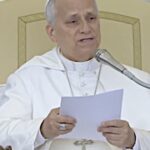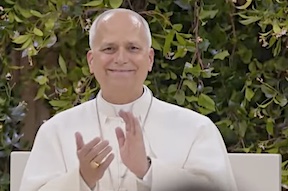
Pope Leo’s address to the Archdiocesan Community of Madrid
Santiago Bernabéu Stadium (Madrid) – Monday, 8 June 2026
“There is a special relationship between the Church and a city”
Dear brothers, dear sisters,
This evening has become a great hymn of faith, and I am pleased to join my voice with yours in praising God and in strengthening the bonds of our beautiful ecclesial family. Our family is learning the art of polyphony—unity in diversity.
I thank your archbishop, Cardinal José, for highlighting the importance of song, which shows us that numbers, data, and facts alone are insufficient for building community. Our hearts must sing — that is, we must celebrate the meaning of events and situations with others.
For the Church, this happens uniquely through the liturgy, the great memorial of the saving events.
Singing is a necessity that permeates our shared life and challenges culture, urging it to remain open and evolve constantly.
You are a diocesan church surrounded by people who love music and dance, and who enjoy being together.
However, they also experience conflict, resignation, and despair.
In such circumstances, the Gospel can offer a path toward hope.
You bear witness to the Gospel in the capital of a great European country,
This is the seat of institutions and organizations where important decisions for the present and the future are made.
It is also a popular destination for millions of visitors and fellow Christians who come in search of new opportunities.
If you transform your joy from a fleeting emotion into a stable way of being—into a deep sentiment that renews individuals, groups, and the diocesan community—it will become contagious.
It’s no coincidence that the apostles often encouraged the churches to rejoice in their writings. It was almost as if it were a commandment.
The Evangeliigaudium, (translated: The Joy of the Gospel) is a response we can sing together to God’s work in Jesus Christ.
His life, death and resurrection have forever changed the perception of history for those who have encountered and followed him, albeit in different ways and along different paths.
Even today, the love of Christ urges us on.
(2 Corinthians 5:14 – the love of Christ controls us, because we are convinced that one has died for all; so all died).
The verb Saint Paul uses also means “captivates us,” “holds us together,” “seizes us” — and thus calls us to responsible action.
Yes, dear brothers and sisters, as some of you have testified this evening, baptism can truly change your life.
Our sensibilities, backgrounds and priorities converge in Christ, drawing life from him, like the branches from the vine.
This means that much of what was already within us is transformed and no longer remains a private gift.
It is now directed toward the service of the common good.
We need not fear that this will ever lead to uniformity.
The New Testament bears witness to communion in diversity through its variety of voices — an understanding lost at Babel.
According to the biblical account, everyone was compelled by a purely human, totalitarian project and ended up failing to understand their neighbor.
In the encyclical letter Magnifica Humanitas, I proposed the figure of Nehemiah as an alternative to standardization and confusion.
Nehemiah involved the entire community in rebuilding the walls of Jerusalem. “Rebuilding today means recognizing that, precisely from the plurality of voices and visions, even though they sometimes remind us of the confusion caused by the diversity of spoken languages, a bright possibility emerges.
Indeed, this is the possibility of building together, of transforming diversity into a resource and of making listening and dialogue the common ground upon which to cultivate justice and fraternity.
Within this shared task, Christians discover their unique role of guiding actions toward God so that, in his light, pluralism does not dissipate into disorder, but instead, through the practice of synodality, it becomes the space in which humanity rediscovers its solid foundations and its final end.” (Magnifica Humanitas No. 10).
There is a special relationship between the Church and a city, and it becomes even more important in our changing times.
This relationship develops among real people through work-related and social interactions, as well as through various communities, associations, and neighborhood organizations.
The need for a particular approach to Christian mission in large urban areas is becoming increasingly evident, as a new culture has emerged and continues to grow in these areas. This idea has been clarified and deepened throughout the synodal journey, enabling us to get to know each other better and listen to one another more deeply within the contexts in which the diocesan community exists and takes shape.
The most important question becomes: do who we are as Christians and what we do reach “where new narratives and paradigms are being formed,” that is, the “the inmost soul of our cities” (No. 74 – What is called for is an evangelization capable of shedding light on these new ways of relating to God, to others and to the world around us, and inspiring essential values. It must reach the places where new narratives and paradigms are being formed, bringing the word of Jesus to the inmost soul of our cities)
We may face challenges in providing an answer, but it’s not impossible if we work towards the truth collaboratively.
For this reason, it is important not to become complacent within a group or environment where we feel safe among people who think alike.
To reach the heart of the city, we must cultivate an awareness that truth is symphonic and always surpasses us.
We must also foster a desire to encounter the Risen One, who always goes before us.
He precedes us and may already be present where we have not yet sought him.
Indeed, seeking and following him is the condition for pointing him out to others. Otherwise, there is no evangelization.
Today, we understand this better than in the past.
In large cities, more so than in other places, we sometimes feel that we no longer have the maps to navigate safely.
Therefore, we must relearn the spiritual art of kindness.
Without it, proclaiming the Gospel risks becoming impersonal and ineffective, leaving room for frustration and mistrust.
Dear brothers and sisters,
Madrid is a great city where different traditions and “souls” co-exist together.
God knows the heart of every one of its inhabitants.
He knows them as only he can, through love and therefore in freedom.
He is infinite mercy and wants everyone to be saved.
In fact, he desires this so much that he became flesh and took on all the world’s sin, evil, and negativity.
Behold Jesus Christ!
Behold the Good News, the grace we have received and are called to share with everyone! For all, without exception, are made for life, and for life in its fullness.
The presence of the Church in a great city is a parable of this mystery of salvation.
The Book of Jonah comes to mind — a gem of the Bible that I invite you to read or reread, personally and with your communities.
It is no coincidence that the apostles established the nascent Church in cities, where they encountered both rejection and acceptance.
After all, people in cities are more accustomed to facing diversity and change.
Do not be troubled or frightened!
As a diocesan church, you have the power to share the Gospel and inspire the best in humanity, which is bombarded with images and words yet hungers for justice and truth.
Have confidence in the growing number of people who are returning to or discovering the faith for the first time in adulthood.
Be ready to welcome new beginnings as the rule of the mission, not the exception.
Participation in parish and diocesan councils aims to adjust each person’s sensibility by closely listening to what the Spirit says to the Church.
It would be a pity to reduce these councils to mere bureaucratic formalities.
These councils are spaces for mutual listening and discernment. Without them, we run the risk of failing to understand where the Lord wants us, what he expects of us, and what kind of conversion he is asking of us.
When we participate in these councils, worship becomes life, and bonds of fraternity and solidarity are formed.
I encourage priests to embrace communal discernment as one of the most valuable opportunities that synodality provides for their ministry.
Dear brothers, without straying from the essential, regularly pausing with your people to interpret the life of neighborhoods, cultural changes, social tensions and ecclesial practices in the light of the Gospel will enrich and console your ministry.
This practice will also help each person and community break free from isolation and experience the joy of the Holy Spirit.
When we reduce ecclesial life to a routine in which everyone remains locked into their habits and roles, the Spirit is absent.
The Spirit stirs up and unites vocations, sometimes causing upheaval, discussion, and a search for a new equilibrium.
Do not be frightened by this – but embrace it. The stories we have heard tonight tell us — or rather, “sing to us”— just how much life there is in this Church.
One person gave the following testimony: “I can say without a doubt that I deeply love the Church, the family of God, where we all have a place.”
Another said: “I felt great joy and responsibility when I became a more active member of the community and shared my gifts with the other members of the church.”
Still others said: “For us, serving in these programs is not only a way to help, but also a way to give back all the love and support we have received.”
Behold the Church, dear brothers and sisters!
Behold the music of the Gospel, with its compelling rhythm.
When it reaches the heart, it makes people feel like they have been welcomed with open arms.
Consider our sister who came from Peru to Madrid.
Many, like her and her family, are initially afraid to get close because they have heard about prejudices and disappointments.
Kindness, even if it comes from just a few, can overcome the fear of many.
Be like an open Bible to everyone: may the Word of God be found in your faces and lives.
Love is the language that makes everyone feel at home
Thank you very much.
Let us pray together using the words Jesus taught us.
The Lord’s Prayer -followed by Pope Leo’s blessing.