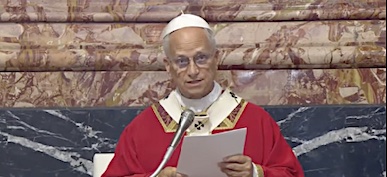
Pope Leo’s Homily Mass for Cardinal Camillo Ruini
St. Peter’s Basilica, Cathedral Altar
Thursday, June 18, 2026
“The truth will set us free“ (John 8:32).
Dear Brothers and Sisters,
We celebrate this Eucharist by entrusting our brother, Cardinal Camillo Ruini, the wise and caring shepherd of Christ’s flock, to the mercy of the Lord.
He served the Church with dedication for many years, whether in humble tasks or in the most significant responsibilities entrusted to him as a priest, bishop, and cardinal.
He taught, studied, and deepened theological knowledge; engaged in pastoral ministry; worked with young people; contributed to culture; cared for the laity and vocations; and exercised power.
The Church in Italy owes him a great deal. He served as president of the Episcopal Conference for sixteen years, as well as vicar of the Holy Father in the Diocese of Rome for the same period.
He led the People of God and his fellow bishops through important and delicate moments, taking on numerous challenges with enthusiasm, discernment, and courage.
We owe our intuitions and initiatives to him, which have left a deep mark on the path of the ecclesial and civic community.
We remember the “Cultural Project,” through which he encouraged Catholic communities to contribute to various areas of religious, civil, and political life in Italy.
We also remember the significant work of the Diocesan Synod and its implementation in Rome. Additionally, we recall his active and dialogue-oriented presence at various levels of the Church and secular society.
As we remember Him and place Him in the arms of the Heavenly Father, we allow ourselves to be enlightened by the Word of God, which we have listened to, as well as by the thoughts that He Himself left in writing.
In the first reading, the Apostle Paul resounded with the moving words: “Neither death nor life, nor angels, nor principalities, nor the present, nor the future, nor powers, nor things high or deep, nor any other creature can separate us from the love of God” (Romans 8:38-39).
Cardinal Ruini was animated by this truth in his ministry.
God’s love is faithful; nothing can overcome it or separate us from it.
It is His gift, given abundantly beyond all our merit and weakness.
Our dear brother experienced many vicissitudes in life, and he accompanied the faithful and the communities entrusted to him throughout his long ministry.
We should look to the Lord’s invincible love and faith’s response to this gift for the source of the strength with which he faced these trials.
In his Spiritual Testament, Cardinal Camillo wrote, “I have received from them no less than I myself have tried to give,” speaking of the many people to whom he was grateful for the good he had been given by them.
These are words that can help us live up to our responsibilities and fulfill our various ministries with the same humility and trust in God.
In fact, he himself testified that prayer was one of the greatest sources of strength that accompanied him throughout his long life, from childhood onward.
It was simple and fervent in his younger years and matured over time, even during periods of weakness and illness.
The liturgy has offered us another sentence of Sacred Scripture that can help us live this moment of grace fruitfully. It is the words of Jesus that we have heard in the Gospel: “Father, I desire that those whom you have given me may also be with me where I am” (Jn 17:24).
These words summarize the purpose, direction, and ultimate goal of a life dedicated to the well-being of our brothers and sisters, lived in constant search of God’s plans for our salvation and theirs.
Cardinal Ruini wrote on this subject: “I hope, Lord, that I acted not for personal gain, but for the purposes entrusted to me, which I wholeheartedly embraced” (Spiritual Testament).
It is beautiful to remember this reality that deeply animated his heart as a shepherd, transcending all other concerns.
Accompanying him in prayer and in the sacrifice of the Eucharist, let us share his desire to reach the Lord’s eternal joy.
Let us pursue this goal together, united forever in him and in each other.
Cardinal Camillo Ruini had the good fortune of knowing and working with some of the great saints of recent times, including St. Paul VI and St. John Paul II.
Regarding his relationship with Pope Wojtyla, with whom he collaborated for many years, he wrote:
“In John Paul II I experienced your presence, Lord; I could tangibly feel the unity in prayer, the indissolubility of prayer, life and apostolate, the courage of faith that guides history, the capacity to love and forgive”.
I believe the Cardinal was able to learn a lot from the example of the great Pope’s unified life. In him, we can also find many of the features with which the Cardinal describes the Holy Pope. I think this harmony of feelings can also inspire us on our path.
For his episcopal motto, our brother chose a phrase inspired by the Gospel of John: “Veritas liberabit nos,” or “The truth will set us free” (Jn 8:32).
These words encapsulate the profound concepts of personhood and freedom revealed by Christ and taught by the Church: we were created for truth and goodness, and only in them do we find unity, peace, and fulfillment, both in mortality and in eternity.
These words clearly remind us of an important message for our time, when it is easy to lose our sense of direction amid relativistic tendencies and fluid views of reality and humanity.
Cardinal Ruini’s life and death are a sign of the strength and permanence with which a person grows and matures when they find the truth from God at the center of their existence.
In conclusion, I would like to express my gratitude to those who accompanied, helped, and supported the Cardinal in his work and pastoral ministry, especially during his old age and illness.
In particular, I would like to thank those who were with him until the very end, showing him reverent devotion.
May the Lord reward everyone and give comfort to his relatives.
May he grant the Cardinal the reward of his peace, which has no end.