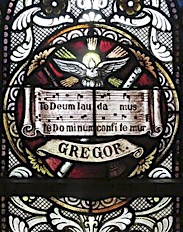
Media: “Te Deum” on a stained glass window in the Sorrowful Mother Shrine Chapel (Bellevue, Ohio)
Pope Leo’s Wednesday Audience
St Peter’s Square – 31 December 2025
Reflection on the last day of the calendar year
From the Letter of St.Paul the Apostle to the Ephesians
(Eph 3:20-21)
To Him who can make infinitely more than what we ask or understand,
To Him be glory in the Church and in Christ Jesus
for all generations of the age of ages! Amen.
Dear Brothers and Sisters,
On the last day of the calendar year, as we approach the end of the Jubilee and the Nativity of the Lord, we reflect on this last day of 2025. The past year has certainly been marked by important events:
– some have been joyful, such as the pilgrimage of many of the faithful on the occasion of the Holy Year;
– others have been painful, such as the passing of Pope Francis the ongoing armed conflicts that plague our planet.
As the year comes to a close, the Church invites us to present everything to the Lord.
We entrust ourselves to His providence, asking Him to renew the miracles of His grace and mercy in us and around us in the coming days.
This tradition is reflected in the solemn singing of the ”Te Deum”, with which we thank the Lord tonight for the blessings we have received.
We will sing: “We praise Thee, O God”; “In You, O Lord, I have placed my hope”; “May Your mercy, O Lord, be upon us.”
In this context, Pope Francis noted that while “world gratitude, world hope are apparent […] they are reduced to the ‘I’ pf their own interests […].
It is in this liturgy that we breathe a completely different atmosphere: of praise, wonder and gratitude”
We are called to this attitude today.
– to reflect on what the Lord has done for us in the past year, as well as
– to honestly examine our conscience,
– to evaluate our response to the L0rds gifts and
– to ask forgiveness for all the moments in which we have failed to appreciate his inspirations and
– to make the most of the talents he has entrusted to us (Matthew 25, 14-30 – on our talents).
This leads us to reflect on the first two signs that have accompanied us in recent months: the signs of “journey” and “destination”.
Many pilgrims from around the globe have come this year to pray at the Tomb of St. Peter and to strengthen their bond with Christ.
This reminds us that entire lives are pilgrimages, with the ultimate goal transcending space and time, to be fulfilled in the encounter with God and in full and eternal communion with Him.
In the Te Deum, we will also ask for this when we say: “Count them among your saints in eternal glory.” St. Paul VI aptly described the Jubilee as a great act of faith in “anticipation of our future destinies … which we are already tasting and which […] we are preparing.””.
In the splendor of this eschatological light which illuminates the encounter between the finite and the infinite, the third sign appears: the passage through the Holy Door that so many of us have made, praying and imploring indulgence for ourselves and our loved ones.
This passage expresses our “yes” to God. With his forgiveness, he invites us to cross the threshold of a new life animated by grace, modeled on the Gospel, and inflamed with love for our neighbor, who is anyone in need of understanding, help, consolation, or sacrifice. This includes those who are unknown to us personally and those who are irritating and unfriendly. Yet, they are all endowed with the incomparable dignity of a brother.
It is our “yes” to a life committed to the present and oriented toward eternity.
Dear friends, let us contemplate these signs in the light of Christmas.
In this context, St. Leo the Great saw the Nativity of Jesus as a joyful message for all.
He said: “Let the saint rejoice”, for he is near to the palm of victory;
let the sinner rejoice, for forgiveness has been given him;
let the pagan return to life, for he is called to it “
Today, his invitation is addressed to all of us who have been sanctified by baptism because God has become our companion on the journey toward true life.
It is addressed to us sinners because, having been forgiven thanks to his grace, we can rise and move on. Finally, it is addressed to us, the poor and frail, because the Lord took on our weakness, redeemed it, and revealed its beauty and power to us in his perfect humanity (cf. Jn 1:14).
Therefore, I would like to conclude by recalling the words with which St. Paul VI described the fundamental message of the Jubilee of 1975: “love.”
He added, “God is love!” This is the ineffable revelation that the Jubilee, with its pedagogy, indulgence, forgiveness, and finally, peace—full of tears and joy—wanted to fill our spirits today and always in the future. God is love! God loves me! God was waiting for me, and I found him again! God is mercy! God is forgiveness! God is salvation! Yes, God is life!” (General Audience, December 17, 1975).
May these thoughts accompany us as we transition from the old year to the new, and may they always accompany us throughout our lives.
_____________________________
Summary of the Holy Father’s Catechesis
The year that is coming to an end was marked by important events—joyful ones, such as the Jubilee Pilgrimage, as well as painful ones, such as the passing of Pope Francis.
On the last day of the year, the Church sings the hymn “Te Deum” to God.
We reflect on what the Lord has done for us and examine our conscience.
Three signs help us with this: the journey, the destination, and the Holy Door.
During the Jubilee Year, our journey’s destination was the Tomb of St. Peter. In our lives, our ultimate goal is to meet God in eternity.
Passing through the Holy Door invites us to enter a new life with Christ.
Footnote: Te Deum Laudamus – We praise you, O God
We praise you, O God, we acclaim you as the Lord; all creation worships you, the Father everlasting.
To you all angels, all the powers of heaven, the cherubim and seraphim, sing in endless praise:
Holy, holy, holy Lord, God of power and might, heaven and earth are full of your glory.
The glorious company of apostles praise you. The noble fellowship of prophets praise you.
The white-robed army of martyrs praise you.
Throughout the world the holy Church acclaims you: Father, of majesty unbounded,
your true and only Son, worthy of all praise, the Holy Spirit, advocate and guide.
You, Christ, are the King of glory, the eternal Son of the Father.
When you took our flesh to set us free you humbly chose the Virgin’s womb.
You overcame the sting of death and opened the kingdom of heaven to all believers.
You are seated at God’s right hand in glory. We believe that you will come and be our judge.
Come then, Lord, and help your people, bought with the price of your own blood,
and bring us with your saints to glory everlasting.