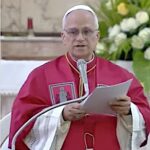
Pope Leo’s homily at Cathedral Basilica of the Immaculate Conception (Mongomo) in Equatorial Guinea
Wednesday, 22 April 2026
First Reading: Acts 8:1-8
Saul was consenting to Stephen’s death.
And on that day a great persecution arose against the church in Jerusalem; and they were all scattered throughout the region of Judea and Samaria, except the apostles. Devout men buried Stephen and made great lamentation over him. But Saul laid waste the church, and entering house after house, he dragged off men and women and committed them to prison. Now those who were scattered went about preaching the word. Philip went down to a city of Samaria and proclaimed to them the Christ. And the multitudes with one accord gave heed to what was said by Philip, when they heard him and saw the signs which he did. For unclean spirits came out of many who were possessed, crying with a loud voice; and many who were paralyzed or lame were healed. So there was much joy in that city.
Gospel: John 6:25-40
Jesus said to the crowd: ‘I am the bread of life.
He who comes to me will never be hungry; he who believes in me will never thirst.
But, as I have told you, you can see me and still you do not believe.
All that the Father gives me will come to me, and whoever comes to me I shall not turn him away; because I have come from heaven, not to do my own will, but to do the will of the one who sent me.
Now the will of him who sent me is that I should lose nothing of all that he has given to me, and that I should raise it up on the last day.
Yes, it is my Father’s will that whoever sees the Son and believes in him shall have eternal life, and that I shall raise him up on the last day.’
Pope Leo’s Homily
Dear brothers and sisters,
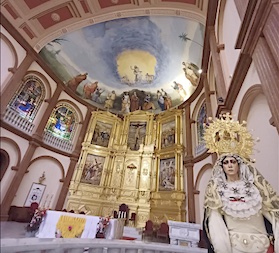
We are gathered in this magnificent cathedral basilica, dedicated to the Immaculate Conception, the mother of the Incarnate word and patroness of Equatorial Guinea, to hear the word of the Lord and celebrate the memorial he left us, the source and summit of the church’s life and mission.
The Eucharist contains all the spiritual blessings of the Church. Christ, our Passover, gives himself to us; he is the living bread that nourishes us.
His presence in the Eucharist reveals God’s infinite love for the entire human family and how he encounters every woman and man, even today
I am pleased to be able to celebrate with you and give thanks to the Lord for these 170 years of evangelization in Equatorial Guinea.
This is an appropriate time to acknowledge all that the Lord has done. At the same time, I would like to express my gratitude to the numerous missionaries, diocesan priests, catechists, and lay faithful who have dedicated their lives to serving the Gospel.
They have embraced the aspirations, questions, and wounds of your people and illuminated them with the Lord’s word. In doing so, they have become a sign of God’s love among you.
Through their example, they played a part in establishing the Kingdom of God, fearlessly suffering for their fidelity to Christ.
It is a history that you must never forget.
On the one hand, it connects you to the universal and apostolic Church that came before you.
On the other hand, it makes you protagonists in proclaiming the Gospel and bearing witness to your faith.
This fulfills the prophetic words spoken by Pope St. Paul VI on African soil: “Africans, from now on, you are missionaries to yourselves. The Church of Christ is well and truly planted in this blessed soil”.
Keeping this in mind, today you are called upon to follow in the footsteps of the missionaries, pastors, and laypeople who came before you. Each of you is invited to make a personal commitment that encompasses your entire life. This commitment will allow the faith celebrated so joyfully in your communities and liturgies to also nourish your charitable works and sense of responsibility toward your neighbor for building up the common good.
Such a commitment requires perseverance; it demands effort and, sometimes, sacrifice.
Yet it is the sign that we are truly the Church of Christ.
The first reading narrates how a church that fearlessly and joyfully proclaims the gospel may also be persecuted (Acts 8:1–8).
The Acts of the Apostles tells us that while Christians were forced to flee and were scattered, many drew near to the word of the Lord.
They saw with their own eyes how the sick had been healed, which brought great joy to the whole city and was a sign of God’s presence.
Brothers and sisters, even when we are faced with personal, family, or social situations that are unfavorable, we can trust that the Lord is at work. He makes the good seed of his Kingdom grow in ways that are unknown to us. This happens even when everything around us seems barren and in moments of darkness.
Rooted in the power of his love rather than our own merits, we are called to remain faithful to the Gospel, proclaim it, live it fully, and bear witness to it with joy.
God will not fail to provide signs of his presence. Just as Jesus told us in the Gospel we heard, he will once again be “the bread of life” that satisfies our hunger (John 6:35 – I am the bread of life).
What hunger do we feel?
What does this nation hunger for today?
The motto chosen for my visit is “Christ, Light of Equatorial Guinea: Towards a Future of Hope.”
Perhaps this is precisely what we hunger for most today.
There is a hunger for a hopeful future capable of engendering a new sense of justice and producing fruits of peace and fraternity.
This future is not one we must passively await; rather, it is one we are called to build with God’s grace.
The future of Equatorial Guinea depends on your choices. It is entrusted to your sense of responsibility and your commitment to safeguarding the life and dignity of every person.
Therefore, it is necessary for all the baptized to feel that they are part of the evangelization effort and become apostles of charity and witnesses to a new humanity.
This involves participating, with the guidance of the Gospel, in the integral development of this land, its renewal, and its transformation.
The Creator has endowed you with abundant natural resources. I urge you to work together so that it may bless all people.
May the Lord help you become a society in which everyone works ever more fully to serve the common good rather than private interests, bridging the gap between the privileged and the disadvantaged, each according to their respective responsibilities.
There should be greater freedom, and the dignity of the human person must always be safeguarded.
My thoughts go out to the poorest among you, to families experiencing difficulty, and to prisoners, who are often forced to live in unsanitary conditions.
Brothers and sisters, it is time for Christians to take control of the destiny of Equatorial Guinea.
For this reason, I encourage you not to be afraid to proclaim the Gospel and bear witness to it with your lives!
Be builders of a future filled with hope, peace, and reconciliation. Continue the work that the missionaries began 170 years ago.
May the Immaculate Virgin Mary accompany you on this journey.
May she intercede for you and help you become generous, joyful disciples of Christ.