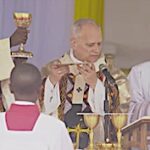
Pope Leo’s homily at Holy Mass in Cameroon
“Japoma Stadium” Douala, Cameroon – Friday, April 17, 2026
Gospel Reading (John 6:1-15)
Jesus went to the other side of the Sea of Galilee, which is the Sea of Tiberias. And a multitude followed him, because they saw the signs which he did on those who were diseased. Jesus went up into the hills, and there sat down with his disciples. Now the Passover, the feast of the Jews, was at hand. Lifting up his eyes, then, and seeing that a multitude was coming to him, Jesus said to Philip, “How are we to buy bread, so that these people may eat?” This he said to test him, for he himself knew what he would do. Philip answered him, “Two hundred denarii[a] would not buy enough bread for each of them to get a little.”
One of his disciples, Andrew, Simon Peter’s brother, said to him, “There is a lad here who has five barley loaves and two fish; but what are they among so many?” Jesus said, “Make the people sit down.” Now there was much grass in the place; so the men sat down, in number about five thousand. Jesus then took the loaves, and when he had given thanks, he distributed them to those who were seated; so also the fish, as much as they wanted. And when they had eaten their fill, he told his disciples, “Gather up the fragments left over, that nothing may be lost.” 13 So they gathered them up and filled twelve baskets with fragments from the five barley loaves, left by those who had eaten. When the people saw the sign which he had done, they said, “This is indeed the prophet who is to come into the world!” Perceiving then that they were about to come and take him by force to make him king, Jesus withdrew again to the hills by himself.
_____________________________
Pope Leo’s Homily
Dear Brothers and Sisters,
The Gospel that we have just heard is a message of salvation for all of humanity.
This good news is being proclaimed everywhere today.
For the Church in Cameroon. it is a message of God’s love and our communion that sounds providential.
In fact, the Apostle John’s testimony tells us of a great crowd, just like us, gathered here today.
However, there is very little food for all these people: only “five barley loaves and two fish.”
Seeing this disparity, Jesus asks us today what we would do to solve this problem, just as he asked his disciples. You see how many people are hungry and exhausted. What will you do about it?
This question is addressed to all of us, especially to fathers and mothers who care for their families.
It is also addressed to pastors who oversee the Lord’s flock.
It is addressed to those who bear social and political responsibility for caring for and ensuring the welfare of the people.
Christ asks this of the powerful and the weak, the rich and the poor, the young and the old because we all feel hunger equally.
This scarcity reminds us that we are creatures.
We must eat to survive.
We are not God. But where is God in the face of people’s hunger?
While we wait for answers, Jesus gives his: “He took the loaves, gave thanks, and distributed them to those who were sitting. He did the same with the fish, giving as much as anyone wanted.”
The problem of not having enough food is solved by blessing what little food there is and dividing it among all who are hungry.
The multiplication of the loaves and fish takes place during the distribution—this is a miracle!
There is enough bread for everyone if it is distributed to everyone.
There is bread for all if it is not taken with the hand that takes but with the hand that gives.
Let us examine Jesus’s gesture closely: When the Son of God takes the bread and fish, he first gives thanks.
He is grateful to the Father for the goodness that becomes a gift and blessing for all.
In this way, an abundance of food is created.
It is not rationed due to a crisis, stolen as a result of disputes, or wasted by people who are fattening themselves while others have nothing to eat.
As food passes from the hands of Christ to his disciples, it becomes sufficient for all and even abundant.
Admiring what Jesus did, people cry out, ” “He is truly a prophet,” meaning he speaks in the name of God; he is the Word of the Almighty.
This is true, but Jesus does not use these words to achieve personal success. He does not want to become king because he came to serve with love, not to reign.
The miracle he performed is a sign of his love.
He shows us how God feeds humanity with the bread of life and how we can share this food with all those who are hungry for peace, freedom, and justice.
Every gesture of solidarity and forgiveness, every initiative that promotes goodness, is a piece of bread for those in need. Yet this is not enough.
To the food that nourishes the body, we must add the food for the soul with equal love.
This food nourishes our conscience and sustains us in dark hours of fear and suffering.
This food is Christ, who abundantly nourishes his Church and strengthens us on our journey with his body.
Brothers and sisters, the Eucharist we celebrate becomes a source of renewed faith because Jesus is present among us.
This sacrament does not merely revive a distant memory; it makes the reality of “co-accompaniment” a possibility that transforms us by sanctifying us.
Blessed are those who have been called to the Lord’s banquet!
The Eucharist table proclaims hope in moments of historical trials and injustices that we see around us. The Eucharist is a sign of God’s love, inviting us to share what we have so that it may be multiplied in ecclesial fraternity.
The Lord embraces heaven and earth.
He knows our hearts and all the situations—joyful or sad—that we experience.
By becoming human to save us, he wanted to share in the basic needs of humanity.
Hunger reveals not only our need, but also the Lord’s love. Let us remember this every time we see someone lacking what is necessary.
These eyes ask us the question Jesus asked his disciples: What are you doing for all these people?
Of course, being witnesses of Christ and imitating his gestures of love often comes with difficulties and obstacles, both external and internal, where pride can corrupt the heart.
At such moments, however, let us repeat with the psalmist: “The Lord is my light and my salvation; whom shall I fear?” (Psalm 27:1).
Even when we hesitate, God encourages us. “Wait for the Lord; be of good courage; take courage and wait for the Lord” (v. 14).
Dear young people,
I address this appeal to you above all because you are beloved children of the African land.
As brothers and sisters of Jesus, let your talents flourish through faith, perseverance, and the friendships that sustain you.
Be the first to bring the bread of life to our neighbors: the food of wisdom and liberation from everything that does not nourish us but rather confuses our good desires and robs us of our dignity.
In your fertile country of Cameroon, many are experiencing material and spiritual poverty.
Do not be discouraged. Reject all forms of abuse and violence that promise easy gains but harden the heart and make it insensitive.
Remember that your nation is richer than this land because its treasures are its values: faith, family, hospitality, and work.
Be creators of the future by following the vocation God gives everyone.
Do not allow yourselves to be bought by temptations that waste energy and hinder societal progress.
To transform your proud spirit into a prophecy of a new world, consider the example set forth in the reading from the Acts of the Apostles.
The first Christians courageously bore witness to the Lord Jesus in the face of difficulties, threats, and insults.
These disciples “did not cease teaching daily in the temple and from house to house, preaching the good news of Jesus Christ,” that is, the Messiah, the world’s deliverer (Acts 5:42).
Indeed, the Lord delivers us from sin and death.
The constant proclamation of this gospel is the mission of every Christian, and it is especially entrusted to you, the young people of Cameroon, and to the entire Church there.
Be a source of good news for your country, as Blessed Floribert Bwana Chui is for the Congolese people.
Brothers and sisters, teaching leaves a mark, just as a farmer does with a plow in a field so that what he sows will bear fruit.
In this way, Christian preaching changes our history by transforming minds and hearts.
Proclaiming the risen Jesus means creating signs of justice in a suffering and oppressed world, signs of peace amidst rivalry and corruption, and signs of faith that free us from superstition and indifference.
With this gospel in our hearts, we will soon share the Eucharistic bread that will sustain us for eternity.
With joyful faith, we ask the Lord to multiply his gift among us for the good of all.