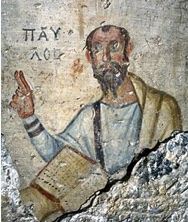
Illustration: 5th century painting of St, Paul in the Grotto of St. Paul, Ephesus
Pope Leo’s Catechesis on 2nd Vatican Council’s “Dei Verbum 4
Wednesday, 4 February 2026
____________________
Catechesis. The Documents of Vatican Council II.
I. Dogmatic Constitution Dei Verbum. 4. The Sacred Scripture: the Word of God in human words
2 Timothy 3:14-16:
14 But as for you, Timothy, continue in what you have learned and have firmly believed, knowing from whom you learned it and how from childhood you have been acquainted with the sacred writings which are able to instruct you for salvation through faith in Christ Jesus. All scripture is inspired by God andprofitable for teaching, for reproof, for correction, and for training in righteousness
Pope Leo’s Catechesis,
Dear brothers and sisters,
During these weeks, we are reflecting on the Conciliar Constitution Dei Verbum, which indicates that Sacred Scripture, read in the living tradition of the Church, is a privileged space for encounter.
There, God continues to speak to the men and women of every time, so that they can know him and love him by listening to his words.
However, the biblical texts were not written in a heavenly or superhuman language.
As daily life teaches us, two people who speak different languages cannot understand each other.
They cannot enter in dialogue and are unable to establish a relationship.
In some cases, making oneself understood by others is an act of love in itself.
This is why God chooses to speak in human languages.
Thus, various authors, inspired by the Holy Spirit, wrote the texts of Sacred Scripture.
As the conciliar document reminds us, “The words of God, expressed in human language, have been made like human discourse, just as the Word of the eternal Father, when he took to himself the flesh of human weakness, was in every way made like men” (DV 13).
Therefore, Scripture reveals God’s merciful condescension toward humanity not only in its content but also in its language, and His desire to be close to them.
Throughout Church history, scholars have studied the relationship between the divine author and the human authors of sacred texts.
For centuries, many theologians sought to defend the divine inspiration of Sacred Scripture, considering the human authors as mere tools of the Holy Spirit.
More recently, however, reflection has reevaluated the contribution of hagiographers to sacred texts. In fact, the conciliar document refers to God as the primary “author” of Sacred Scripture but also acknowledges hagiographers as “true authors” of the sacred books (DV, 11).
As an astute exegete of the past century observed, “Reducing human activity to that of a mere amanuensis does not glorify divine activity.”
God never diminishes human beings and their potential!
Therefore, if Scripture is the Word of God expressed in human language, any approach that neglects or denies either dimension is incomplete.
A correct interpretation of sacred texts cannot disregard the historical context in which they were written or the literary forms used. Conversely, neglecting the human language God employed can lead to fundamentalist or spiritualist interpretations that distort the Scripture’s meaning.
The same principle applies to proclaiming the Word of God.
If it loses touch with reality and human hopes and sufferings or uses an incomprehensible, uncommunicative, or anachronistic language, it is ineffective.
In every age, the Church is called to re-propose the Word of God in a language that can be embodied in history and reach hearts
As Pope Francis reminds us.
Whenever we make the effort to return to the source and to recover the original freshness of the Gospel,
new avenues arise, new paths of creativity open up, with different forms of expression,
more eloquent signs and words with new meaning for today’s world”.
On the other hand, a reading of Scripture that neglects its divine origin is equally reductive. Such a reading ends up understanding Scripture as a mere human teaching, as something to be studied from a technical point of view, or as “a text of the past only.”
However, when proclaimed in the context of the liturgy, Scripture is intended to speak to today’s believers. It touches their present lives, addressing their problems and enlightening them about the steps to take and decisions to make.
This is only possible when believers read and interpret sacred texts under the guidance of the Spirit who inspired them.
In this regard, the Scripture nurtures the life and charity of believers, as St. Augustine recalls:
“Whoever … thinks that he understands the Holy Scriptures … but puts such an interpretation upon them as does not tend to build up this twofold love of God and our neighbor, does not yet understand them as he ought”.
The divine origin of Scripture also reminds us that the Gospel, entrusted to the witness of the baptized, despite embracing all the dimensions of life and reality, transcends them
It cannot be reduced to a mere philanthropic or social message.
Rather, it is the joyful proclamation of the full and eternal life that God has given to us in Jesus.
Dear brothers and sisters,
Let us thank the Lord for ensuring that our lives are nourished by his Word.
Let us also pray that our words and lives do not obscure the love of God that they convey.
_______________
Summary of the Holy Father’s words:
Dear brothers and sisters,
In our continuing catechesis on the Dogmatic Constitution Dei Verbum, we reflect on the divine and human authorship of Scripture.
God is the principal author of Scripture and he chooses to reveal himself by using human language.
Indeed, the various authors of Scripture are not passive instruments, but are divinely inspired to communicate the word of God through literary forms and creative methods incorporating images and examples of their time.
Scripture is a text rooted in historical truth that also contains a limitless spiritual depth.
It speaks to people of all times and places, communicating God’s love and desire to save us above all else.
Let us thank God for his word, which nourishes our lives, illuminates our paths, and reminds us of the promise of eternal life.