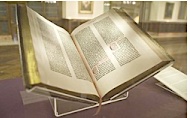
Illustration: The 15th century Gutenberg Bible, is the first published Bible
Pope Leo’s Catechesis on Vatican Council II
Paul VI Audience Hall – Wednesday, 11 February 2026
This is a series of catecheses on the Documents of the Second Vatican Council.
I. The Dogmatic Constitution Dei Verbum.
5. The Word of God in the Life of the Church
Scriptural reading from the First Letter of St. Paul the Apostle to the Thessalonians (1 Thess 2:13)
[Brothers:] We thank God constantly for this, that when you received the word of God which you heard from us, you accepted it not as the word of men but as what it really is, the word of God, which is at work in you believers.
“Ignorance of the Holy Scriptures is indeed ignorance of Christ.”
Pope Leo’s Catechesis,
Dear Brothers and Sisters,
Today, we will reflect on the profound and life-giving bond between the Word of God and the Church.
This bond is expressed in the sixth chapter of the conciliar constitution Dei Verbum.
The Church is the proper home of Sacred Scripture.
Inspired by the Holy Spirit, the Bible emerged from the People of God and is intended for them.
In the Christian community, the Bible finds its habitat, so to speak.
It is in the life and faith of the Church that the Bible can reveal its meaning and manifest its power.
The Second Vatican Council reminds us that “the Church has always revered the Scriptures of God, as well as the Body of the Lord.
In particular. during the sacred liturgy, the Church constantly takes the bread of life from the table of God’s word and the body of Christ and gives it to the faithful.
Furthermore, “in conjunction with Sacred Tradition, the Church considers these Scriptures the supreme rule of her faith.” (Dei Verbum, 21).
The Church will never stop reflecting on the value of Sacred Scripture.
A very important moment in this regard was the 2008 Ordinary General Assembly of the Synod of Bishops, which focused on the theme “The Word of God in the Life and Mission of the Church.”
Pope Benedict XVI built on this in his post-synodal apostolic exhortation Verbum Domini (September 30, 2010), stating: “The close relationship between word and faith indicates that an authentic hermeneutics of the Bible is possible only within the faith of the Church, for whom the ‘yes’ to Mary is the model. The proper place to interpret the Bible is the life of the Church.” (n. 29).
Therefore, in the ecclesial community, Sacred Scripture finds a space in which it can carry out its particular task and achieve its goal of revealing Christ and opening dialogue with God.
“Ignorance of the Holy Scriptures is indeed ignorance of Christ.”
This famous phrase by St. Jerome reminds us of the ultimate purpose of reading and meditating on Sacred Scripture: to know Christ and enter into a relationship with God through him.
This relationship can be understood as a conversation or dialogue.
The Constitution Dei Verbum shows us revelation as a dialogue in which God speaks to men and women as friends (cf. DV 2).
This occurs when we read the Bible with an attitude of interior prayer; then, God meets us and strikes up a conversation.
Sacred Scripture, entrusted to and guarded by the Church, plays an active role. Indeed, with its effectiveness and power, it supports and energizes the Christian community.
All the faithful are called to draw from this source, especially during the celebration of the Eucharist and the other sacraments.
Those who exercise the ministry of the Word—bishops, priests, deacons, and catechists—should be guided by a love of Sacred Scripture and familiarity with its content.
The work of exegetes and those who teach biblical studies is valuable.
Sacred Scripture occupies a central place in theology, which finds its foundation and life-giving power in the Word of God.
The Church ardently desires that the Word of God reaches her members, nourishing their journey of faith. The Word of God also propels the Church beyond itself, constantly opening it to a mission for all. We live surrounded by many words, but how many of them are empty!
Sometimes we hear words of wisdom, but they do not apply to our ultimate destiny.
The Word of God, on the other hand, meets our desire for meaning and truth about our lives.
It is the only word that is always new.
In revealing the mystery of God to us, it is inexhaustible and never ceases to offer its riches.
Beloved, as members of the Church, we learn that Sacred Scripture refers entirely to Jesus Christ.
We experience that this is the deepest reason for its value and power.
Christ is the living Word of the Father—the Word of God made flesh.
All the books of Scripture proclaim his presence and his salvation for each one of us and for all of humanity.
Therefore, let us open our hearts and minds to receive this gift in the school of Mary, Mother of the Church.
____________________________
Summary of the Holy Father’s catechesis
The Conciliar Constitution Dei Verbum speaks of the profound and life-giving bond between the Word of God and the Church.
The Church is the proper home of Sacred Scripture because, alongside Sacred Tradition. it forms the ultimate foundation of the Church’s faith,.
It reveals Christ and opens individuals to a dialogue with God.
The Church safeguards and interprets Sacred Scripture, encouraging people to draw from this source, especially during the celebration of the Eucharist and the other sacraments.
Sacred Scripture refers entirely to Jesus Christ and proclaims his saving presence for all humanity.