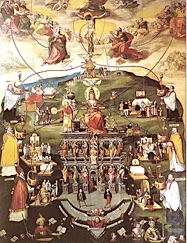
Illustration; Distribution of divine graces by the Church through the sacraments.
(Johannes Hopffe, Wrisberg epitaph, Hildesheim, – before 1615)
In the center the personification of Ecclesia with the (papal) tiara;
above her baptism, from which streams of grace proceed;
at the right marriage, eucharist, confession;
at the left anointing of the sick, holy orders, confirmation
Pope Leo’s Catechesis on The Documents of The Second Vatican Council
II. Dogmatic Constitution “Lumen gentium”.
1. The mystery of the Church, sacrament of the union with God, and the unity of all humanity
St Peter’s Square – Wednesday, 18 February 2026
Scripture Reading from Colossians 1:15-20
15 (Christ) is the image of the invisible God, the first-bornof all creation; 16 for in him all things were created, in heaven and on earth, visible and invisible, whether thrones or dominions or principalities or authorities—all things were created through him and for him. 17 He is before all things, and in him all things hold together. 18
He is the head of the body, the church; he is the beginning, the first-born from the dead, that in everything he[d]might be pre-eminent.19 For in him all the fulness of God was pleased to dwell,20 and through him to reconcile to himself all things, whether on earth or in heaven, making peace by the blood of his cross.
___________________________________
Pope Leo’s Catechesis
Dear brothers and sisters,
In the documents of the Second Vatican Council, to which our catecheses are dedicated, the Church is described by first explaining where it originates.
In the Dogmatic Constitution Lumen Gentium, approved on November 21, 1964, the Council used the term “mystery,” taken from the letters of St. Paul, to do this.
The Council did not intend to imply that the Church is obscure or incomprehensible when using this term, despite the common misconception that the word “mystery” implies such qualities.
On the contrary, when St. Paul uses this concept, especially in his Letter to the Ephesians, he points to a previously hidden reality that has now been revealed.
God’s plan has a purpose: to unite all creatures through the reconciling action of Jesus Christ, which was accomplished through His death on the cross.
This is most evident in the assembly gathered for the liturgical celebration.
There, differences are relativized, and the important thing is that we are together, united by the love of Christ. Christ tore down the wall that separates individuals and social groups (Ephesians 2:14 — “Jesus is our peace, who has made us both one and broken down the dividing wall of hostility”).
For St. Paul, the mystery is the manifestation of God’s plan for all humanity.
This plan can be experienced in local communities and gradually expand to embrace everyone and even the universe.
Humanity is in a state of disarray that it is unable to remedy itself, although the desire for unity lives in its heart.
This state includes the actions of Jesus Christ, who, through the Holy Spirit, overcomes the forces of division and the author of division himself.
Celebrating together and believing in the Gospel’s message is an experience of being drawn together by the Cross of Christ, the ultimate revelation of God’s love.
This feeling of being called together by God is why the term ekklesía is used: the gathering of people who realize they have been called.
Therefore, there is a certain convergence between this mystery and the Church.
The Church is a visible mystery.
This convocation is brought about by God and, therefore, cannot be limited to a group of people.
Rather, it is destined to become the experience of all human beings.
Therefore, at the beginning of the Constitution Lumen Gentium, the Second Vatican Council states that: “The Church is, as it were, in Christ a sacrament, that is, a sign and instrument of intimate union with God and of the unity of the whole human race” (No. 1).
The use of the term “sacrament” and its explanation indicate that the Church, throughout history, is an expression of God’s will.
Therefore, by observing the Church, one can understand God’s plan and mystery to a certain extent: in this sense, the Church is an active sign.
Looking at the Church, one can understand God’s plan and mystery to a certain extent: in this sense, the Church is a sign.
Indeed, when God acts in history, he involves the people who are the recipients of his actions.
Through the Church, God gathers people to himself and unites them with one another.
The union of human beings reflects the union with God.
This is the experience of salvation.
It is no coincidence that in the Constitution Lumen gentium Chapter 7, which is devoted to the eschatological character of the pilgrim Church, uses the description of the Church as a sacrament in number 48.
“Christ, having been lifted up from the earth has drawn all to Himself (John 12:32 – I, when I am lifted up[a] from the earth, will draw all men to myself.”).
Having risen from the dead (Romans 6:9 – we know that Christ being raised from the dead will never die again; death no longer has dominion over him)
He sent His life-giving Spirit upon His disciples and through Him established His Body, which is the Church, as the universal sacrament of salvation.
Sitting at the right hand of the Father, he works continually in the world lead people to the Church and through it to unite them more strongly to himself, and by nourishing them with his own Body and Blood, to make them partakers of his glorious life”.
This text helps us understand the relationship between the unifying action of Jesus’s Pasch, the mystery of his passion, death, and resurrection, and the identity of the Church.
It also makes us grateful to belong to the Church—the body of the risen Christ—and to the one pilgrim people of God, who journey through history as a sanctifying presence among a still fragmented humanity. The Church is an effective sign of unity and reconciliation among peoples.
Summary of the Holy Father’s words
Dear brothers and sisters,
In our ongoing catechesis on the Second Vatican Council, we have reflected on various aspects of divine revelation.
In particular, we have examined how God chose to reveal himself and make known the loving mystery of his divine plan to unite all people to him through his Son, Jesus Christ.
It is only within this mystery that we can understand the origin and mission of the Church.
In this light, today we turn to consider Lumen Gentium, the Dogmatic Constitution on the Church, which presents the Church as a sign and instrument of God’s plan of salvation.
The Church is a sign because it makes the unity established by Christ through his cross and resurrection visible to the world today.
The Church is an instrument because it is through the Church that God achieves his goal of uniting people to himself and bringing them together.
As we journey through a world still marked by division, let us ask the Lord to guide his Church in its mission of sanctification and reconciliation.