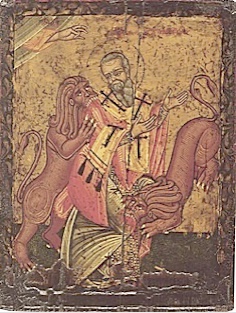
Illustration: St. Ignatius the God-bearer. 17th century, Macedonia.
Pope Leo’s Catechesis. The Documents of Vatican Council II.
II. Dogmatic Constitution Lumen Gentium.
2. The Church, a Visible and Spiritual Reality
Scripture reading: Ephesians 4:15-16
Speaking the truth in love, we are to grow up in every way into him who is the head, into Christ, 16 from whom the whole body, joined and knit together by every joint with which it is supplied, when each part is working properly, makes bodily growth and upbuilds itself in love.
“The Church is generated by God’s plan for humanity, realized in Christ”
Pope Leo’s Catechesis,
Dear brothers and sisters,
Today, we will continue our exploration of the conciliar constitution Lumen Gentium, a dogmatic constitution on the church.
The first chapter is primarily intended to answer the question of what the Church is.
It described the Church as a “complex reality” (no. 8).
So, what does this complexity consist of?
Some might argue that the Church is complex because she is ‘complicated’ and therefore difficult to explain.
Others might argue that her complexity stems from her being an institution steeped in two thousand years of history, with characteristics that set her apart from any other social or religious group.
However, in Latin the word ‘complex’ indicates the orderly union of different aspects or dimensions within the same reality.
For this reason, Lumen gentium states that the Church is a well-organized body in which the human and divine dimensions coexist without being separated or confusion.
The first dimension is immediately apparent: the Church is a community of men and women who share the joys and struggles of being Christians, with their strengths and weaknesses.
They proclaim the Gospel and serve as a sign of Christ’s presence, accompanying us on our life’s journey.
However, this aspect – which is also evident in its institutional organization – is insufficient to describe the true nature of the Church, because it also has a divine dimension.
This does not refer to the ideal perfection or spiritual superiority of its members, but to the fact that the Church is generated by God’s plan for humanity, realized in Christ.
Therefore, the Church is at the same time
1. an earthly community and the Mystical Body of Christ,
2. a visible assembly and a spiritual mystery,
It is also a reality present in history and a people journeying towards heaven.
The human and divine dimensions integrate harmoniously without one overshadowing the other; and it is this paradox that the Church embodies.
She is a human and divine reality that welcomes sinful people and leads them to God.
To shed light on this ecclesial condition, Lumen Gentium draws on the life of Christ.
Those who encountered Jesus in Palestine experienced his humanity: his eyes, his hands and the sound of his voice.
Those who decided to follow him were moved by precisely this experience: his welcoming gaze, the touch of his blessing hands and his words of liberation and healing.
However, by following that man, the disciples also opened themselves to an encounter with God.
Indeed, Christ’s flesh, face, gestures and words visibly manifest the invisible God.
In light of Jesus’ reality, we can now return to the Church
When we examine it closely, we discover that it is made up of real people who sometimes embody the beauty of the Gospel, but who also struggle and make mistakes like everyone else.
However, it is precisely through her members and her limited earthly aspects that Christ’s presence and his saving action are manifested.
As Benedict XVI said, there is no opposition between the Gospel and the institution;
On the contrary, the Church’s structures serve to realize and concretize the Gospel in our time.
There is no such thing as an ideal, pure Church, separate from the earth.
There is only the one Church of Christ, embodied in history.
The holiness of the Church is constituted by the fact that Christ dwells in her and continues to give himself through her members, who are small and fragile.
Contemplating this perpetual miracle, we understand ‘God’s method’:
He makes himself visible through the weakness of creatures, continuing to manifest himself and to act. For this reason, in Evangelii gaudium, Pope Francis, exhorted us all to learn “to remove our sandals before the sacred ground of the other” (Exodus 3:5)”.
This enables us to build up the Church even today, not only by organizing its visible forms, but also by constructing the spiritual edifice that is the body of Christ through communion and charity among ourselves.
Indeed, charity constantly brings the Risen One into our presence.
“If only we could all just let our thoughts dwell on the one thing, charity!
It’s the only thing, you see, which both surpasses all things, and without which all things worth nothing, and which draws all things to itself, wherever it may be” (St. Augustine’s Sermon 354, 6, 6).
____________________________________________________
Summary of Pope Francis’ words:
Dear brothers and sisters,
In our ongoing catechesis on the Second Vatican Council, we today consider the human and divine dimensions of the Church, as presented in the Dogmatic Constitution Lumen Gentium.
Just as Jesus’ humanity was immediately apparent to his disciples, so too is the human dimension of the Church.
It is a community of men and women, with their gifts and flaws, who seek to proclaim the Gospel within a visible structure.
However, those who followed Jesus more closely recognized that his humanity — his loving gaze, his merciful gestures, and his powerful words — manifested his divinity, leading them to salvation.
Similarly, through the visible and human dimension of the Church, the Spirit of Christ and his redeeming power are present and active in the world.
Let us strive to be authentic witnesses to Christ’s love, so that all may recognize the charity that characterizes true Christians and builds up the Church in us and among us.