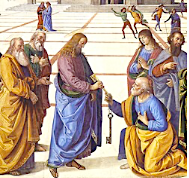
Illustration:Christ Handing the Keys to St. Peter by Pietro Perugino (1481-82)
Pope Leo’s Catechesis on the Documents of Vatican Council II
Dogmatic Constitution Lumen gentium. 5. On the foundation of the Apostles.
“The Church in her hierarchical dimension”
St Peter’s Square – Wednesday, 25 March 2026
Scripture Reading: Ephesians 2:19-20
You are no longer strangers and strangers, but you are fellow citizens of the saints and members of the household of God – built on the foundation of the apostles and prophets, where Christ Jesus Himself is the head of the coal.
Dear brothers and sisters,
We will continue our catecheses on the Documents of the Second Vatican Council, commenting on the Dogmatic Constitution Lumen gentium (LG). on the church.
Having presented the Church as the People of God, today we will consider its hierarchical form.
The Catholic Church is founded on the Apostles, whom Christ appointed as the living pillars of His Mystical Body
It possesses a hierarchical structure that serves the unity, mission and sanctification of all its members.
This sacred order is founded on the apostles, who are authoritative witnesses to the resurrection of Jesus and were sent by the Lord himself on a mission into the world (cf. Acts of the Apostles 1:22; 1 Corinthians 15:7; Mark 16:15; Matthew 28:19).
As they are called to preserve the Master’s salvific teaching faithfully (cf. 2 Timothy 1:13–14), the Apostles hand on their ministry to men who continue to sanctify, guide and instruct the Church “through their successors in pastoral office” until Christ’s return (Catechism of the Catholic Church, no. 857).
This apostolic succession, founded on the Gospel and in the Tradition, is further explored in Chapter III of Lumen gentium, which is entitled “On the Hierarchical Structure of the Church, in Particular on the Episcopate”.
The Council teaches that this structure is not a human construct for the organization of the Church as a social body, but a divine institution whose purpose is to perpetuate Christ’s mission to the Apostles until the end of time.
The fact that this theme is addressed in Chapter III, after the first two chapters have considered the very essence of the Church, does not imply that the hierarchical constitution is a subsequent element with respect to the People of God/
As the Decree Ad gentes notes, “the Apostles were the first budding-forth of the New Israel, and at the same time the beginning of the sacred hierarchy” (no. 5), because they were the community of those redeemed by Christ’s Paschal Mystery and established as a means of salvation for the world.
To understand the Council’s intentions, it is advisable to carefully read the title of Chapter III of Lumen gentium, which explains the Church’s fundamental structure. received from God the Father through the Son and brought to fulfilment by the outpouring of the Holy Spirit.
The Council Fathers did not intend to present the institutional elements of the Church, as the term ‘constitution’ might suggest when understood in a modern context.
Instead, the document focuses on the ‘ministerial or hierarchical priesthood’, which differs ‘in essence and not only in degree’ from the common priesthood of the faithful. It recalls that the latter are ‘nonetheless interrelated’: each of them, in its own special way, participates in Christ’s one priesthood.
The Council thus addresses the ministry conferred upon men endowed with sacra potestas, sacred power (cf. LG, 18) for service in the Church: it focuses particularly on the episcopate (LG, 18–27), then on the priesthood (LG, 28) and the diaconate (LG, 29) which are all considered to be degrees of the one sacrament of Holy Orders.
Therefore, by the adjective ‘hierarchical’, the Council intends to indicate both the sacred origin of the apostolic ministry in the action of Jesus, the Good Shepherd, and its internal relationships.
First and foremost, the bishops, and through them the priests and deacons, have received tasks leading them to serve ‘all those who belong to the People of God’, so that ‘working towards a common goal freely and in an orderly way, they may arrive at salvation’ (LG 18).
Lumen gentium repeatedly and effectively recalls the collegial and communal nature of this apostolic mission, reaffirming that the “duty which the Lord committed to the shepherds of His people is a true service, which in sacred literature is significantly called ‘diakonia’ or ministry” (LG, 24).
Therefore, we can understand why Saint Paul VI presented the hierarchy as a reality “born of the charity of Christ, to fulfil, spread and ensure the intact and fruitful transmission of the wealth of faith, examples, precepts and charisms bequeathed by Christ to his Church” (Address, 14 September 1964, in Acta Synodalia III/1, 147).
Dear sisters and dear brothers, let us pray that the Lord will send His Church ministers who are filled with evangelical charity and dedicated to the good of all the baptized, as well as courageous missionaries throughout the world
____________________________________________________
Summary of the Holy Father’s words:
Dear brothers and sisters,
In our ongoing catechesis on the Second Vatican Council, today we reflect on the teachings of the Dogmatic Constitution Lumen Gentium concerning the hierarchical structure of the Church.
In this regard, it is helpful to bear in mind that the Church is not something we invented, but is a divine institution established by Jesus himself.
Christ appointed the apostles, placing Peter at their head, and sent them out to continue his salvific mission until his return in glory.
In order to perpetuate this mission, ministers were invested with sacred power and became the successors of the Apostles as bishops. Priests and deacons likewise participate in this ministry through the sacrament of holy orders.
By sharing in the ministry of Jesus, the Good Shepherd, they are dedicated to serving the faithful, building up the Church, and ensuring the fruitful transmission of the faith.
Therefore, let us ask the Lord to continue to bless his Church with shepherds after his own heart.