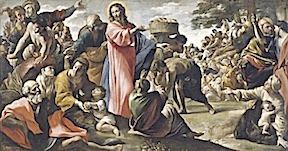
Illustration:Miracle of the Bread and Fish by Giovanni Lanfranco, 1623 (National Gallery of Ireland).
Pope Leo’s message to the Pontifical Biblical Commission
on the occasion of its plenary sessions
[13-17 April 2026]
“An Exegesis Sensitive to the Drama of the Suffering”
Mark 6:34-47. 34 As Jesus landed he saw a great throng, and he had compassion on them, because they were like sheep without a shepherd; and he began to teach them many things. 35 And when it grew late, his disciples came to him and said, “This is a lonely place, and the hour is now late; 36 send them away, to go into the country and villages round about and buy themselves something to eat.” 37 But he answered them, “You give them something to eat.” And they said to him, “Shall we go and buy two hundred denarii[a] worth of bread, and give it to them to eat?” 38 And he said to them, “How many loaves have you? Go and see.” And when they had found out, they said, “Five, and two fish.” 39 Then he commanded them all to sit down by companies upon the green grass. 40 So they sat down in groups, by hundreds and by fifties. 41 And taking the five loaves and the two fish he looked up to heaven, and blessed, and broke the loaves, and gave them to the disciples to set before the people; and he divided the two fish among them all. 42 And they all ate and were satisfied. 43 And they took up twelve baskets full of broken pieces and of the fish. 44 And those who ate the loaves were five thousand men.
Pope Leo’s Message
Mr. Cardinal President,
Dear Members of the Pontifical Biblical Commission,
I am pleased to be present among you through this message, at the beginning of your annual Plenary Assembly.
You have gathered to reflect more deeply on the theme of suffering and illness: an experience that concerns everyone, every human being marked by fragility, sickness, and death.
In fact, our wounded nature bears within itself the reality of limitation and finitude.
Why illness? Why suffering? Why death?
Faced with these questions, even believers sometimes falter, experiencing disorientation, even despair and rebellion against God.
However, in the light of faith we know that pain and illness can make a person wiser and more mature, (a) helping them to discern in their life what is not essential, (b) in order to turn or return to the Lord.
We can draw this vision of faith from Sacred Scripture and from the Tradition of the Church.
In this regard, I encourage you to unite in your exegetical work, scientific research and attention to the common experiences of life, so as to illuminate with the wisdom of the inspired Word even its most difficult aspects.
The evangelist Mark reported that one day Jesus, seeing the bewildered and suffering crowds, was moved with pity for them, because they were like sheep without a shepherd (Mark 6:34 – As Jesus landed he saw a great throng, and he had compassion on them, because they were like sheep without a shepherd; and he began to teach them many things).
This compassion of Jesus toward the needy and the sick appears frequently in the pages of the Gospel. The Lord took pity on a leper who asks to be healed (Mark 1:40–41).
He is moved with pity for the hungry and exhausted crowds and intervenes on their behalf (Mark 8:2).
He has compassion on two blind men who ask to regain their sight and He heals them (Matthew 20:34);
He is filled with great compassion for a widowed mother accompanying her only son to the tomb, and He raises him (Luke 7:13).
Christ’s compassion toward all who suffer is so profound that He identifies Himself with them: “I was sick and you visited me” (Matthew 25:36).
Jesus Himself, who went about among the people doing good to all and healing every kind of disease and infirmity, commanded His disciples to care for the sick, to lay hands on them and bless them in His name (Matthew experience of fragility and illness, we too can and must learn to walk together, in human and Christian solidarity, according to God’s way, which is compassion, closeness, tenderness, and solidarity.
Strengthened by faith in Christ, we can overcome the fear of illness and death precisely by becoming more aware of our fragility in the light of His passion, death, and resurrection.
In Christ, suffering and illness are no longer a cruel destiny before which we must bow without understanding.
With Jesus, pain is transformed into love, into redemption, and into fraternal help.
Let us, then, welcome Christ into our lives: He is the only physician who can heal the illnesses of the soul forever.
I invite you to consider, in addition to illness, physical pain, and death, also the sufferings of the poor, migrants, and the marginalized of society, which are present in many pages of Sacred Scripture.
Let us contemplate in particular the Sorrowful Mother together with Jesus at the foot of the Cross: as Mother, she suffers on Calvary the sufferings of her Son and shares in them with a heart full of faith, offering her piercing sorrow for the good of all. In this way, her intercession acquires for us a unique value.
The example of the Mother invites every believer, not only to pray for their brothers and sisters, but also to imitate the humble offering of their own sufferings in union with the Sacrifice of Christ.
In this sense, each one can say with Mary: “In my flesh I am filling up what is lacking in the afflictions of Christ on behalf of his body, which is the church” ( Colossians 1:24).
This completion is real in us, even though it adds nothing to the salvific work of the one Redeemer, which is perfect, universal, and superabundant: “The suffering of Christ has created the good of the world’s redemption.
This good in itself is inexhaustible and infinite.
No man can add anything to it.”This completion rather means that every sufferer becomes a participant, that is, becomes involved in that work and expresses it with the unique characteristics that spring from their own history.
Indeed, Christ “has opened His suffering to man, because He Himself in His redemptive suffering has, in a certain sense, become a participant in all human sufferings […] enriched with a new content and a new meaning.”
The Cardinal President has informed me that the Biblical Commission is analyzing various figures of suffering biblical characters.
Together, they will surely become a beautiful symbol of hope for every person who unites their sufferings to the crucified Christ, renewing the manifestation of His loving face.
Dear Members of the Pontifical Biblical Commission, I express to all of you my personal gratitude and encouragement.
Wishing you a fruitful continuation of your work, I invoke the light of the Holy Spirit on you and impart to all my Apostolic Blessing.
From the Vatican, March 27, 2026