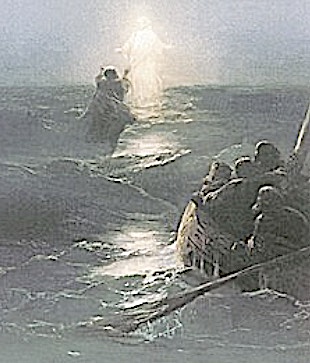
Illustration: Walking on Water, by Ivan Aivazovsky (1888)
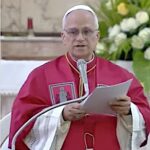
Pope Leo’s homily at holy mass
Yaoundé-Ville Airport, Cameroon – Saturday, April 18, 2026
First Reading Acts 6:1-7
Now in these days when the disciples were increasing in number, the Hellenists murmured against the Hebrews because their widows were neglected in the daily distribution. And the twelve summoned the body of the disciples and said, “It is not right that we should give up preaching the word of God to serve tables. Therefore, brethren, pick out from among you seven men of good repute, full of the Spirit and of wisdom, whom we may appoint to this duty. But we will devote ourselves to prayer and to the ministry of the word.” And what they said pleased the whole multitude, and they chose Stephen, a man full of faith and of the Holy Spirit, and Philip, and Prochorus, and Nicanor, and Timon, and Parmenas, and Nicolaus, a proselyte of Antioch. These they set before the apostles, and they prayed and laid their hands upon them. And the word of God increased; and the number of the disciples multiplied greatly in Jerusalem, and a great many of the priests were obedient to the faith.
Gospel according to John 6:16-21
When evening came, his disciples went down to the sea, got into a boat, and started across the sea to Capernaum.
It was now dark, and Jesus had not yet come to them. The sea rose because a strong wind was blowing. When they had rowed about three or four miles, they saw Jesus walking on the sea and drawing near to the boat. They were frightened, but he said to them, “It is I; do not be afraid.” Then they were glad to take him into the boat, and immediately the boat was at the land to which they were going.
Pope Leo’s Homily,
Dear Brothers and Sisters, peace be with you!
May the peace of Christ, whose presence illuminates our path and alleviates the storms of life, be with you.
We are celebrating this Mass at the end of my visit to Cameroon. I am very grateful for your warm welcome and for the moments of joy and faith we shared.
As we heard in the Gospel, faith does not spare us from storms and tribulations. Sometimes, it may seem as if fear has taken over. However, we know that, as with the disciples on the Sea of Galilee, Jesus does not abandon us.
Three Evangelists recount the event we just heard, each in his own way and with a message adapted to his audience.
St. Mark (Mark 6:45-52) describes the Lord joining the disciples as they struggle to row against the wind. The wind stops as soon as he enters the boat with them.
Matthew adds a detail: Peter wants to approach the Master by walking on the waves (Matthew 14:22-33). However, when he steps out of the boat, he is overcome with fear and begins to drown.
Christ takes Peter by the hand, saves him, and reprimands him for his unbelief.
In today’s reading from St. John, the Savior walks on water and approaches the disciples, saying, “It is I; do not be afraid” (v. 20). The evangelist emphasizes that “darkness had already come.”
In the Jewish tradition, “water” evokes the depths of mystery, chaos, danger, and death.
Together with darkness, water signifies the uncontrollable forces of evil.
However, in the memory of the Exodus miracles, water is also seen as a place of passage, a ford through which God leads his people out of slavery with his power.
Throughout history, the Church has weathered many storms and “contrary winds,” and perhaps we can also relate to the disciples’ feelings of fear and doubt when crossing the Sea of Tiberias.
We experience this when we feel like we are drowning, overwhelmed by hostile forces. Everything seems dark, and we feel lonely and weak.
But this is not the case. Jesus is always with us, stronger than all the power of evil. In every storm, he joins us and says, “I am here with you. Do not be afraid.”
This is why we rise after every fall, never letting any storm stop us. We move forward with courage and confidence.
As Pope Francis said, it is thanks to him that so many men and women bring glory to our people and our Church because they are brave. They courageously go through their lives, take care of their families, work, and cultivate their faith.
Jesus draws close to us. He does not immediately calm the storms, but joins us in the midst of danger. He invites us to be together in solidarity, like the disciples in the same boat, in joys and sorrows. He invites us to not look at suffering from afar, but to become close and stick together.
No one should face life’s adversities alone. To this end, every community must create and support structures of solidarity and mutual assistance. In times of crisis — whether social, political, health, or economic — these structures ensure that everyone can give and receive help according to their capacities and needs.
Jesus’s words remind us that: “I am” remind us that in a society based on respect for human dignity, everyone’s contribution is important and has unique value, regardless of their status or position in the eyes of the world.
Therefore, the incentive “Do not be afraid” takes on a broad dimension that includes social and political levels. It is an invitation to face the problems and challenges together, especially those related to poverty and justice, with a sense of citizenship and social responsibility.
Faith does not separate the spiritual from the social; rather, it gives Christians the strength to engage with the world and respond to the needs of others, especially the most vulnerable.
The efforts of individuals alone are not enough to save the community. A common decision is needed that places the spiritual and ethical dimensions of the Gospel at the heart of institutions and structures. This will make them instruments for the common good instead of places of conflict, interests, or futile disputes.
The first reading speaks to this, showing how the Church struggled with her first crisis of development.
The rapid increase in the number of disciples created new challenges for the community in practicing charity that the apostles could no longer meet alone.
Some are overlooked when serving at the tables, leading to growing complaints and a sense of injustice that threatens unity.
Providing daily service to the poor was an essential practice in the early Church, intended to support the most vulnerable, especially orphans and widows.
However, this practice had to be balanced with the urgent need for preaching and teaching. The solution was not simple.
The apostles gathered, shared their fears, and discussed everything in light of Jesus’s teachings. They prayed together and overcame obstacles and misunderstandings that, at first glance, seemed insurmountable.
In this way, they created something new: they chose men of “good repute, full of the Spirit and wisdom” (Acts 6:3) and ordained them for practical service, which was also a spiritual mission, by laying hands on them.
By listening to the voice of the Holy Spirit and being attentive to the cries of the suffering, they avoided an internal rift in the community. Thanks to God’s inspiration, they also equipped the community with new, appropriate tools for development, transforming a moment of crisis into an opportunity for enrichment and growth.
Sometimes, the lives of families and societies require the courage to change habits and structures so that the dignity of each person remains at the center and so that inequalities and marginalizations are overcome.
Furthermore, by becoming human, God identified himself with the least fortunate, making preferential care for the poor a fundamental aspect of our Christian identity.
Brothers and sisters, today we say goodbye.
Everyone will return to their daily activities, and thanks to God’s grace and the commitment of each one of us, the boat of the Church will continue on its course towards the goal.
Let us keep the memory of our beautiful moments together in our hearts. Even in the midst of difficulties, let us continue to make room for Jesus and allow his presence to enlighten and renew us daily.
The Church in Cameroon is vibrant and young. It is rich in gifts and enthusiasm. It is full of life in its diversity and magnificent in its harmony.
With the help of the Virgin Mary, our Mother, may his joyful presence blossom ever more. May even the contrary winds, which are never lacking in life, become opportunities for us to grow in joyful service to God and to our brothers and sisters—to share, listen, pray, and desire to grow together