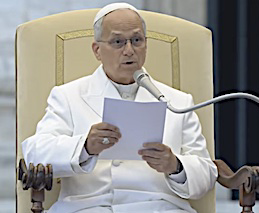
Pope Leo’s Catechesis on Promoting Peace
St. Peter’s Square – Wednesday, November 25, 2026
Series of catecheses – Documents of the Second Vatican Council. IV.
Pastoral constitution Gaudium et Spes. 9. Promoting peace (GS, 77-93)
Scripture Reading: From the Book of the Prophet Isaiah (Isaiah 32:17-20)
Peace will be the work of justice, and the fruit of the law will be eternal security. My people will dwell in the capital of peace, in safe dwellings, in quiet places of rest, even if the forest is felled and the city falls low. Blessed are you! You will sow over every water, setting oxen and donkeys free.
Pope Leo’s Catechesis,
Dear Brothers and Sisters,
Today, we will continue our reflection on the fifth chapter of the constitution Gaudium et Spes (GS), which is dedicated to promoting peace.
Above all else, the Council Fathers admire God’s plan for humanity.
According to this plan, “in Christ Jesus, humanity is called to become a family of God’s children” (GS 92).
As children of God, we are called to be brothers and sisters and build a peaceful world in the Lord’s name.
This hopeful perspective encompasses not only humanity but also the entire created world, as mentioned in the Letter of St. Paul to the Colossians.
Through Christ, God willed to “reconcile all things to himself again, having made peace through the blood of his cross” (Colossians 1:20).
The peace born from the cross of Christ is offered as a gift of redemption to all peoples and all of creation.
It is a gift of grace to be accepted, as well as a commitment to freedom and to living according to the blessing proclaimed by Jesus: “Blessed are the peacemakers, for they will be called children of God.” (Mt 5:9).
The teaching of Gaudium et Spes is by no means naive.
Aware of human sin, we acknowledge that “peace is never achieved once and for all but must be continuously rebuilt” (GS 78).
Therefore, there is no room for resignation as if violence were inevitable.
Furthermore, the nature of contemporary wars compels the Council Fathers to revise the ecclesial doctrine in this area.
In the face of these cruelties, they state: “All this forces us to begin thinking about war in a completely new way” (GS 80).
Christ’s disciples today view history in the light of the Gospel, supported by the Holy Spirit, and this is precisely the “duty.”
When we renew this awareness within ourselves, we see that the digital revolution is changing the way conflicts are conducted.
Alongside traditional warfare, hybrid forms have emerged: including cyberattacks, information manipulation, influence campaigns, and the automation of strategic decisions. (…)
“What arises for defense can quickly be transformed into a tool of attack, and the boundary between protection and aggression becomes blurred” (Encyclical, Magnifica humanitas, 18.3).
Today, conflicts that today appear increasingly inhuman and destructive intensify hatred and injustice among peoples, while disfiguring creation and its beauty.
The immense suffering affecting men, women, and children of all ages cannot be ignored.
The Council’s solemn appeal to convert minds and hearts to Christ, the King of Peace, calls on everyone to break free from the ideological and economic chains that enslave them to war.
In this context, we must powerfully reiterate that “the arms race is the greatest plague of humanity, most severely affecting the poor.
If it continues, the arms race will one day unleash those deadly threats for which the means are already being prepared” (GS, 81).
The Council’s prophetic words resound today as an urgent warning.
Moreover, they echo the cries of suffering peoples, of children killed and mutilated, and of destroyed families, crying out to the powerful of this world.
The Second Vatican Council calls on all people of goodwill to prepare for an era in which “any war can be banned altogether” (GS, 82).
While it acknowledges the right to just defense, the Council emphasizes the need for international organizations that can effectively intervene to restore justice where it has been violated and defend the oppressed.
Therefore, the Council calls for support of peace-serving institutions so that, together, we may build a global political and economic order based on cooperation, dialogue, and sharing the cultural and material resources of nations to promote the integral development of humanity.
When faced with these tasks, Christians are called to be the salt of the earth and the light of the world.
Trusting in God’s grace, we should not be afraid to promote peace and defend human dignity through constant prayer and consistent social and political actions.
All of us are all invited to participate in these processes and speak with one voice. Proclaiming the Gospel means forming consciences, converting hearts, and living sacramentally.
Christ is the source of it all because he is our peace.
Dear brothers and sisters,
Let us confidently ask God for the strength to illuminate our lives and the world with the message of the Gospel. The Gospel is a message of reconciliation and salvation for all peoples. May the Spirit of Christ continually awaken experiences of brotherhood and peace, fostering sincerity in dialogue among individuals and nations.
In times of suffering especially, let us never cease seeking and sharing true peace—that peace which is both a gift from God and the fruit of tireless human effort.
May the Virgin Mary, Queen of Peace, support every effort for good with her powerful intercession, today and always.
______________________________
Summary of the Holy Father’s CatechesisChapter five of Gaudium et Spes promotes peace and building it in the world in the name of the Lord.
This hopeful plan embraces both humanity and the created world.
True peace, born from the cross of Christ, is offered to all as the fruit of redemption.
It is a gift of grace to which we respond with our freely chosen efforts.
Therefore, the Council Fathers firmly condemn war and solemnly appeal to convert minds and hearts to Christ, the King of Peace.
They call for the breaking of the ideological chains and economic interests that fuel conflicts.
Thus, the right to just defense is linked to supporting international institutions that promote peace among peoples and the integral development of the human person.