Pope Leo’s Homily at Holy Mass
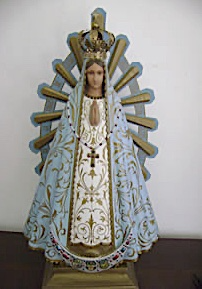
Square in front of the Basilica of Our Lady of Luján
Wednesday, November 11, 2026
Reading from the Book of Isaiah
Let the wilderness and the parched land rejoice, Rejoice and let the steppe bloom!
Yes, bloom like the daffodil, let him rejoice and burst into songs of joy!
The glory of Lebanon has been given to him, the splendor of Carmel and Sharon.
They will see the glory of the Lord, the splendor of our God.
Strengthen weak arms, strengthen the faltering knees;
Say to those who are discouraged: “Be strong, do not fear: there is their God!
Vengeance comes, God’s retaliation: He himself comes to save them.”
Then the eyes of the blind will open and the ears of the deaf will be unstopped;
Then the cripple will jump like a deer and the tongue of the dumb will shout for joy.
Those who are ransomed by the Lord will return, and they shall enter Zion with shouts of joy, crowned with perpetual joy: joy and gladness will accompany them, sadness and groans will go away.
From the Gospel according to John
At that time, his mother, his sister, and his sister, were standing by the cross of Jesus. his mother, Mary the mother of Cleopas and Mary of Magdala.
Jesus then, seeing his mother and beside her the disciple whom he loved him, he said to his mother, “Woman, behold your son!” Then he said to the disciple: “Behold your mother!”
And from that hour the disciple welcomed her with be.
Pope Leo’s Homily,
Dear Brothers and Sisters,
The reading from the Book of the Prophet Isaiah invites us to imagine various landscapes, such as deserts, steppes and mountains.
All of these landscapes are called to blossom and sing with joy at the sight of God’s glory.
Today, we think of Argentina, a beautiful country adorned by the Creator of the universe with diverse landscapes: vast pampas, rushing rivers, rolling hills, green plateaus, endless plains, deep seas, majestic glaciers, and vast deserts.
The entire “end of the world” sings the glory of the Lord in all its splendor and beauty.
Isaiah continues by saying that just as God makes water gush forth from the dry earth and makes it fertile, so too does He quench humanity’s deep thirst, heal illnesses, and open the eyes of the blind and the ears of the deaf.
Dear brothers and sisters,
These images speak to us of a new era of liberation.
Do not be afraid—God is with us! Rejoice and find strength in the Lord.
During these days, I have experienced the richness of Argentina, in both its landscapes
and its people. I have seen this richness in every encounter, in the city squares and streets, and in the creativity, spontaneity, and vitality that abound at every turn.
In the Magnificat which we sang as a responsorial psalm, Mary rejoices in the Lord and praises him for the great things he has done for her.
I thank God for the opportunity to meet this beloved people, who open their doors to everyone, share food and music, and always make room for guests at the table.
They selflessly dedicate time to talking “at the next sip of mate” and lend a helping hand to those in need.
Today, at the House of Our Lady of Luján, I especially remember our beloved Pope Francis, who always carried his “dark-skinned Patroness” in his heart.
Throughout his life, he taught us to love and venerate Mary.
He reminds us of this today through the place he chose for his burial, close to Our Lady.
In fact, his parting words were often: “May Jesus bless you, and may the Blessed Virgin Mary watch over you.”
With a heart full of gratitude for the many gifts God has given this country, I propose to follow a specific path during each Eucharist celebration.
It consists of four stages: reconciliation, illumination through the Word of God, communion, and mission.
Mary stands at the foot of the cross, uniting herself with the Eucharistic sacrifice and accompanying us on this journey.
Many of our brothers and sisters—and even we, ourselves or our families—are now experiencing their own Calvary.
They suffer from illness, poverty, unemployment, discrimination, family breakdown, and other hardships.
During these difficult times, we empathize with Mary’s pain as she stood at the foot of the cross.
Mary was given a new mission by her Son at that terrible moment in her life.
Her missions is to welcome all of humanity into her maternal heart.
Like Mary, we are called to welcome God’s grace into our hearts.
We must embrace the processes of forgiveness and reconciliation so that peace, hope, and love may be renewed within us.
Reconciliation,
“Let us be sincere. Let us acknowledge our faults and ask the Lord for forgiveness. “Forgive me for that beggar, for the tear I caused. I apologize for the eyes that looked into mine, but I did not want to look into them” (Zamba del perdón).
In order to create a future where love has the final say, we also need to reconcile with our history and present.
Illumination,
Let us recall the experience of the disciples on their way to Emmaus.
Discouraged by the difficult reality they faced, they walked with sad faces.
Then, the risen Jesus appeared to them and explained the Scriptures.
They sat down together for supper and recognized his presence, which warmed their hearts (Luke 24:13-35).
Dear brothers and sisters,
This is often our experience as well.
We feel tired, disappointed, and lost.
We need a compass and a guide, and we find both in Sacred Scripture!
Let us allow ourselves to be enlightened.
The Word of God is a lamp for our feet and a light on our path. (Ps 119:105).
Communion
Following reconciliation and enlightenment through the Word of God, we are called to the third stage: communion.
Christ himself invites us to his table, where all are welcome (see Matthew 22:9-10).
There is a place for everyone, especially the poor, hungry, migrants, sick, and prisoners, with whom the Lord identifies (cf. Matthew 25:35-40).
The Eucharist, the sacrament of unity, strengthens our belonging to the body of Christ and teaches us to share.
The various sensitivities present in the Church and the strong convictions that motivate us are a treasure, provided they remain grounded in the knowledge that unity is both a gift and a responsibility.
Communion with Christ does not isolate us in our own affairs. It does not lead us to exploit others’ scarcity or neglect our duties.
Rather, it impels us to play an active role in community life, share the gifts we have received freely, and offer what we have, even if it is little, for the greater good.
We are called to live by love, imitating Christ. Mary also teaches us this way of loving by standing at the foot of the cross. There, on Calvary, she and her Son loved “to the end” (John 13:1).
What matters is not doing great things, but remaining faithful to the Lord, as his mother did, standing with him through moments of the cross as well as times of joy, glory, and light.
It means viewing life through the eyes of heaven and painting our days with hope.
There are many difficulties, but the Lord inspires heroic acts of love in his faithful people. Examples include a father getting up at dawn to provide for his family, a mother staying with a sick child through long hospital nights, and a good friend dedicating his time to those in need.
Mission
Dear brothers and sisters,
The final stage is the mission message that we receive at the end of Mass.
“Go and preach!” (see Mark 16:15), because “we cannot keep silent about what we have seen and heard” (Acts 4:20).
Go and evangelize!
Proclaim the joy of the Gospel through words and deeds.
Argentina, rise up and go!
As St. Augustine tells us: “Love, and do what you will!”
When you are silent, be silent with love.
When you speak, speak with love.
When you chastise, do so with love.
When you forgive, do so with love.
Let love be the root of in your heart, for only good will grow from it.”
Prayer to Our Lady of Luján,
My pontificate began on May 8, the day of your feast.
Like the millions of Argentines who come to your house seeking your protection, I too want to take refuge under your mantle.
Guide me in the apostolic mission that the Lord has entrusted to me, Mother.
Guide the Argentine people as well and accompany them on their pilgrimage.
Inspire them to build bridges of love and networks of solidarity.
Encourage them to continue on the paths of reconciliation, communion, and mission.
May they be firmly rooted in Him who “became the head of the body.” (Acts 4:11).