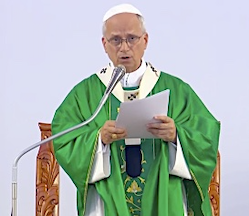
Pope Leo’s Homily for the Sunday Mass
“Villa Deportiva Regional Ucayali” (Pucallpa)
Sunday, 15 November 2026
The Gospel of the Holy Mass
The Parable of the Talents (Matthew 25:14-35)
“For it will be as when a man going on a journey called his servants and entrusted to them his property; to one he gave five talents, to another two, to another one, to each according to his ability. Then he went away.
He who had received the five talents went at once and traded with them; and he made five talents more. So also, he who had the two talents made two talents more. But he who had received the one talent went and dug in the ground and hid his master’s money. Now after a long time the master of those servants came and settled accounts with them. He who had received the five talents came forward, bringing five talents more, saying,
‘Master, you delivered to me five talents; here I have made five talents more.’
His master said to him, ‘Well done, good and faithful servant; you have been faithful over a little,
I will set you over much; enter into the joy of your master.’
And he also who had the two talents came forward, saying, ‘Master, you delivered to me two talents; here I have made two talents more.’ His master said to him, ‘Well done, good and faithful servant; you have been faithful over a little,
I will set you over much; enter into the joy of your master.’ He also who had received the one talent came forward, saying, ‘Master, I knew you to be a hard man, reaping where you did not sow, and gathering where you did not winnow; so I was afraid, and I went and hid your talent in the ground. Here you have what is yours.’
But his master answered him, ‘You wicked and slothful servant! You knew that I reap where I have not sowed, and gather where I have not winnowed? Then you ought to have invested my money with the bankers, and at my coming I should have received what was my own with interest.
So take the talent from him and give it to him who has the ten talents.
The Moral of the Story: to everyone who has more will be given, and he will have abundance; but from him who has not, even what he has will be taken away. And He cast the worthless servant into the outer darkness; there men will weep and gnash their teeth.’
Pope Leo’s homily,
Dear Brothers and Sisters,
I am filled with great joy to celebrate the Eucharist with you today.
When we gather around the altar of the Lord in faith, his Word enters our lives and gives them meaning.
This is happening in this city today.
The Gospel we just heard contains a parable that invites us to reflect on our relationship with God.
When Jesus tells the story of a master and his servants, he invites us to listen closely to discover the true meaning of his words.
What does it mean for God to be a master?
What does it mean for a person to be a servant?
In the world, these words bring to mind the tensions of exercising power.
In the mouth of Christ, however, they take on a new and surprising meaning.
He proclaims them intentionally so that we change the way we think and act.
He proclaims freedom to those who are servants in this world and teaches conversion to those who consider themselves masters.
The one true Lord calls us to transform our lives by inviting us all to fraternity, thereby transforming our relationships and society.
Therefore, let us listen to what Christ tells us in the parable:
“Very well, good and faithful servant! enter into the joy of your master!”
First, this praise shows us that being good and faithful means responding to the goodness and trust we receive from God.
His expectations of us are not a sign of oppression or distance.
On the contrary, it guarantees our participation in the common good and happiness.
The Lord first shows us his goodness and entrusts us with his gifts.One sign of this goodness is the precious talents mentioned in the parable.
In our hands, these talents become a task and a responsibility, enabling us to bear the fruits of good works.
Thanks to these talents, life – God’s first gift – becomes good.
By using them, we learn to act justly, to seek the truth and care for our neighbors and society.
In this way, we multiply the blessings we have received by using all that the Lord has entrusted to us wisely.
However, the parable speaks of “an evil and slothful servant” whom the master rebukes:
“You knew that I reap where I have not sown, and I gather where I have not scattered”.
Jesus’ words test us.
Isn’t the master — that is, God — not good and generous to his servants and, therefore, to us?
Of course he is!
Nevertheless, some do not trust him, viewing him to be harsh, merciless, and exploitative.
On the other hand, God says to us, “I trust in your abilities. I do not limit your life in any way.
On the contrary, I love you all.”
I share my goods with you and entrust them to you so they may bear fruit because I want to share my joy with everyone.”
The servant in the parable is wicked because he thinks God is like the masters of this world, who often consider themselves gods.
Thus, Jesus does not only rebuke the servant’s laziness, but above all his wicked way of thinking, which leads him to say to his master: “Lord, I knew that you were a hard man: you reap where you have not sown and you reap where you have not scattered” (v. 24).
The parable, then, calls us to move from fear to trust in the Lord,
from the feeling of being his slaves that accompanies those who are far from God,
to sharing in the joy that comes from him.
In other words, to realize that we are his beloved children.
The parable told by Jesus is very timely because it leads us to ask ourselves what we do with the goods that God bestows on us, especially the gifts of life and the earth.
These two gifts are intimately linked – one cannot exist without the other.
The health of our lives and the health of the earth in which we inhabit are inextricably linked, one does not exist without the other, so everything that strikes at the dignity of life also destroys the beauty of the earth;
human zeal and concern for creation go hand in hand, so that any exploitation of workers is at the same time a predatory exploitation of the natural environment.
Social peace and ecological balance are intimately linked, so violence against the population is at the same time violence against the land,
and violence against the land is violence against the population.
Dear friends! The word of Christ permeates the drama of our history here.
I add my voice to the voice of my Predecessors, Pope Benedict XVI and Pope Francis, in order to emphasize the painful link between “the destruction of the natural environment in the Amazon and the dangers that threaten the human dignity of its inhabitants”
(Benedict XVI, Address to Young People, 10 May 2007, 2;
Pope Francis, Apostolic Exhortation. Querida Amazonia, 12) [1].
Very little has been done so far, and at an extremely slow pace, while the means of exploiting and polluting creation have been developed more and more rapidly.
In the face of this evil, let us not bury in the ground the talents received from the Lord, who gives us the strength to repair the damage done and to heal the sufferings caused by the insatiable desire to dominate.
In this context, the Gospel we hear becomes a message of liberation and hope for the whole people.
It is up to us, each one of us, to respond to the Lord with the words:
“We thank you for the talents you give us! We want to use them for the good of all”.
It is also up to each one of us to say to our neighbor: “You are a brother and sister to me.
Let us develop together the talents that bear fruit of a good life for this city, for our country and for the future that we want to build as a time of justice and peace.”
This desire is expressed in the gesture that we make during Mass, bringing to the altar the fruits of the earth and the work of human hands.
The table that the Lord prepares for us involves us in the exchange of gifts that we offer to God so as to share them with the world.
In the light of the Gospel, therefore, I invite you to multiply the talents that the Lord entrusts to us by cultivating three concrete realities.
First, cultivate the faith together.
Be a people that celebrates God’s salvation and heals the wounds of humanity.
In this way, in fact, the Church uses human words to express the truth about God and proclaims the Word of God in order to reveal the truth about man.
Following the example of Christ, the Word made flesh, look at everyday reality with the wisdom of the Gospel, opening up to all the prospect of a future based on justice.
This mission begins with prayer and draws strength from the sacraments; as the work of the whole Church, it is realized in families and parishes, in the streets and in schools, in hospitals and prisons.
Strive everywhere to multiply the talents received from the Lord, building communion with all men and women of good will.
Secondly, I invite you to cultivate our wonderful humanity.
This commitment concerns above all young people, who are the hope of the Peruvian people.
It includes caring for the little ones and caring for the elderly, as well as solidarity with the poor and oppressed.
To do good means to oppose violence with love, and to respond to corruption with honesty.
Where man recovers, the earth flourishes, and the culture of love soothes the moral corruption that is at the root of all the wounds inflicted on creation, our common home.
Finally, in the face of all trials, always cultivate joy.
Christians know that this joy does not come from wealth or power, which, like drugs, leads to downfall, deceives the heart and leaves it full of anxiety.
True joy is born of faith, because its foundation is God’s grace, which bears fruit in our fraternal dedication.
As we go through tribulations and face challenges, let us build together a happy, free and peaceful society, looking to the Lord Jesus who, through his cross, brings peace, taking upon himself all our difficulties.
Let us ask, our Redeemer, to accompany us on our journey, giving us the light of hope.
May his Mother Mary, the Immaculate Virgin, always strengthen us and protect us.