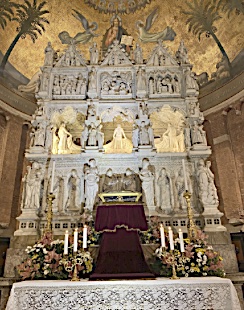
Media: Chapel with relics of St. Augustine
Pope Leo’s visit to Pavia in Italy and Sant’Angelo lodigiano
along with veneration of the Relics of St. Augustine
St. Augustine’s main mortal remains (which consist primarily of his bones)
are housed in the Basilica of San Pietro in Ciel d’Oro in Pavia, Northern Italy.
_________________
Pope Leo’s homily, celebration of word and veneration of the relics of St. Augustine
Basilica of San Pietro in Ciel d’Oro (Pavia) – Saturday, 20 June 2026
Preliminary words from Pope Leo:
St. Augustine taught us to live by the teachings of Jesus Christ: to love God and our neighbors.
When asked, he replied: “Which is more important, loving God or loving our neighbors?” he replied, “As for what you have written, we must love God. But we cannot love God if we do not love our brothers and sisters.”
Brotherly love is so important!
The message of charity towards all is very important for the world, as taught by St. Augustine and Jesus Christ.
May we all be a true sign of love and charity in the world!
May we learn to live with forgiveness, reconciliation, and peace
1st Reading 1 Peter 2:4-10
Come to him, to that living stone, rejected by men but in God’s sight chosen and precious; and like living stones be yourselves built into a spiritual house, to be a holy priesthood, to offer spiritual sacrifices acceptable to God through Jesus Christ. For it stands in scripture: “Behold, I am laying in Zion a stone, a cornerstone chosen and precious,
and he who believes in him will not be put to shame.” To you therefore who believe, he is precious, but for those who do not believe, “The very stone which the builders rejected has become the head of the corner,” and “a stone that will make men stumble, a rock that will make them fall”; for they stumble because they disobey the word, as they were destined to do.
But you are a chosen race, a royal priesthood, a holy nation, God’s own people, that you may declare the wonderful deeds of him who called you out of darkness into his marvelous light. Once you were no people but now you are God’s people; once you had not received mercy but now you have received mercy.
Homily of Pope Leo:
Your Eminence, Your Excellencies, dear Brothers in the Episcopate, dear priests and deacons,
dear men and women religious and seminarians, my Augustinian confreres, brothers and sisters,
I am happy to be here with you today.
I would like to thank Bishop Corrado Sanguineti and Fr. Joseph Farrell, Prior General of the Order of St. Augustine, for their kind words.
I am pleased to hear that this church in Pavia is a community with an ancient tradition that remains active in the city and the surrounding area.
It is attentive to the signs of the times and its challenges without being discouraged by hardships, a secularized context, and difficulties in transmitting the faith.
To avoid discouragement, we need a gaze animated by the spirit of faith.
This gaze helps us read reality more deeply than what appears at first glance.
It prevents us from slipping into a negative, pessimistic attitude that is incapable of generating new life.
The gaze required of us — and given to us by the Holy Spirit — is that of Jesus.
Even in the midst of difficulties and misunderstandings, Jesus sees the Father’s provident hand in the lilies of the field and the birds of the air.
(Matthew 6:28-29 – why are you anxious about clothing? Consider the lilies of the field, how they grow; they neither toil nor spin; yet I tell you, even Solomon in all his glory was not arrayed like one of these)
He nourishes hope in the little seed that grows
(Mark 4:30-33 – Jesus said, “With what can we compare the kingdom of God, or what parable shall we use for it? 31 It is like a grain of mustard seed, which, when sown upon the ground, is the smallest of all the seeds on earth; 32 yet when it is sown it grows up and becomes the greatest of all shrubs, and puts forth large branches, so that the birds of the air can make nests in its shade.”) and invites us to lift up our eyes and look at the fields that are already white with the harvest
(John 4:35 – Do you not say, ‘There are yet four months, then comes the harvest’? I tell you, lift up your eyes, and see how the fields are already white for harvest.).
In the Apostolic Exhortation Evangelii Gaudium, Pope Francis urged us to this spiritual reading of reality, saying:
“The gaze of faith is capable of recognizing the light that the Holy Spirit always spreads in the midst of darkness […].
Our faith is challenged to glimpse the wine into which water can be transformed, and to discover the wheat that grows in the midst of the weeds” (n. 84).
Enlightened by the hope of the Gospel, and taking our cue from the Apostle Peter’s words in the reading above (1 Peter 2:4-10), in which he calls the Lord’s disciples “living stones,” let us ask ourselves: How can we be a living church here in Pavia today?
The Apostle’s initial instruction is crucial: to be united with Christ, the living stone rejected by humans but chosen by God.
He is the cornerstone of our ecclesial journey, of pastoral action, and of evangelization.
Building up in Christ preserves us from the risk of getting lost in secondary things that are perhaps good but not essential.
Of course, we are called to be realistic.
We know that parish communities and diocesan life have many urgent needs and activities that require our presence.
However, we must bring everything back to the center.
We must always build from the cornerstone and prevent our actions from being dispersive and centered solely on ourselves and our efforts.
Since Christ is the center, we draw from this one source and subject our efforts to the discernment that comes from his light and his word.
Let us grow a Church in which we walk together, capable of renewing one another without dividing.
In this Church, everyone recognizes one another as brothers and sisters, working joyfully in service to the Kingdom of God.
This reinforces what your bishop said at the beginning: we must learn to be Christian communities centered on the essentials, even if it means giving up some of the structures and securities of the past.
The most important thing is to live with Christ and spread his gospel.
First of all, I recommend this to priests, who sometimes suffer from a sense of inner dispersion and weariness from their many tasks.
Always return to the center.
Unify everything in your relationship with the Lord.
In him, discover the joy of priestly fraternity and of working together with the laity in pastoral work.
I also recommend this to religious men and women, who often struggle to actualize their charism, but must always start anew with Christ and share their talents with other religious communities and the entire diocesan Church.
Adhering to Christ, the cornerstone, allows us to address today’s issues regarding the transmission of the faith and religious practice.
In a time when many people have lost their spiritual connection or are unable to see the appeal of the Christian faith, we must first proclaim the joyful and liberating message of Jesus Christ.
This proclamation reveals the beauty of faith in our lives and society.
Today, there is an increasing need to accompany people in discovering or rediscovering the faith.
Therefore, we must proclaim the essence of the Gospel: Jesus.
Through his incarnation, death, and resurrection, Jesus reveals the mystery of God and the mystery of ourselves. “Pastoral care with a missionary focus […] focuses on the essential: what is most beautiful, greatest, most attractive, and most necessary” (Evangelii Gaudium, 35).
In this context, St. Augustine’s figure shines with a precious light.
His thoughts, the story of his conversion, and his spirituality remind us of the value and primacy of interiority.
“Do not go out of yourself; return to yourself, for the truth dwells in the inner man”
(De vera religione, XXXIX, 72).
The need to return to oneself, to avoid getting lost in external fragmentation, and to seek and find meaning to orient our lives and animate our relationships is common to all.
Today, it resurfaces in different ways, even amidst the hustle and bustle of daily life, particularly in the questions of the young.
When our faith is consistently and passionately witnessed, we ourselves become “living stones” that comprise the spiritual edifice of the Church.
The Christian lifestyle, which was new and remarkable compared to the Jewish and pagan worlds in the beginning, must still be so today.
United with Christ, we can express our holy priesthood by offering spiritual sacrifices daily (1 Pt 2:5).
When interwoven with prayer and service to others, this worship transforms our lives, bearing witness to the Gospel through our choices, actions, and relationships.
Dear friends,
Like living stones, we are called to be a church that is well-rooted in the territory.
We are a church that walks alongside people in their struggles and hopes.
We are experts in the art of listening and providing accompaniment.
We care for relationships with families, with those preparing to receive the sacraments, and with those who are occasionally present or far from the life of faith.
I know you are already driven by this pastoral passion, and I encourage you to continue pursuing it without being discouraged. Seek to share the joy of the Gospel with everyone, making the most of your history — consider the oratories, for example — and experiment with new ways to meet people.
Particular attention should be given to fostering networks of small communities that meet in houses around the Gospel and are open to serving the parish or pastoral community.
Listening to the Word generates spiritual vitality and stimulates witness in living environments, including through movements and associations. It also encourages us to be close to the poor.
Here in Pavia, I especially emphasize the importance of university pastoral care and dialogue with culture.
Study and scientific analysis encourage believers to develop a proposal of faith that illuminates the human soul’s search for truth, justice, and beauty.
I know you have begun taking significant steps to adopt a synodal style in community life, integrating traditional parish activities with new evangelization initiatives.
I therefore invite you to continue on this path, learning to walk together more and more in common discernment, developing shared projects, cultivating fraternity, and promoting co-responsibility.
Dear brothers and sisters,
May the Most Holy Mother of the Church inspire in you an ardent desire to live and bear witness to the Gospel in fraternal charity, which unites us as one people on our journey to God.
As I venerate the relics of the Holy Father Augustine, I ask that he and your patron saint, San Siro, always intercede for this church and the city of Pavia.
Thank you!