 0
0
 0
0
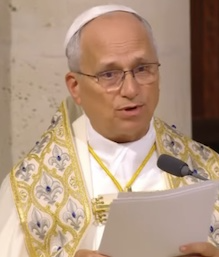
Pope Leo’s Homily at Vespers in France
Notre-Dame de Paris Cathedral
Friday, 25 September 2026
Galatians 4:4-5
When the time had fully come, God sent forth his Son, born of woman, born under the law, to redeem those who were under the law, so that we might receive adoption as sons.
Because you are sons, God sent the Spirit of his Son into our hearts, saying, “Abba! Father!”
So through God you are no longer a slave but a son, and if a son then an heir.
Dear brothers and sisters,
We are gathered here for Evening Prayer.
This place has invited the people of Paris for centuries to lift their eyes toward heaven more than any other.
Seven years have passed since the whole world held its breath and watched the cathedral engulfed in a terrible fire.
We also watched anxiously at that time, conscious of how powerless humans are in the face of the unforeseen.
This pain was not only felt by Catholics or believers.
In that tragic moment, we realized that Notre-Dame is more than a monument.
The collective effort to rebuild it and its magnificent result reveal that the heart of a people beats here. Here, we stand at the living center of a civilization where past and future embrace and heaven and earth meet.
It was my wish to meet you here, in this symbolic place for the Church in France.
I am happy to have crossed its threshold a short while ago, as thousands of brothers and sisters do each day, coming here from every corner of the world.
Simply entering this place brings us face-to-face with a beauty that speaks to our restless hearts and calls them to peace.
Following the restoration of this sacred space for all humanity, it has become clear how visitors can be renewed by what they see, hear, and experience.
The public, private, and ecclesial institutions involved in Notre-Dame’s restoration have each contributed to reawakening the cultural, existential, and spiritual journeys the cathedral offers.
In this context, the Church has embraced her mission in terms of both preservation and creativity, keeping tradition alive with the boldness of the faithful and hopeful.
I would like to thank the Archbishop, his colleagues, and the Diocese of Paris for creating an initial proclamation and Christian initiation pathway open to all.
The baptismal font at the entrance is a sign of this.
It is a blessing and an invitation.
Rebuilding the cathedral provided an opportunity to expand the horizons of welcome and participation beyond ecclesial affiliation.
Dear Bishops, Priests, Deacons, Consecrated Men and Women, Seminarians of France,
Let yourselves be inspired by what has happened here!
Prioritize the vision of Evangelii Gaudium (The Joy of the Gospel), specifically the missionary conversion Pope Francis discussed in his first apostolic exhortation.
In the Letter to the Galatians, we learned why we should not be afraid: “God sent forth his Son” (Galatians 4:4). He sent him among us, into our world. According to Saint Paul, this verb describes a real, historical event, not an ideal set of circumstances.
Christians do not shy away from complexity because God has called them to follow his Son in a world that is already inhabited and in motion.
This world is marked by both human misery and goodness.
The Way of the Cross reveals the darkness in our world, but it also reveals the love of God that triumphs over death.
The cathedral’s cruciform layout, where stone and light converge, symbolizes the union of earth and heaven.
It gathers and orders the events of history, interwoven with human joys and sufferings.
This symbolic dynamic transforms these diverse expressions into a living language, uniting them into a whole.
Dear friends,
The identity of the Church flows from the Incarnation — “God sent forth his Son” — for she is always called to be a “going forth” Church.
As disciples of Christ, you know that the Christian community is not a refuge where we hide from the world.
On the contrary, like the cathedrals of old, the Church is a place of welcome, respect, revelation, and meaning for all.
A living Church’s strength lies in welcoming those on the peripheries, who already have a place in her heart; those who are far away but are already near; and the stranger, in whom Christ knocks at the door.
If Notre-Dame is a sign of this encounter in the heart of Paris, then other cities and regions of France, even the most remote and rural ones, can be transformed by a simple, welcoming, missionary presence.
Such a presence can help bring cultural differences into harmony and heal the wounds in our societies.
From the northern coasts to the Mediterranean, from the inland regions to the overseas departments, be a living, diverse, and close church.
A lack of material resources does not prevent mission because it is the grace of God that gives rise to interior freedom and simplicity of life. This enables us to reflect an evangelical way of life.
Confidently value the missionary presence of the lay faithful, who are the living front line of the Church at the crossroads of everyday life.
Brothers and sisters,
At the same time, we must not forget that, like every other church, this Cathedral was built for prayer and worship.
Here, the Christian community celebrates the highest form of prayer and worship by renewing the redemptive sacrifice of Christ in the Eucharist.
This cathedral is more than just a stone structure to be admired.
It lives by the sacred mysteries celebrated within it.
Without liturgy, it would lose its soul.
Here at Notre-Dame, this truth is evident in the altar’s placement at the center of the cathedral.
The community gathers here to praise the Lord, standing at the heart of the building while visitors walk around and observe it, even during celebrations.
Here, the Church reveals itself as a living organism and a believing community that incorporates all that culture and tradition have handed down into its praise.
Through her celebration, she tells each person the reason for her existence.
Today, more than ever, we live in an age that seems to lack fullness, depth, and promise.
The noble simplicity of song, the spoken word, and liturgical gestures can offer many a glimmer of hope and an oasis of peace in our hyper-connected, noisy society.
There, we can experience the presence of the Author of the greatest love: “When the time had fully come, God sent forth his Son” (Galatians 4:4).
Celebrating the liturgical year, its Sundays and feasts, makes us companions of Christ.
We become attentive to the different moments of his life, which he gave entirely to the Father for the sake of the world. In this way, we become more sensitive and open to the signs of the times.
Our prayer and shared study of the Scriptures enable us to view historical events in the light of God.
This makes us more aware of our responsibilities and allows us to expose unjust power relations and sow the seeds of justice and peace.
Therefore, it is hope that drives us, not resignation.
From this arise bonds of greater fraternity and networks of solidarity—the fruit of communion in Christ’s one sacrifice.
To those who celebrate the Eucharist daily, I ask that you ensure liturgical celebrations are carried out with dignity and reverence, even in smaller communities.
Be conscious heirs of the Church Fathers and saints who, over the centuries, handed down the profound meaning and beauty of the liturgy to us, always setting an example of great humility before the Mystery celebrated.
The Second Vatican Council, which drew much of its inspiration from France, built upon and enriched this heritage, recognizing the central role of the liturgy in the life of the Church (Sacrosanctum Concilium, 10 – the liturgy is the summit toward which the activity of the Church is directed; at the same time it is the font from which all her power flows.
Therefore, I exhort you, the bishops, priests, deacons, and consecrated persons, to cultivate an authentic love for the liturgy.
Be witnesses and servants of the prophetic, priestly, and kingly vocation of the entire People of God.
In this regard, the liturgy is a reflection of life.
Eucharistic joy takes root and spreads wherever harmony is restored, dignity is renewed, authority becomes service, and freedom flourishes.
This is the greatest gift we can share.
Therefore, prioritize communion with the successor of Peter and the Church over your personal preferences to foster unity among God’s people.
Together, we will bear prophetic witness to the possibility of a reconciled world.
Dear Bishops, Priests, Seminarians, and Consecrated Persons,
As those who have been called to follow Christ, I thank you for your response and fidelity to the Lord.
Never neglect the friendship the Lord desires, which must be cultivated through personal prayer and is the foundation of every vocation.
As Madeleine Delbrêl said: “Without prayer, we would not love the God of love.
“Without prayer, we would not love the God of love. We might be his servants, warriors, or disciples, but we would not be his loving children or friends of Jesus Christ.”
(Notre vie, Œuvres complètes vol. XV, Nouvelle Cité, 2017, p. 41).
Nurture your inner life with the Lord by following the example of the many saints who have come before you.
Always draw from the source of God’s infinite love through silent prayer.
Your mission stems from this intimate relationship with the Lord, who awaits you there.
In the heart of the city, the open cathedral symbolizes a community that praises the Lord and practices hospitality not as an occasional gesture but as its way of life, so that all may feel at home and not be dominated or marginalized in a changing world.
“God sent forth his Son, born of a woman, […] so that we might receive adoption as sons” (Galatians 4:4-5). And “if a son, then you are also an heir” (Galatians 4:7).
Brothers and Sisters gathered here, heirs by grace,
It is now up to each of you in this praying and living assembly to become the flesh and voice of this promise.
Clergy and consecrated persons of France,
You are called to be the first guardians of this open house and the living stones of a Church that hopes and does not fear the future.
This cathedral has been reborn so that you, too, may be reborn with it, gaining new impetus toward holiness and your daily mission.
Be a clear expression of the divine motherhood of the Church among your people.
By bearing witness to God’s love, the Church restores and heals the human family.
Let us look at the fourteenth-century statue of the Virgin and Child.
Untouched by the fire, it now shines before us once again.
May Mary, who carried the Word in her womb, keep you faithful.
May she guide the mission of the Church in France like a star.
Holy Mary, Our Lady of Paris and Mother of the Church, pray for the French people.
Sustain their pastors and walk always at our side.


