 0
0
 0
0
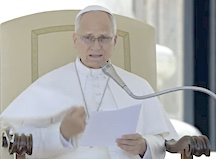
LEO XIV GENERAL AUDIENCE
St. Peter’s Square – Wednesday, September 23, 2026
Cycle of Catecheses – Documents of the Second Vatican Council. IV.
Pastoral Constitution Gaudium et Spes (GS, 33-39).
4. The Importance of Human Activity in the World
From the Book of Genesis. (Gen 2:8-9a.15)
And when he had planted a garden in Eden in the east, the Lord God placed there the man whom he had made.
By the command of the Lord God, all trees grew out of the soil that were pleasing in appearance and bearing good fruit. […]
So the Lord God took the man and put him in the garden of Eden to cultivate and take care of it.
_______________________
Pope Leo’s Catechesis,
Brothers and Sisters,
In continuing our reflection on the Pastoral Constitution Gaudium et Spes of the Second Vatican Council, we now turn to the third chapter of the first section, which has the intriguing title: “Human activity in the world”.
The fundamental question is this: What is the value of human activity in the world, and by extension of technical, social and scientific progress?
It is worth recalling that less than four years after the Council ended, on July 20-21, 1969, humans set foot on the moon for the first time.
Created in the image and likeness of God, man is the subject of progress.
Through the use of his freedom and intelligence, he expands knowledge and contributes to the development of society as a whole.
This is evident when we observe the improvement in living conditions that has followed from generation to generation.
In fact, the document states: “Many goods that man once expected from higher powers are now acquired through his own action” (n. 33).
For this reason, some thinkers have presented technical and scientific progress as something that weakens the bond with God.
Some even deem Him superfluous or consider Him contrary to the Christian faith.
This interpretation has caused modern humans to view the world differently than people in past eras did.
This prejudice has taken root primarily in Western cultures that have lost their connection to Christian revelation.
Post-Christian humanisms wrongly present man and God as rivals.
According to this view, in order to affirm his knowledge, freedom, and capacity for development, man must free himself from God. However, by rejecting God, one also loses the ability to recognize the transcendent value of the human person.
This is the “drama of atheistic humanism,” as described by Henri de Lubac, an important theologian of the Second Vatican Council. [1].
The Council wishes to give a clear answer: “For believers”, Gaudium et Spes affirms,
“it is essential that both individual and collective human activity – that is, the enormous effort by which men and women seek to improve their lives over the course of the centuries—when considered in itself, corresponds to God’s plan” (n. 34).
Moreover, the Constitution goes on to say:
“Christians do not believe that their achievements are contrary to God’s power, or that they become rivals of the Creator.
Rather, they are convinced that human achievements are a sign of God’s greatness and the fruit of his unfathomable plan”” (ibid.).
God has entrusted man and woman with a creature that still remains ‘in statu viae’, that is, ‘in the state of being on the way’, so that, through wise activity, they may bring it to its intended fullness. [2].
This text contains an important reference to the mystery of the Incarnation.
In the encounter with God, humanity – along with the work, progress, and autonomy of created realities – is not absorbed or annihilated.
Rather, it is accepted in all its integrity, remaining free and active in Christ.
In Him, humanity finds the fullness of truth and freedom.
Furthermore, during the Eucharist, the fruits of human labor, symbolized by bread and wine, are presented on the altar daily to be transformed into the body and blood of Christ.
From this perspective, an important truth emerges.
To encounter God, a person does not have to abandon earthly pursuits.
Rather, a person can fulfill their calling by doing their daily work well and sanctifying it. Christians, like everyone else, participate in building the city of people with the ultimate goal of encountering God in mind.
They also remind their fellow travelers of this ultimate goal.
Of course, earthly progress must be clearly distinguished from the growth of Christ’s kingdom.
The Council affirms that this progress “in so far as it can contribute to the better organization of human society, is of great importance for the kingdom of God. (…)
For when, in the Spirit of the Lord and according to his command, we have spread on earth (…) all these good fruits of nature and our efforts, we shall find them again, but already cleansed of all impurity, illumined and transformed” (n. 39).
Finally, let us remember that technical and scientific progress must be animated and directed by charity in order to become true human progress — that is, the progress of the whole person and of all people.
Only then will it be able to consistently defend the dignity of the human person and improve living conditions for all, especially the most vulnerable.
Dear brothers and sisters,
The Second Vatican Council invites us to share the bread of knowledge and practical skills so that everyone can reach their full potential and we can all build a better future together with God’s help.
______________________________
Summary of the Holy Father’s catechesis
The third chapter of the first section of the Pastoral Constitution Gaudium et Spes focuses on human activity in the world.
It addresses the value of human activity, technical progress, social progress, and scientific progress, as well as their significance for the relationship between humans and God.
Regarding views that present progress as a threat to or competitor of human freedom, the Council emphasizes that human activity, both individual and collective, aimed at improving living conditions, corresponds to God’s plan (cf. n. 34).
The “drama of atheistic humanism,” consisting of rejecting the relationship with God, ultimately leads to questioning man himself.
______________________________
[1] H. DE LUBAC, The drama of atheistic humanism, Paris 1944:
[2] Cf. Catechism of the Catholic Church, nn. 302, 306, 307.
[3] Cf. St. John Paul II, Homily for the Canonization of Josemaría Escriva de Balaguera (6 October 2002


