 0
0
 0
0
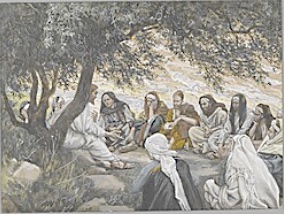
Illustration: The Exhortation to the Apostles by James Tissot,
Pope Leo’s Angelus Reflection for 11th Sunday in Ordinary Time
St Peter’s Square – Sunday, 14 June 2026
Today’s Gospel (Mt 9:36–10:8)
When Jesus saw the crowds, he had compassion for them, because they were harassed and helpless, like sheep without a shepherd. Then he said to his disciples, “The harvest is plentiful, but the laborers are few; pray therefore the Lord of the harvest to send out laborers into his harvest.”
And he called to him his twelve disciples and gave them authority over unclean spirits, to cast them out, and to heal every disease and every infirmity. The names of the twelve apostles are these: first, Simon, who is called Peter, and Andrew his brother; James the son of Zeb′edee, and John his brother; Philip and Bartholomew; Thomas and Matthew the tax collector; James the son of Alphaeus, and Thaddaeus; Simon the Cananaean, and Judas Iscariot, who betrayed him.These twelve Jesus sent out, charging them, “Go nowhere among the Gentiles, and enter no town of the Samaritans, but go to the lost sheep of the house of Israel. And preach as you go, saying, ‘The kingdom of heaven is at hand.’ Heal the sick, raise the dead, cleanse lepers, cast out demons. You received without pay, give without pay.
Pope Leo’s Homily for 11th Sunday in Ordinary Time
Dear brothers and sisters,
Today’s Gospel is a great gift because it draws everyone who hears it into the gaze of Jesus.
It is a story that shows us how attentive this gaze is, and what the Lord sees.
We read, in fact, that Christ “When Jesus saw the crowds, he had compassion for them, because they were harassed and helpless” .
Having become one of us, the Son of God looks at people; he looks at humanity.
He sees the oppression that burdens them and the violence that weakens them.
He sees the wounds of war and the emptiness of consumerism.
He sees people whose faces have become masks, families torn apart by evil and young people misled by false ideals.
Jesus sees and loves.
He suffers with and for us, and his compassion expresses not only fraternal closeness, but also his desire to redeem us.
He knows our hearts and cares for us.
Looking upon so many people as ‘sheep without a shepherd’, Christ devotes himself to all as the Good Shepherd.
As Lord of the harvest, he sends workers into the world’s fields.
What is their task?
They must offer God’s comfort to the suffering by bringing charity to the miserable, hope to the afflicted and faith to the distrustful.
The Gospel lists the names of the first twelve ‘workers’: they are disciples who were made apostles, i.e. missionaries and preachers.
The first person we find among them is Simon, also known as Peter.
Then there is Judas Iscariot, who is named last to remind us that it is possible to follow Jesus and yet betray him.
Nevertheless, the Gospel remains a living and true word for all.
The Good News that has spanned the centuries remains the same: always young, fresh and liberating. ‘The Kingdom of Heaven has come near!’ (Matthew 10:7).
Indeed, it is near, for in Jesus Christ, God draws near to every man and woman, to every people and nation.
When this gospel is proclaimed and lived out, evil crumbles, passing away like a disease, a night giving way to dawn or death conquered by the risen one.
(Matthew 10:8 – Heal the sick, raise the dead, cleanse lepers, cast out demons),
This is how Jesus’ gaze transforms reality.
Filled with love, he takes the initiative and establishes a new community: the Church.
This community is called to continue the mission of the apostles: ‘You received without payment; give without payment’ (v. 8).
Indeed, Jesus’ gift is entirely free of charge, for its value is immeasurable: it cannot be earned or “purchased”.
This grace is the beautiful manifestation of God’s mercy, seeking us out wherever we are to draw us closer.
“Ask the Lord of the harvest, therefore, to send out workers into his harvest” (Mt 9:38)!
Dear friends,
The task of evangelization stems from God’s gift of forgiveness to the world through Christ, of service to the least and the poor, and of commitment to justice.
Let us invoke the help of the Virgin Mary, full of grace, so that we may respond with joy and courage to Jesus’ call to mission.