 0
0
 0
0
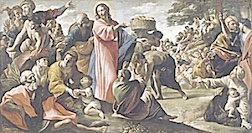
Illustration: Miracle of the Bread and Fish by Giovanni Lanfranco, 1623 (National Gallery of Ireland).
Pope Leo’s Angelus Reflection:
St Peter’s Square – Sunday, 2 August 2026
(18th Sunday in Ordinary Time)
Sunday’s Gospel – Matthew 14:13-21
When Jesus received the news of John the Baptist’s death he withdrew by boat to a lonely place where they could be by themselves.
But the people heard of this and, leaving the towns, went after him on foot.
So as he stepped ashore he saw a large crowd; and he took pity on them and healed their sick.
When evening came, the disciples went to him and said, ‘This is a lonely place, and the time has slipped by; so send the people away, and they can go to the villages to buy themselves some food.’ Jesus replied, ‘There is no need for them to go: give them something to eat yourselves.’
But they answered ‘All we have with us is five loaves and two fish.’
‘Bring them here to me’ he said.
He gave orders that the people were to sit down on the grass; then he took the five loaves and the two fish, raised his eyes to heaven and said the blessing.
And breaking the loaves handed them to his disciples who gave them to the crowds.
They all ate as much as they wanted, and they collected the scraps remaining; twelve baskets full. Those who ate numbered about five thousand men, to say nothing of women and children.
Pope Leo’s Angelus Reflection,
Dear brothers and sisters,When we listen to the Gospel, we often hear about the signs Jesus performed.
These acts reveal his special dedication to us and the salvation he brings to the world. Jesus is presented as the one who gives our lives meaning, freeing us from evil and sin.
By restoring sight to the blind and hearing to the deaf, Christ does more than perform miraculous deeds.
He proclaims to all that the Kingdom of God is near.
Today’s Gospel bears witness not only to Jesus’ ability to restore the senses of those who lack them, but also to his ability to fill our senses with good things.
To the deaf man, who regains his hearing, the Lord proclaims the Good News to be heard; to the blind man, who regains his sight, the Lord shows the magnificent work of redemption being accomplished for him.
Similarly, Jesus feeds those who are hungry.
The account of the multiplication of the loaves shows us that encountering the Lord is a nourishing experience.
In the desert – that is, when we are in need – Christ is the bread of life.
With him, our needs are abundantly met: “All ate and were filled,” and there were “twelve baskets full” left over (v. 20).
This number ‘twelve’ highlights that the Lord’s gift is universal, and that his providential care for us never fails.
Dear friends, Christ truly satisfies humanity’s hunger, our hunger for truth and life.
His gesture teaches us that nothing is discarded when it is shared.
Hoarding and waste, on the contrary, are two sides of the same evil: greed.
This spiritual sickness numbs the senses, which become intoxicated with wealth, to the point of making people forget those who weep from hunger and cry out from thirst.
And so, in the face of an opulence that reeks of decay, we find the outstretched hands of those who have no nourishment, the burned homes of those who have no peace.
Faced with the deserts of war and arrogance, let us consider with what kindness the Lord “looked up to heaven, and blessed,” “broke the loaves, and gave them” to his disciples, so that they might distribute them to the crowd (cf. v. 19).
In this miracle of charity, we recognize the characteristic actions of Jesus, which find their culmination in the Last Supper, for it was then that the Son of God gave us his very life as our brother in humanity.
As we savor the grace of the Eucharist, let us commit ourselves to bearing witness to its beauty in our daily actions, beginning with blessing meals at the table with family and friends.
In Jesus’ company, even vacations can become a time of fraternal serenity, if we reach out to our neighbors in need.
Let us therefore ask the Virgin Mary, our loving Mother, to help us grow in charity, so that no one may lack their daily bread.


