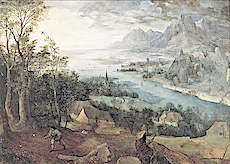
Illustration: Pieter Bruegel the Elder, Parable of the Sower, 1557.
Pope Leo’s Angelus Reflection for 15th Sunday of Ordinary Time
(Liberty Square – Piazza della Libertà (Castel Gandolfo) – 12 July 2026
Sunday Gospel Matthew 13:1-23
Jesus left the house and sat by the lakeside, but such large crowds gathered round him that he got into a boat and sat there.
The people all stood on the beach, and he told them many things in parables.
Jesus said, ‘Imagine a sower going out to sow. As he sowed, some seeds fell on the edge of the path, and the birds came and ate them up. Others fell on patches of rock where they found little soil and sprang up straight away, because there was no depth of earth; but as soon as the sun came up they were scorched and, not having any roots, they withered away. Others fell among thorns, and the thorns grew up and choked them. Others fell on rich soil and produced their crop, some a hundredfold, some sixty, some thirty.
Listen, anyone who has ears!’
Then the disciples went up to him and asked, ‘Why do you talk to them in parables?’ ‘Because’ he replied, ‘the mysteries of the kingdom of heaven are revealed to you, but they are not revealed to them. For anyone who has will be given more, and he will have more than enough; but from anyone who has not, even what he has will be taken away.
The reason I talk to them in parables is that they look without seeing and listen without hearing or understanding. So in their case this prophecy of Isaiah is being fulfilled:
You will listen and listen again, but not understand, see and see again, but not perceive.
For the heart of this nation has grown coarse, their ears are dull of hearing, and they have shut their eyes, for fear they should see with their eyes, hear with their ears, understand with their heart, and be converted and be healed by me.
‘But happy are your eyes because they see, your ears because they hear!
I tell you solemnly, many prophets and holy men longed to see what you see and never saw it; to hear what you hear, and never heard it.
‘You, therefore, are to hear the parable of the sower.
When anyone hears the word of the kingdom without understanding, the evil one comes and carries off what was sown in his heart: this is the man who received the seed on the edge of the path. The one who received it on patches of rock is the man who hears the word and welcomes it at once with joy. But he has no root in him, he does not last; let some trial come, or some persecution on account of the word, and he falls away at once. The one who received the seed in thorns is the man who hears the word, but the worries of this world and the lure of riches choke the word and so he produces nothing. And the one who received the seed in rich soil is the man who hears the word and understands it; he is the one who yields a harvest and produces now a hundredfold, now sixty, now thirty.’
Pope Leo’s Angelus Reflection
Dear brothers and sisters,
In today’s liturgy, Evangelist Matthew presents us with the Parable of the Sower.
This parable describes God’s generosity and trust in sowing his Word in our hearts, as well as his power within us.
Jesus, the Word made flesh who gave his life for our salvation, is the seed that the Father sows throughout the world. By dying, Jesus bears much fruit
(John 12:24 – unless a grain of wheat falls into the earth and dies, it remains alone; but if it dies, it bears much fruit.)
Sometimes he finds hard and unresponsive soil in us, and at other times, distracted soil like the beaten path, rocky ground, or thorny bushes.
Yet, there are also moments when he finds fertile, receptive ground. Then, miracles of love are set in motion that have the power to transform everything, as we have undoubtedly experienced in our own lives.
For this reason, the Father never ceases to sow because he knows the power of his love is stronger than our weakness.
(2 Corinthians 12:7-10 – to keep me from being too elated by the abundance of revelations, a thorn was given me in the flesh, a messenger of Satan, to harass me, to keep me from being too elated. Three times I besought the Lord about this, that it should leave me; but he said to me, “My grace is sufficient for you, for my power is made perfect in weakness.”
I will all the more gladly boast of my weaknesses, that the power of Christ may rest upon me. For the sake of Christ, then, I am content with weaknesses, insults, hardships, persecutions, and calamities; for when I am weak, then I am strong).
Referring to the “seed” of the Word of God, Saint John Chrysostom asks,
“How could it be reasonable to sow among thorns, on rocky ground, or on the path?
It would not be reasonable in the case of seeds and soil, but it is praiseworthy in the case of souls and doctrine because, in God’s hands, it is possible for “rocky ground to be transformed into fertile soil, for the path to no longer be trampled underfoot or exposed to every passerby, and for the thorns to be cleared away so that the seed may enjoy complete security.”
God’s generosity toward us is wise, not naive.
He sees the potential for good within us that we ourselves might sometimes fail to recognize.
The Lord knows the soil of our hearts better than we do, so he never ceases to believe in us—in who we are and who we can become if we entrust ourselves to him in faith, day by day.
Thus, the fruits of the Holy Spirit grow within us and spread from the generosity and trust with which the seed is sown and the humility and openness with which it is received.
Saint Paul teaches that these fruits are “love, joy, peace, patience, kindness, goodness, faithfulness, gentleness, and self-control” (Galatians 5:22). Our world greatly needs these fruits to fill and transform it!
Therefore, let us resolve to make time for listening to, reading, and meditating on the Word of God during these summer vacation days.
In this way, we can foster meaningful moments of silence and prayer alongside rest and wholesome recreation.
In this way, we will return to our usual activities renewed in body and spirit.
We will be ready to proclaim the Good News of the Gospel and contribute more effectively to the growth of the Kingdom of God.
May Mary, Queen of the Apostles and Star of the Evangelization, help us.