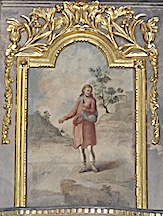
Illustration: ‘Sowing the Seed’ (Cathedral of Hajdúdorog, Hungary)
Pope Leo’s Angelus Reflection for 16th Sunday in Ordinary Time
Liberty Square – Piazza della Libertà (Castel Gandolfo)
Sunday, 19 July 2026
Scripture Reading: Matthew 13:24-43
The Parable of the Weeds
24 Jesus told them another parable: “The kingdom of heaven is like a man who sowed good seed in his field.
25 But while everyone was sleeping, his enemy came and sowed weeds among the wheat and went away. 26 When the wheat sprouted and formed heads, then the weeds also appeared.
27 “The owner’s servants came to him and said, ‘Sir, didn’t you sow good seed in your field? Where then did the weeds come from?’
28 “‘An enemy did this,’ he replied. “The servants asked him, ‘Do you want us to go and pull them up?’
29 “‘No,’ he answered, ‘because while you are pulling the weeds, you may uproot the wheat with them.
30 Let both grow together until the harvest. At that time I will tell the harvesters: First collect the weeds and tie them in bundles to be burned; then gather the wheat and bring it into my barn.’”
31 He told them another parable: “The kingdom of heaven is like a mustard seed, which a man took and planted in his field.
32 Though it is the smallest of all seeds, yet when it grows, it is the largest of garden plants and becomes a tree, so that the birds come and perch in its branches.”
33 He told them still another parable: “The kingdom of heaven is like yeast that a woman took and mixed into about sixty pounds of flour until it worked all through the dough.”
34 Jesus spoke all these things to the crowd in parables; he did not say anything to them without using a parable.
35 So was fulfilled what was spoken through the prophet: “I will open my mouth in parables, I will utter things hidden since the creation of the world.”
36 Then he left the crowd and went into the house. His disciples came to him and said, “Explain to us the parable of the weeds in the field.”
37 He answered, “The one who sowed the good seed is the Son of Man.
38 The field is the world, and the good seed stands for the people of the kingdom. The weeds are the people of the evil one,
39 and the enemy who sows them is the devil. The harvest is the end of the age, and the harvesters are angels.
40 “As the weeds are pulled up and burned in the fire, so it will be at the end of the age.
41 The Son of Man will send out his angels, and they will weed out of his kingdom everything that causes sin and all who do evil.
42 They will throw them into the blazing furnace, where there will be weeping and gnashing of teeth.
43 Then the righteous will shine like the sun in the kingdom of their Father. Whoever has ears, let them hear.
Dear brothers and sisters,
After telling the parable of the sower, Jesus continues to speak to the crowds using a series of images, such as the good wheat and the weeds, and the mustard seed and the yeast in the dough.
These three short parables recall the arrival of the Kingdom of God in history,
its impact on people’s lives,
and how it grows and transforms the world from within..
Through these images, Jesus warns us against the temptation of thinking of God as a powerful figure who imposes himself by force, takes over, dominates and arrives triumphantly.
Instead, God favors humility, a sign of his subtle love, which allows us to choose whether to accept or reject him.
His love is present even among the weeds.
It acts in a hidden and invisible way, like the smallest of seeds, and leavens the dough without making a sound.
Brothers and sisters
Through these parables, Jesus reveals important information about how God works in our lives and throughout history.
Sometimes we expect God to perform spectacular acts; we want him to intervene immediately and uproot the evil in the world.
Unfortunately, we model our way of being Christians and the way the Church operates on the image of a strong and powerful God.
However, the Kingdom of God spreads even amidst the weeds.
This requires us to train our vision so that we can discern the good that flourishes despite the darkness of evil and avoid making rash judgements.
It grows from the smallest of seeds, so patience is required to recognize this process in the little things of daily life and the simplicity of ordinary existence.
Like yeast in flour, it grows invisibly, freeing us from discouragement and inviting us to have faith, even when it seems that God is absent.
He is always with us and his love is always ready to help us.
We must make God’s way of acting the way in which we live, both as individuals and as the Church, amidst the surrounding reality.
We are called to take a Gospel-centered approach.
This means not hastily opposing others with arrogant judgments, not imposing ourselves with power and force, and not losing trust in God’s work. As Cardinal Ratzinger said at the time, it is a matter of submitting ourselves to the logic of the seed, which is not the logic of success and greatness but the logic of humility and service.
In this way, we will become like small seeds of the Gospel that sprout and transform the world with love.
Let us ask the Blessed Virgin Mary to sustain us on our journey. She knew how to welcome the seed of the Word in her smallness. Let us also ask her to intercede for us.