0
0
 0
0
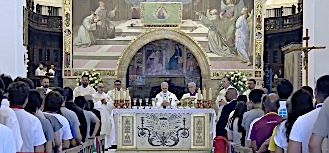
Pope Leo’s homily for Transfiguration of the Lord
Pontifical Basilica of Our Lady of the Angels, Assisi – Thursday, August 6, 2026
Gospel Reading (Mark 9:2-10)
Jesus took with him Peter and James and John and led them up a high mountain where they could be alone by themselves. There in their presence he was transfigured: his clothes became dazzlingly white, whiter than any earthly bleacher could make them. Elijah appeared to them with Moses; and they were talking with Jesus. Then Peter spoke to Jesus: ‘Rabbi, it is wonderful for us to be here; so let us make three tents, one for you, one for Moses and one for Elijah.’ He did not know what to say; they were so frightened. And a cloud came, covering them in shadow; and there came a voice from the cloud, ‘This is my Son, the Beloved. Listen to him.’ Then suddenly, when they looked round, they saw no one with them anymore but only Jesus.
As they came down from the mountain he warned them to tell no one what they had seen, until after the Son of Man had risen from the dead.
They observed the warning faithfully, though among themselves they discussed what ‘rising from the dead’ could mean.
Dearest Brothers and Sisters,
Dearest Young People!
We celebrate the Feast of the Transfiguration of the Lord, a mystery of light that helps us live more deeply our encounter—so joyful yet full of questions about the present and future. The Gospel account contrasts light and shadow, silence and words, amazement and misunderstanding.
We are in Assisi, a city that has attracted pilgrims for centuries — including us today — because here, everything whispers that our lives can be transformed, shine with light, and repair the world.
The transfiguration of Francis and Clare began here, and then that of thousands of other young people. They accepted the Gospel sine glossa — what we would call today “without a reduced tariff” — and the life of Jesus began anew in them.
We have come here to understand the direction of history and our own path. In the Gospel, we learn that we can find meaning and see the way.
Like Peter, James, and John, we have also been brought aside, and Jesus is with us. His presence is what matters.
On the mountain, the apostles contemplate Jesus as he turns toward what awaits him. There had been a misunderstanding between them about this earlier. Six days earlier, Peter opposed the Master when he spoke openly about the cross. Peter expected glory for the Messiah and perhaps for himself. He did not consider resistance or risk and did not ask what glory actually is.
(Matthew 16:21-26 – 21 From that time Jesus began to show his disciples that he must go to Jerusalem and suffer many things from the elders and chief priests and scribes, and be killed, and on the third day be raised.
22 And Peter took him and began to rebuke him, saying, “God forbid, Lord! This shall never happen to you.”
23 But he turned and said to Peter, “Get behind me, Satan! You are a hindrance to me; for you are not on the side of God, but of men.”
24 Then Jesus told his disciples, “If any man would come after me, let him deny himself and take up his cross and follow me.
25 For whoever would save his life will lose it, and whoever loses his life for my sake will find it.
26 For what will it profit a man, if he gains the whole world and forfeits his life? Or what shall a man give in return for his life?)
In the Transfiguration of Jesus, God reveals his glory in the form of a cloud that covers and envelops Jesus. God points to Jesus and calls us to listen to him.
We discover the way of life by following him together.
Jesus’ beauty appears in an unprecedented form, so Peter wants to stop time and prolong this vision.
Peter generously offers to build three tents, as if he wants the conversation between Jesus, Moses, and Elijah to continue.
However, we must enter into this conversation.
We cannot remain mere spectators.
In fact, we are called to read the Scriptures with the Master, interpret our time, and make decisions as we follow his path.
We are here to overcome resignation and fear and dispel the doubts that hold us back, just as they held back the apostles.
Jesus calls us to engage with his history and write new chapters.
When we listen to the words: “His face shone like the sun, and his clothes became as white as light” (Matthew 17:2), we are reminded of Easter morning when the angel of the Lord rolled away the stone from the tomb and announced the resurrection of Jesus.
“His form shone like lightning, and his garments were white as snow” (Matthew 28:3).
Although there is still darkness around us and sometimes within us, it is the light of a new day to which we are turned.
We see this dawn in canonized saints, such as St. Francis and St. Clare, and in the countless brothers and sisters who respond to evil with good.
We are not alone! During this time, you have experienced this firsthand: you have met and listened to one another, transitioning from cacophonous voices that oppose each other to the art of conversation.
Today, we contemplate Jesus, who is transfigured in conversation with the Father, Moses, Elijah, and his disciples.
The Church introduces us to the process of listening and making decisions, through which we understand how and for whom to live.
The Church is a community where we learn to recognize the voice of God, which can never be equated with our own opinions. It is a community where we dare to obey the Holy Spirit, which has inspired boldness and creativity in all who follow Jesus. When we separate ourselves from God and others, we become distorted. On the other hand, we are transformed by the bonds that sustain and call us to life.
The Franciscan spirituality in which you have been formed is one of the most sensitive to the need to repair the fundamental relationship with God and all of his creatures.
It is a harmony that, today more than ever, must be protected and nurtured.
In this spirit, at the beginning of my first encyclical, I wrote: “Each generation is given the task of shaping its own time, bringing history to maturity as a space where the dignity of each person is honored, justice is upheld, and fraternity is possible.
However, every epoch is at risk of creating an inhuman and unjust world. When humanity is in danger of losing its identity, we Christians look to God made flesh, knowing that ‘the mystery of man is truly explained only in the mystery of the Incarnate Word.'”
“This wonderful humanity of Jesus Christ becomes the way, the truth, and the life, opening the way for each of us to grow toward fullness” (Encyclical Letter to the Gospel, Magnificat Humanitas, 1). Magnificat Humanitas 1).
Dear friends,
St. Francis continues to attract us even eight hundred years after his death thanks to his wonderful humanity. It was this that led him to abandon the well-trodden path in order to forge a new one more in harmony with Jesus’.
Even in a city like Assisi, which had been Christian for centuries, this seemed revolutionary.
“Clare’s choice was even more impressive: a girl who wanted to be like Francis and live as a free woman alongside those brothers!” (Jubilee Audience, October 4, 2025) [1].
This is the vital force of Christianity, present in its beginnings and its many new beginnings.
Dear young people,
Today, Europe and the world are looking to you to be the new saints.
Have the courage to believe in the Gospel, become fully human through the freedom of Jesus Christ, and embrace poverty as your sister!
The title of your meeting, “Go!,” is a mission. It is a mission on paths whose maps we do not yet have because they open when we listen to our hearts, obey the Holy Spirit, and follow the Risen One wherever He wants to lead us. Go! Go!
Or better yet, let’s go! Let’s go!
Let’s go to the peripheries where injustice and violence rob the dignity and dreams of too many sons and daughters of God.
Drawing inspiration from the Poor Woman of Assisi, Pope Francis warned us against the temptation to be Christians while keeping a prudent distance from the wounds of the Lord.
But Jesus wants us to touch human misery, to touch the suffering flesh of others.
He expects us to refrain from seeking personal or communal protective measures that allow us to distance ourselves from the essence of human anguish (Pope Francis, Evangelii Gaudium, 270).
One may encounter misunderstanding even within one’s own household, as was the case with St. Francis.
However, freeing oneself from the influence of a culture of power and tearing down the walls that separate people never means betraying one’s family, city, or tradition. On the contrary, it means freeing them from their delusions and the enemies they invent out of fear and ignorance. It also means freeing them from the violence with which they try to impose their narrow view of reality on everyone.
Like Francis and Clare, trusting in God means finding a world of brothers and sisters who must be valued and served, not exploited and dominated.
It is not a world that must be defended, but rather, a world that must be embraced.
Dear young people, dedicate yourselves to the civilization of love. You have seen the seeds of this civilization in countless examples of selflessness, and it transforms countless peacebuilders committed to the service of life in the most tragic scenes of death, in the image of Christ. Combine the best of your humanity—studies, skills, work, friendships, love, and prayer—to bring Francis’s vision to life in various ways. You are probably familiar with the prayer often attributed to Francis, a text from the last century:
Lord, make me an instrument of your peace. Where there is hatred, let me sow love. Where there is injury, let me bring forgiveness. Where there is discord, let me bring harmony. Where there is error, let me bring truth. Where there is doubt, let me bring faith. Where there is despair, let me bring hope. Where there is darkness, let me bring light. Where there is sadness, let me bring joy.
Here’s where to go! Go! And above all, here’s how to go!
Lord, grant that I may seek comfort more than consolation.
He did not desire to be understood as much as he understood. He did not want to be loved as much as he loved.
For by giving, we receive.
By forgetting ourselves, we find ourselves. By forgiving, we are forgiven. By dying, we are resurrected to eternal life.
Dear friends, may you deeply remember those days in Assisi, and may your return to the various European countries be like Peter, James, and John’s descent from the high Mount of Transfiguration.
May it be a reflective return, open to the future, and committed to Jesus Christ.
He trusts you, counts on you, and will always be with you.