 0
0
 0
0
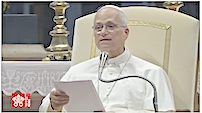
Pope Leo’s Wednesday Audience is a Catechesis on
The Documents of the Second Vatican Council. III.
Constitution Sacrosanctum Concilium. 5. The prayer of the Church
St. Peter’s Basilica – Wednesday, 5 August 2026
From the Letter of St. Paul the Apostle to the Ephesians
(Ephesians 6:18-19)
In the midst of all prayer and supplication, pray in the Spirit at every opportunity!
Be watchful of this, and pray for all the saints and for me, that I may be given the words to proclaim the mystery of the Gospel openly and freely when I open my mouth.
Dear Brothers and Sisters,
In this catechesis we will reflect on the conciliar constitution on the liturgy
Sacrosanctum Concilium.
Today we will consider the ecclesial dimension of liturgical prayer.
As the Apostle Paul suggests, it is the Holy Spirit who teaches us how to pray.
Since the Day of Pentecost, the Spirit has dwelled in the Church, inspiring all her activities, especially prayer.
The life of the first community, born in Jerusalem after Jesus’ resurrection is a life in the Spirit given by the risen Lord.
“Since then, the Church has never ceased gathering to celebrate the Paschal Mystery:
– by reading ‘what referred to him in all the Scriptures’ (Luke 24:27),
– by celebrating the Eucharist in which ‘the victory and triumph of his death are made present’, and at the same time
– by giving thanks to God for his inexpressible gift’ (2 Cor 9:15), in Christ Jesus, ‘to the glory of his majesty’ (Ephesians 1,12), by the power of the Holy Spirit” (SC, 6).
In our time, when efficiency and consumption dominate our mentality, prayer may seem useless or unworthy of attention.
In a world where science and technology claim to answer all questions, prayer may seem like an escape from reality.
Furthermore, prayer is no longer passed down in many Christian families, and many people risk confusing it with one of the many psychological techniques aimed at achieving personal well-being.
Nevertheless, prayer is a fundamental aspect of our humanity and deserves to be rediscovered in all its truth.
The Constitution Sacrosanctum Concilium addressed this need.
This pleased St. Pope Paul VI greatly.
When promulgating this first document approved by the Second Vatican Council, he stated: “ First and foremost, God. Prayer is our first duty. The liturgy is the primary source of God’s life given to us and the primary school of our spiritual life. “ (Address, St. Peter’s Basilica, 4 December 1963).
In the Constitution [Sacrosanctum Concilium], the term “prayer” refers to the entire liturgy.
This perspective is significant because it set the direction for liturgical reform, which focuses on the active participation of the faithful.
Above all, the liturgy is presented as a place of encounter, an initiative of God who, through his Son, draws near to humanity. “the incarnate Word anointed by the Holy Spirit” (SC, 5), and to whom we can respond “through Christ, with Christ and in Christ, in the union of the Holy Spirit”, that is, through “prayer in which Christ with his Body addresses the Father” (SC, 84).
For this reason, St. Paul VI ardently desired that the Liturgy of the Hours — the daily public prayer of the Church inseparably linked to the Eucharist — should permeate, enliven, guide, and express all Christian prayer.
He wanted it to effectively nourish the spiritual life of the People of God.
For this desire to be fulfilled, the Liturgy of the Hours must be welcomed and incorporated into the daily lives of the baptized and their communities.
For so many people who want to learn how to pray, especially catechumens, it can provide a foundation for Christian prayer.
The Eucharist and the Liturgy of the Hours are the breath of the Church’s life every week and every day.
Through them, the Holy Spirit permeates the whole Body of Christ
In this prayer, Christ “ unites the entire community of men and women and brings them together through the singing of God’s song of praise.” (SC, 83).
This way, day by day, we are becoming more and more involved in the Paschal Mystery and conformed to Christ.
St. Augustine states: “Therefore, when we speak to God and offer our prayers to Him, let us not separate the Son from Him.
When the body of the Son prays, it should not be separated from its Head.
There is one Savior of His body: Jesus Christ, the Son of God.
He prays for us and in us, and we pray to Him.
He prays for us as our priest. He prays in us as our Head.
Finally, as our God, He is the One to whom we offer our prayers.
Let us therefore recognize His voice in us and our voice in Him.”
The Liturgy of the Hours, linked to the Eucharist and extending its light, sanctifies our daily lives.
In the morning, we begin the day with faith and gratitude.
At noon, we ask for strength to remain faithful in the midst of hardships.
In the evening, after work ends,
Vespers accompany the sunset.
At night, we fall asleep entrusting ourselves to God’s peace.
Each of these hours is an act of hope.
During our earthly pilgrimage, we await the glorious return of the Lord alongside the entire Church.
Summary of the Holy Father’s catechesis
Today’s catechesis, devoted to the Constitution Sacrosanctum Concilium, emphasizes the communal nature of liturgical prayer.
In a world dominated by efficiency, consumption, and technology, prayer is often dismissed as useless or mistakenly viewed as a psychological technique.
Therefore, it is crucial to rediscover its true significance.
By setting aside specific times for prayer, we can teach the faithful how to pray.


