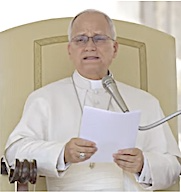
LEO XIV GENERAL AUDIENCE
St. Peter’s Square – Wednesday, September 9, 2026
A series of catecheses – Documents of the Second Vatican Council. IV.
Pastoral Constitution Gaudium et Spes (GS 12-22).
2. Human dignity – a gift and a responsibility
From the Book of Psalms (Psalm 8:2:5-7)
O Lord, our Lord, how wonderful is Thy name in all the earth!
What is a man that you remember about him,
What is the Son of Man that you care for him?
You made him not much smaller than the angels,
You crowned it with honor and glory.
You have given him authority over the works of Your hands,
You have put everything under His feet.
_______________________
Pope Leo’s Catechesis
Brothers and Sisters,
The conciliar constitution Gaudium et Spes, devotes the first chapter to the dignity of the human person.
It emphasizes that this dignity is the foundation and condition of the values most highly regarded today.
However, these values must not lose their connection to the divine source”, lest they succumb to possible distortions resulting from the “corruption of the human heart”.
The journey that revealed the fundamental dimensions of the human dignity and the fundamental rights that stem from it is one of the most significant chapters in human history.
However, this journey is not yet complete.
It must overcome the contradictions of the past and present that hinder the full realization of this dignity. (GS, 11).
The Church contributes to this matter by clearly recalling that human dignity stems from one’s very existence.
I also had the opportunity to reaffirm this in the recent Encyclical Magnifica Humanitas: “Every person … is intended and willed by God in order to enter into a history of communion with him, with others and with creation.
His dignity does not depend on the capacities he possesses, on the riches or the place he occupies, on the right or wrong choices he makes.
Rather, it is a gift that precedes and surpasses them.
It is offered by God as an expression of his love that never fails’,
The infinite dignity of mankind has its source in the fact that they are creatures made “in the image of God, capable of knowing and loving his Creator”.
It is a plan and a gift of love that elevates humans above the other creatures entrusted to their care Humans are meant to “govern and use them, glorifying God” (GS, 12).
In light of faith, we can grasp the ultimate basis of human dignity because the Son “reveals the mystery of the Father and of his love, fully revealing man to himself and his supreme vocation.” (ibid., 22).
Being a person always implies relationships, communion, and participation with God and other people.
Therefore, it implies a filial bond with God the Father and a fraternal bond with Christ and all people. It excludes self-isolation.
Being a person means seeing oneself as a gift to be shared and growing and maturing by welcoming others, practicing reciprocity, and serving.
Every human being has been entrusted with this dignity.
At the same time, it requires solidarity, mutual care, and overcoming the many falsifications and manipulations that continue to distort its understanding and hinder its realization.
Due to historical choices that undermine human dignity, even today, “man is divided within himself,” and “the whole life of human beings, whether individual or collective, turns out to be a dramatic struggle between good and evil, between light and darkness.”
However, despite this fragile and limited human condition, there is hope because “the Lord himself came to liberate and strengthen man, transforming him inwardly and casting out the ‘ruler of this world’ (Jn 12:31), who held him in bondage to sin.” (GS, 13).
Moreover, Gaudium et Spes, a document of the Second Vatican Council, states that human dignity embraces the whole person. Therefore, it is necessary to overcome dualistic notions; man is a “bodily and spiritual unity.”
Reducing the body to an “object” that can be disposed of at will denies the person’s dignity. Therefore, “man must not despise bodily life,” but rather, “he must consider his body, created by God and destined to be resurrected on the last day, as good and worthy of respect.”
Since we are all wounded by sin, we must also be vigilant that the flesh does not “give itself over to the evil inclinations of the heart.” (GS, 14).
Finally, Gaudium et Spes highlights three significant aspects of human dignity: reason, which makes humans tireless seekers of truth (ibid., n. 15); conscience, which gives meaning and unity to life (ibid., n. 16); and freedom, which makes humans responsible for their decisions (ibid., n. 17).
These dimensions are intimately linked.
It is in conscience that truth is recognized as truth and where freedom finds its foundation and space to flourish.
The Holy Spirit gives us life in Christ.
He frees us from fear and assures us of our dignity as children of God.
He leads us to our ultimate goal: the fullness of life after death that Christ promised us. Only in him is the mystery of humanity fully revealed; he gives us the light to understand the riddle of suffering and death, and with him, we move toward resurrection.
Dear brothers and sisters,
Created in the image of God and for Christ’s sake, we have received unique and inalienable dignity.
Let us always strive to promote and protect this dignity with the light and power of the Gospel.
_____________________________
Summary of the Holy Father’s catechesis
The first chapter of the conciliar constitution Gaudium et Spes is devoted to the dignity of the human person.
This dignity stems from the very existence of the person, who is intended and willed by God.
Created “in the image of God,” humans are capable of entering into communion with their Creator, with one another, and with creation.
This dignity is entrusted to every human being, who is a “physical and spiritual unity” (cf. GS 14).
The Holy Spirit enlightens our reason, conscience, and freedom, assuring us of our dignity as children of God.
The Holy Spirit frees us from fear and leads us to the fullness of life after death.