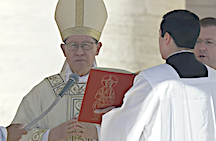
Pope Leo’s homily for the conclusion of the meeting
marking the 10th anniversary of “Amoris Laetitia (The Joy of Love)”
(The Homily was read by Cardinal Luis Antonio Tagle, (Dean of the College of Cardinals)St. Peter’s Square – Wednesday, October 14, 2026
“The joy of love experienced by families is also the joy of the church” (Pope Francis)
First Reading: 1 Corinthians 12:31 and 1 Corinthians 13:1-13
31 But I earnestly desire the higher gifts and I will show you a still more excellent way.
13 If I speak in the tongues of men and of angels, but have not love, I am a noisy gong or a clanging cymbal.
2 And if I have prophetic powers, and understand all mysteries and all knowledge, and if I have all faith, so as to remove mountains, but have not love, I am nothing.
3 If I give away all I have, and if I deliver my body to be burned, but have not love, I gain nothing.
4 Love is patient and kind; love is not jealous or boastful;
5 it is not arrogant or rude. Love does not insist on its own way; it is not irritable or resentful;
6 it does not rejoice at wrong but rejoices in the right.
7 Love bears all things, believes all things, hopes all things, endures all things.
8 Love never ends; as for prophecies, they will pass away; as for tongues, they will cease; as for knowledge, it will pass away.
9 For our knowledge is imperfect and our prophecy is imperfect;
10 but when the perfect comes, the imperfect will pass away.
11 When I was a child, I spoke like a child, I thought like a child, I reasoned like a child; when I became a man, I gave up childish ways.
12 For now we see in a mirror dimly, but then face to face. Now I know in part; then I shall understand fully, even as I have been fully understood.
13 So faith, hope, love abide, these three; but the greatest of these is love.
Gospel Reading John 15: 12-17
“This is my commandment, that you love one another as I have loved you.
13 Greater love has no man than this, that a man lay down his life for his friends.
14 You are my friends if you do what I command you.
15 No longer do I call you servants, for the servant does not know what his master is doing; but I have called you friends, for all that I have heard from my Father I have made known to you.
16 You did not choose me, but I chose you and appointed you that you should go and bear fruit and that your fruit should abide; so that whatever you ask the Father in my name, he may give it to you.
17 This I command you, to love one another
Pope Leo’s homily (read by Cardinal Luis Antonio Tagle, (Dean of the College of Cardinals )
Pope Francis said: “The joy of love experienced by families is also the joy of the church”,
With these words, ten years ago, Pope Francis began Amoris Laetitia. (March 19 , 2016).
Today, as we celebrate the Eucharist, we offer the Lord the fruits of our labor on this document.
We seek to embrace its wisdom and put its pastoral guidance into practice.
Today’s liturgy offers several points for reflection in this regard.
In the first reading, we heard Saint Paul’s “Hymn to Love” (1 Cor 12:31–13:13).
Chapter 4 of Amoris Laetitia, builds on this text to offer a rich meditation on the virtues of Christian marriage.
A Marriage is a union that is “affective… spiritual and sacrificial”, and an icon of god’s love.
By living out these values and with the help of grace, spouses grow together day by day in the image of the Trinity.
Spouses mature in their own ways and grow to resemble each other through their “stable commitment to share and shape together the whole of life”.
Thus, true marital joy is a gradual deepening of union in which each person’s uniqueness flourishes through self-giving and the presence of the other.
Moreover, the Apostle Paul was addressing a community that was rich in gifts and charisms, yet one that needed to mature in love.
He reminded the Corinthians that people without love, despite all the talents they may have, are like “a noisy gong or a clanging cymbal” (1 Cor. 13:1).
They are like a voice without love, unable to speak to the heart.
They are cut off from others; they are distant, cold, and impenetrable.
We were not made to live this way.
The responsorial psalm reminds us of this by calling us the “people” and “flock” of a God whose “steadfast love endures forever” and whose faithfulness extends “to all generations” (Psalm 100:5).
He is a Lord who loves us unconditionally, never ceasing to seek us, trust us, and renew his friendship with us.
Amoris Laetitia encourages us to base our families on this love.
We are urged to teach young people preparing for marriage about true love.
We must teach them “the importance of virtues,” especially chastity, which is “invaluable for the genuine growth in love “ (no. 206).
Marriage preparation programs conscientiously developed for this purpose in parishes and pastoral areas are commendable.
However, these courses alone are insufficient because they must be preceded and supported by an education in love that accompanies a person’s growth from childhood.
Regarding this matter, Pope Francis noted that “learning to love someone doesn’t happen automatically, nor can it be taught in a workshop right before a wedding”.
He explained: “For every couple, marriage preparation begins at birth,” adding that the experiences of young persons within the family should prepare them for “a full and definitive commitment.”.
In this way, love thrives within the family.
Families have their moments of struggle, mistakes, and failures, but they also experience the marvel of unpredictable everyday life.
Thus, the family becomes the primary school of human affection and the first precious, irreplaceable apprenticeship in the “joy of love.”
For this reason, we should recognize and support the efforts of the many families who live out their vocations and missions, day by day, often with heroic fidelity, without fanfare.
They bear generous and compelling witness to the words of Jesus that we heard in the Gospel. “You did not choose me, but I chose you.
And I appointed you to go and bear fruit, fruit that will last” (John 15:16).
Through the witness of parents, children, grandparents, and the young and elderly, the Gospel’s message of truth and fullness of life reaches the world.
The evangelist John passed on the simple and clear instruction that Jesus gave at the end of his earthly life: “This is my commandment, that you love one another as I have loved you” (John 15:12).
Let us put this commandment into practice, so that we may grow as a church that is a “family of families” (Amoris Laetitia, no. 87), in an atmosphere of mutual care that benefits us all.
Young couples will feel encouraged as they begin their married lives; parents will find support as they face the demanding challenges of raising their children and managing family life; and older people will be recognized and valued for their wisdom and virtue, even as their physical strength wanes.
Those who are more vulnerable, or who are experiencing difficult circumstances or moments of crisis, will also find support and encouragement.
They will be surrounded by affection and shielded from judgment and prejudice.
Let us remember that “as wounded as the family may be, it can always grow beginning with love” (14th Ordinary General Assembly of the Synod of Bishops, Relatio Finalis, 10).
The values of openness to life and respect for life, from conception to natural death, are also rooted in this charity, which is fundamental to our existence and to our life together as human beings.
The family is the foremost guardian of these values and a beacon for the good of humanity.
Pope Francis emphasized this point in Amoris Laetitia, stating that “no union that is temporary or closed to the transmission of life can ensure the future of society”.
Without strong families open to the gift of children and attentive to their education and growth, the world has no future.
In the readings we have heard, Jesus invites us to ask the Father “in my name”
(John 15:16).
These words remind us that the family is a privileged place of prayer.
But sadly, in many parts of the world today, the practice of praying together at home — before meals, at the beginning and end of the day, or on special occasions — has fallen away.
Amoris Laetitia reminds us that “emphasis should also be given to the importance of family spirituality, prayer and participation in the Sunday Eucharist” (no.223).
It likewise recommends that families gather regularly to promote growth in their spiritual lives and solidarity in life’s challenges.
Common prayer and the sacraments play a vital role in family life because they open hearts to God’s action, enabling families to reach places together that they could never reach alone.
Indeed, prayer and the sacraments are solid nourishment and healing medicine.
Therefore, I strongly urge everyone to rediscover and encourage these practices.
Dear brothers and sisters,
I have the honor of presiding over this celebration by a special mandate from His Holiness, Pope Leo XIV.
This is to publicly manifest the ecclesiastical communion that he has granted to His Beatitude, Paul III Nona, the Chaldean Patriarch of Babylon, who is participating in this Eucharist.
A patriarch’s communion with the Successor of Peter recalls an ancient practice that affirmed unity in faith and charity between the Patriarchal Church and the See of Rome, as well as among the churches themselves at that time.
This is therefore not a mere formality, but rather a living reality that stems from Eucharistic communion, the source and summit of the Church’s unity in Christ.
Your Beatitude,
Your presence helps us to better understand our identity as the Church, a communion of churches of various rites and traditions united in Christ, the Lord, and expressed tangibly with the Successor of Peter.
We assure you of the affection and prayers of the entire Catholic Church for the faithful entrusted to your pastoral care. They have been tested for a long time, yet they remain steadfast and often heroic in bearing witness to their faith in Jesus amid many adversities.
Dear brothers and sisters,
Let us entrust all families and the entire church to the Holy Family of Nazareth
Once again, let us take up the prayer with which Pope Francis concluded Amoris Laetitia.
Holy Family of Nazareth,
Grant that our families may also be places of communion and prayer,
authentic schools of the Gospel and small domestic churches…
May families never again experience violence, rejection or division;
May all who have been hurt or scandalized find swift comfort and healing…
Make us mindful, once more, of the sacredness and inviolability of the family, and its beauty in God’s plan.
Jesus, Mary and Joseph, graciously hear our prayer. Amen.