 0
0
 0
0
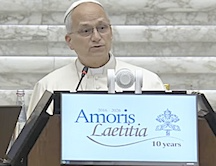
Pope Leo’s opening address to the meeting with the heads of Eastern Churches and the Presidents of Episcopal Conferences
Paul VI Audience Hall –Wednesday, 7 October 2026
“Proclaiming the Gospel with Families today- Ten Years after Amoris Laetitia“
My dear Brothers in the Episcopate,
Dear families,
Dear brothers and sisters,
I wished to convene this meeting ten years after the publication of Amoris Laetitia.
I would like to express my sincere gratitude to the married couples and everyone who has come to share their experiences in Christ and participate in our discussions.
I would also like to thank the experts and facilitators.
Let me begin by recalling the long and fruitful synodal and missionary journey that the Church has undertaken concerning marriage and the family.
It is a journey that we are called to continue.
The family has always held a special place in the pastoral concerns of the Successor of Peter and the bishops who assist him through the Synod of Bishops.
The 1980 Synod addressed a desire already expressed by Pope John Paul during his brief pontificate, which eventually led to Saint John Paul II’s apostolic exhortation Familiaris Consortio.
At the beginning of his pontificate, Pope Francis placed the family at the heart of a synodal process once again, recognizing the need for the Church to continue discerning in the face of profound changes affecting an area closely linked to her mission today.
This journey culminated ten years ago in the Apostolic Exhortation Amoris Laetitia.
In this regard, the Church has continued along the path indicated by the Second Vatican Council.
When the Council Fathers placed the dignity of marriage and the family at the beginning of the second part of Gaudium et Spes, they acknowledged that family life provides an ideal entryway into significant cultural, economic, social, and political issues of our time, including the promotion of peace among nations.
The interdependence of these issues is even more evident today in light of God’s word: “God made them male and female”
For this reason, a man shall leave his father and mother and be joined to his wife” (Mark 10:6-7).
The family remains key to an approach that connects the local and the global. This approach is guided by the search for universal fraternity in Christ, which the Gospel calls us to build with everyone.
The history of the past half-century places a particular responsibility on our meeting as shepherds, as the synodal vocation of the entire Church continues to unfold.
Amoris Laetitia marked an important stage within this history, and the ten years since its publication have become part of the life of our particular churches.
During this time, the apostolic exhortation has been received in different cultures and pastoral contexts.
It has accompanied the lives of families and inspired initiatives and processes.
We now bring these ten years together before the Lord Jesus.
With the guidance of the Holy Spirit, reflecting on what has happened can help us more deeply recognize what Christ has been teaching his Church over the years.
The Acts of the Apostles provides a fitting image for what we are about to do.
At the end of their missionary journey, Paul and Barnabas gathered the church together and declared all that God had done with them, and how he had opened a door of faith to the Gentiles (Acts 14:27).
Later, on their way to Jerusalem, they passed through Phoenicia and Samaria, recounting what had happened on their mission.
Their account brought great joy to the brothers and sisters.
When they came to Jerusalem, they were welcomed by the church and the apostles and the elders, and they declared all that God had done with them. (Acts 15:4).
There is something of this movement in our own gathering.
As I have said, the Church has spent these ten years receiving Amoris Laetitia and walking with families in very different circumstances.
These are stories gathered along the path of our mission.
They are stories of conversion, unexpected fruit, and the relationships God has woven within families as we have sought to accompany them.
They also include the difficulties we have faced, the questions that have emerged, and what we have learned along the way.
These stories give us confidence as we begin our work together.
Let us bring them before the Lord and share them with one another.
In doing so, we will recognize what God has been doing among us and where his Spirit is leading the Church today.
In my message on March 19th, on the tenth anniversary of Amoris Laetitia, I recalled that “there are places and circumstances in which the Church ‘can only become the salt of the earth’ through the lay faithful and, particularly, through families.”
Indeed, Amoris Laetitia encourages us to embrace this vocation and responsibility.
Families participate in the Church’s mission through the ordinary fabric of their lives: love and fidelity, care and forgiveness, educating children, transmitting faith, attending to the elderly and vulnerable, and serving their communities and society.
Through these actions, families bear witness to the Gospel and contribute to the life and mission of the Church.
As pastors, we are responsible for proclaiming the beauty of God’s plan for marriage and the family, as well as his call for love and tenderness, in season and out of season.
This calls us to support people as they strive to fulfill their vocations amidst the realities of their lives.
This ministry places us in a school of listening.
The wisdom of the People of God reaches us through our shared faith, which illuminates all families, even those facing difficulties, loneliness, and apparent failure.
When we take the time to listen, the Lord himself patiently teaches us, and we certainly have much to learn from families.
Their lives present us with questions that deserve courageous answers. In many contexts, a growing distance has emerged between how sex and intimacy are experienced and the Christian vision of marriage.
Young people still long for love, fidelity, and belonging.
Yet, many struggle to envision how such a vision of love can manifest in their lives.
They also find it difficult to believe that a lifelong commitment is necessary to achieve their desires.
Economic insecurity, migration, violence, loneliness, and other forms of emotional fragility also influence the choices people make and the possibilities they envision for their future.
These realities raise a number of questions that we must courageously face.
What are people truly seeking beneath these cultural changes?
What do their joys, hopes, griefs, and anxieties reveal to us?
In which areas do our pastoral language and practices succeed in opening a path, and in which areas do they fail to touch people’s hearts or assist them in doing what is good?
What can we learn from the lived experience of families — an experience from which we have not yet fully learned?
What can we offer to promote healthy and holy family life?
In particular, what can we learn from parents who are trying to support their children and young adults in these situations?
Fragility deserves special attention because it can profoundly impact how people view themselves, their future, and their relationship with God and the Church.
Experiencing fragility raises the question of whether we can remain close to one another when life no longer aligns with our hopes, and if we can recognize grace in situations marked by limitations, wounds, and apparent failure.
In this respect, too, families’ experiences have something to teach us all, since fragility is part of our shared human condition and thus part of the life of the Church as well.
We are all familiar with the difference between what we want and what we are able to achieve.
To accomplish God’s will, we need grace, forgiveness, and new beginnings. We learn that fidelity is a grace to be received and a path to be gradually renewed, often through trial.
Recognizing this shared challenge should influence how we support one another within the Church.
What kind of church do people encounter when they are most fragile?
Do our communities help them discover that they have a place and a responsibility, and that they have gifts to offer?
Can people encounter the truth we proclaim through the patience, closeness, and mercy of our pastoral presence?
How can we share the fullness of the Gospel’s teachings about the family with them?
During these days, I invite you to consider such questions fully.
The Holy Spirit often speaks through the situations that challenge us and enlightens us so that we may discover how God’s mercy and Christ’s salvific grace can reach our families today. This is particularly true in moments of weakness and resilience, hope and disappointment, longing for communion, and search for meaning.
Therefore, our task is not only to interpret these realities, but also to allow them to inspire our pastoral responsibility. In this way, the Church can find new ways to proclaim the Gospel, offer sacramental graces, accompany families, and demonstrate the tenderness with which Christ continues to walk among his people.
May our dialogue be marked by the evangelical freedom seen in the Acts of the Apostles.
We can share what has brought us joy in our churches, what has challenged us, and the questions that have become clearer through experience.
Furthermore, our diverse backgrounds can contribute to the discernment of the entire Church
The Thematic Framework prepared for this meeting aims to maintain the scope of Amoris Laetitia and facilitate a dialogue between the Apostolic Exhortation and the experiences of our churches over the past ten years.
Let us draw inspiration from the richness of Christ’s words and the Church’s traditions.
We have made the program public so that the People of God may accompany our work through prayer and synodal reflection.
On our end, listening to one another, allowing what we hear to resonate within us, and paying attention to the promptings of the Holy Spirit can awaken the pastoral creativity we need when faced with new questions.
This is why our common retreat this evening and our daily prayers are at the heart of our work.
I ask the Lord to help us gather the fruits that Amoris Laetitia has borne in our local churches so they may nourish the entire Church.
Through the many stories you bring from your churches and different cultural contexts, I hope a shared narrative of these past ten years will gradually take shape. This narrative should be marked by joy and hope and enable us to face the remaining trials and difficulties honestly.
This shared narrative will nourish the pastoral discernment of Episcopal conferences and the hierarchical structures of Eastern churches.
Likewise, it will help local churches recognize new paths and draw all the baptized more deeply into the church’s synodal journey.
I ask that we all preserve the discretion and confidentiality this time of listening and discernment requires.
May the Lord grant us the freedom to listen to one another, the wisdom to recognize his work among his people, and the courage to follow wherever he leads us. May the Gospel become ever more fully good news for families throughout the world each day. Thank you.


