 0
0
 0
0
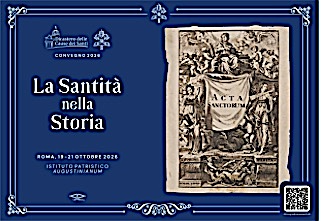
Pope Leo’s address to Participants in the Study Conference:
“The 21st Century: A New Time of Martyrs?”,
organized by the Dicastery for the Causes of Saints
Clementine Hall – Wednesday, 16 September 2026
This year the conference analyzed the theme of “Holiness in history”.
The conference featured contributions from renowned academics and experts that are useful for those dedicated to studying and teaching the Causes of Saints
In the name of the Father, of the Son and of the Spirit.
Peace be with you!
Pope Leo’s Address
Your Eminence, dear brothers and sisters,
I am pleased to welcome you at the conclusion of the conference “The 21st Century: A New Time of Martyrs?”, organized by the Dicastery for the Causes of Saints and the Commission for New Martyrs – Witnesses of the Faith.
The term “New Martyrs – Witnesses of the Faith” indicates a broader category than the martyrs whose cause for beatification is underway or those officially registered in the catalog of Blesseds and Saints.
Established by Pope Francis in 2023, the Commission aims to collect testimonies of individuals who lost their lives for Christ, regardless of the canonical process, to ensure their legacy is not forgotten.
They are brothers and sisters who, despite different geographical, historical, and political contexts, gave their lives for the Gospel.
They remind us of the words of the risen Lord during his final appearance before ascending into heaven: “You will receive power when the Holy Spirit comes upon you, and you will be my witnesses in Jerusalem, in all Judea and Samaria, and to the ends of the earth”
(Acts of the Apostles 1:8).
Their example shows us that in our time, which is dominated by a culture of power, limitless strength, and the constant development of weapons systems, we see the heroism of those whom we call “new witnesses to the faith.”
Many of them are killed by criminal organizations or for abuse of power because they oppose injustices in the name of the Gospel as Christians.
The concept of “witness of the faith” was formulated to acknowledge and honor complex historical situations in which the executioners’ motivations are not explicitly attributable to “hatred of the faith.”
From this perspective, the work of the Commission for New Martyrs — Witnesses of the Faith, supported by the Dicastery for the Causes of Saints, is historiographical and popular rather than juridical. It focuses on the dispositions of the victims rather than the motivations of the persecutors.
In other words, it examines how the victim remained faithful to Christ and fulfilled his evangelical commitment until death.
Jesus himself foretold this at the Last Supper.
“You will have tribulations in this world but take courage: I have overcome the world!”
(John 16:33).
These witnesses of faith demonstrate that perseverance in goodness and fidelity to the point of supreme self-sacrifice in love draw strength from the Lamb’s victory over evil.
This victory is the only certainty capable of offering profound peace to believers.
In them, the Christian’s heroic style is manifested.
They never seek opposition but rather defuse it with the effectiveness of meekness.
As Pope Francis wrote, “The disciple knows how to offer his whole life and play it out to the point of martyrdom as a witness to Jesus Christ.
However his dream is not to be surrounded by enemies.
Rather he dreams that the Word will be accepted and manifest its liberating and renewing power.”
(Evangelii Gaudium, 24).
According to the famous affirmation of Saint Paul VI in the Apostolic Exhortation Evangelii Nuntiandi, the evangelizing power of the new witnesses to the faith represents one of the Church’s greatest resources for proclaiming the Gospel in today’s world.
“Modern man listens more willingly to witnesses than to teachers, […] or if he listens to teachers, it is only because they are witnesses” (n. 41).
Witnesses to the faith do not propose an ideology; rather, they demonstrate a faith lived out in everyday life. Their credibility stems from the consistency between their words and actions, which is often carried to the point of supreme sacrifice. In indifferent cultural contexts, “holiness next door” and silent heroism are significant arguments capable of challenging even the most distrustful.
Dear friends,
We admire our brothers and sisters as stars that shine in the darkness of selfishness and oppression.
They help the Church reflect the light of Christ more fully, showing contemporary humanity the path to a civilization of love.
We are all called to contribute to this commitment and hope. (Encyclical Letter Evangelii Gaudium (The Joy of the Gospel), n. 185; Magnificat humanitas (Magnificent Humanity).
By giving their lives for justice, truth, peace, and freedom, witnesses to the faith have effectively contributed to the coming of the new heavens and the new earth, which we confidently await from God’s mercy.
I thank you for your dedication to this valuable service, and I hope your days of study and discussion are fruitful.
May the intercession of Mary, Queen of Martyrs, obtain this for you.
May you be accompanied by the apostolic blessing that I cordially impart to all of you.


