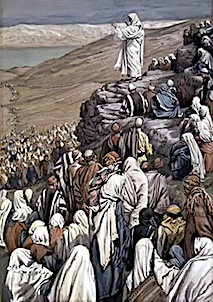
Illustration: James Tissot, The Beatitudes Sermon, c. 1890, Brooklyn Museum
Pope Leo’s Angelus Reflection for Solemnity of All Saints
St Peter’s Square – Sunday, 25 October 2026
[Sunday Gospel: Matthew 5:1-12
Seeing the crowds, Jesus went up the hill.
There he sat down and was joined by his disciples. Then he began to speak.
This is what he taught them:
“Blessed are the poor in spirit, for theirs is the kingdom of heaven.
4 Blessed are those who mourn, for they will be comforted.
5 Blessed are the meek, for they will inherit the earth.
6 Blessed are those who hunger and thirst for righteousness, for they will be filled.
7 Blessed are the merciful, for they will be shown mercy.
8 Blessed are the pure in heart, for they will see God.
9 Blessed are the peacemakers, for they will be called children of God.
10 Blessed are those who are persecuted because of righteousness, for theirs is the kingdom of heaven.
11 “Blessed are you when people insult you, persecute you and falsely say all kinds of evil against you because of me.
12 Rejoice and be glad, because great is your reward in heaven
Pope Leo’s Angelus Reflection,
Dear brothers and sisters,
The Solemnity of All Saints invites us to savor the joy of the countless men and women who followed the Lord Jesus, made their lives a gift to God and neighbor and, in the different paths of sanctification, longed for “the ocean of infinite love”, according to a beautiful expression of Pope Benedict XVI –
It would be like plunging into an ocean of infinite love, a moment in which the before and after no longer exist. (See Encyclical Letter, n. Spe Salvi, 12 in Footnote below).
The Liturgy of the Word for this feast describes them to us as a “great multitude, numbered by no one, from every nation, kindred, people, and tongue” (Revelations 7:9).
Today, we celebrate all saints, both those recognized by the Church and those whom God knows but who have not been canonized.
As today’s Gospel reminds us, they are poor in spirit but rich in God’s love.
Their faces are streaked with tears, yet they find consolation in prayer.
They are meek in the face of violence and are rewarded by the Father.
They hunger for justice and find satisfaction in their consciences.
They are open to forgiveness and embraced by mercy.
They are unarmed in heart, yet guarded by God.
They are builders of peace, called by name by God.
They are persecuted and offended but strong in faith and charity.
It is truly true that it is impossible to “count” the ranks of these brothers and sisters, and not only numerically: but in terms of holiness as well.
Holiness cannot be reduced to any calculation, because it is the goodness that all the saints have spread throughout the world.
When we look at them with admiration, we ask ourselves, “What have these people generated with God’s grace?”
Essentially, they have generated gestures and choices of love that transcend the calculations of greed and the arrogance of evil, which sometimes seems to prevail.
The saints are the strongest and most beautiful sign of the coming Kingdom of God. Indeed, as Jesus teaches, the Kingdom of God is already among us.
(see Luke 17:20-21– Being asked by the Pharisees when the kingdom of God was coming, he answered them, “The kingdom of God is not coming with signs to be observed; nor will they say, ‘Lo, here it is!’ or ‘There!’ for behold, the kingdom of God is in the midst of you.”).
Moreover, this blessed multitude embraces people from the most diverse backgrounds, cultures, and life situations.
Holiness is not a privilege for the few, but rather a universal vocation that challenges each of us, no matter where we live.
This is the hopeful message of today’s feast.
God sees the good that we cannot see.
He knows stories that we do not know.
He reaches hearts to which we cannot access.
May the Virgin Mary, who was blessed because she believed in the word of the Lord, accompany us on our journey toward holiness.
May she give us the strength to build peace in the most important situations and in our everyday lives.Footnote: 12. Encyclical Letter, n. Spe Salvi, – 12 in full
In this precise and enduring manner, I believe Augustine is describing the fundamental human condition, which gives rise to all our contradictions and aspirations.
We want life itself—true life, untouched by death—yet we don’t know what drives us. We cannot st
op reaching for it, yet we know that what we experience or accomplish is not what we yearn for.
This unknown “thing” is the true “hope” that drives us. At the same time, the fact that it is unknown causes all forms of despair, as well as all efforts, whether positive or destructive, directed toward worldly and human authenticity.
The term “eternal life” attempts to name this known “unknown.”
It is inevitably an inadequate term that creates confusion.
“Eternal” suggests the idea of something interminable, which frightens us. “Life” makes us think of the life we know, love, and do not want to lose, even though it often brings more toil than satisfaction. Thus, while we desire it, we also do not want it.
We can only attempt to imagine ourselves outside the temporality that imprisons us, sensing that eternity is not an unending succession of days on a calendar but rather a supreme moment of satisfaction in which totality embraces us and we embrace totality. It would be like plunging into an ocean of infinite love, a moment in which the before and after no longer exist