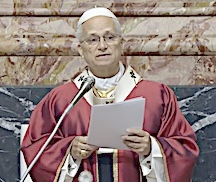
Pope Leo’s Catechesis
Saint Peter’s Square – Wednesday, 4 November 2026
Catechesis. The Documents of the Second Vatican Council. IV.
Constitution Gaudium et Spes. (translated “Joy and Hope”)
8. Faith and social life, political life, and economic life
(GS, 63–76)
Scripture Reading: 1 Peter 2:12-17
12 Maintain good conduct among the Gentiles, so that in case they speak against you as wrongdoers, they may see your good deeds and glorify God on the day of visitation.
13 Be subject for the Lord’s sake to every human institution, whether it be to the emperor as supreme, 14 or to governors as sent by him to punish those who do wrong and to praise those who do right. 15 For it is God’s will that by doing right you should put to silence the ignorance of foolish men. 16 Live as free men, yet without using your freedom as a pretext for evil; but live as servants of God. 17 Honor all men. Love the brotherhood. Fear God. Honor the emperor.
Pope Leo’s Catechesis,
Dear brothers and sisters,
The social dimension of the church is an integral part of both human nature and our faith in Christ Jesus.
It is the precious legacy we receive from the Incarnation of the Son of God.
The constitution Gaudium et Spes (GS) acknowledges this in Chapters III and IV of Part II, which address economic and social life, as well as the life of the political community. In these areas, too, the Christian faith provides criteria for discernment.
First, the Council fathers emphasize the threat to world peace posed by imbalances resulting from unequal and unsustainable economic development. (GS, 63).
This was a far-sighted vision that unfortunately became reality towards the end of the last century and is even more evident today.
To correct this course, the document warns that technical progress alone is insufficient. Rather, it states that “many reforms in the socioeconomic realm, as well as a change in mentality and attitude, are required of all.” (GS, 63).
Therefore, Gaudium et Spes summarizes the Christian vision of economic development: stating that it must always serve and be controlled by humankind. (GS, 64–65).
Therefore, Gaudium et Spes summarizes the Christian vision of economic development, stating that it must always serve and be under the control of humankind. (1967).
Calls to eliminate discrimination against the most vulnerable social groups and migrants are more relevant than ever. (GS, 66).
Work is at the heart of the economy.
Through work, one can develop personally, provide for one’s family, express one’s talents, participate in social life, and help build a better world by collaborating with God’s creative work.
Work should never be distorted in a way that harms people, the common good, or creation.
The real challenge lies in providing everyone with opportunities to maximize their potential. Unemployment, exploitation, and dangerous working conditions are unacceptable. (GS, 67).
Workers have the right and duty to participate in decisions that affect their work.
They can do so through trade unions by resolving conflicts through dialogue and nonviolent action. (GS, 68).
In this context, the Council applies one of the fundamental principles of social teaching, namely the universal destination of earthly goods (GS, 69) and to the financial sphere, stating that “whoever makes decisions concerning these investments and the planning of the economy – whether they be individuals or groups of public authorities – are bound … to recognize their serious obligation of watching, on the one hand, that provision be made for the necessities required for a decent life both of individuals and of the whole community and, on the other, of looking out for the future and of establishing a right balance between the needs of present-day consumption, both individual and collective, and the demands of investing for the generation to come” (GS, 70).
Then, Gaudium et Spes goes on to discuss the political community, noting several positive developments in the contemporary era.
Above all , it highlights the fact that “the present keener sense of human dignity has given rise in many parts of the world to attempts to bring about a politico-juridical order which will give better protection to the rights of the person in public life” (GS, 73).
The political community exists for the sake of the common good, which consists of “the sum of those conditions of the social life whereby men, families and associations more adequately and readily may attain their own perfection” (GS, 74).
Political authority should always be exercised for the common good. This good must be structured and operated according to local and historical circumstances while keeping the well-being of the entire human family in mind.. (GS, 74}
Gaudium et Spes reiterates that “the Church and the political community in their own fields are autonomous and independent from each other. Yet both, under different titles, are devoted to the personal and social vocation of the same men. The more that both foster sounder cooperation between themselves with due consideration for the circumstances of time and place, the more effective will their service be exercised for the good of all” (GS, 76).
One way to build peace is to engage in economic and political life according to these criteria.
As Pope Francis recalled, “war is a failure of politics and of humanity, a shameful capitulation, a stinging defeat before the forces of evil” (Encyclical Letter Fratelli tutti, 261).
On the contrary, politics that address people’s needs and the injustices they have suffered offer hope for humanity’s future.
For this reason, I encourage young people to follow the examples set by the faithful men and women who have worked in these fields.
I also renew my call to Christian communities to revive their education in the Church’s social doctrine.
Summary
Dear brothers and sisters,
In our ongoing catechesis on the Second Vatican Council’s Pastoral Constitution Gaudium et Spes, today, we reflect on the social dimension of humanity.
This dimension is integral in both our human nature, and our faith in Christ.
Chapters III and IV of Part II focus on socioeconomic life and the political community, with a particular emphasis on the theme of peace
From this perspective, the Council Fathers presented the Catholic vision of economic development, placing work at its center.
Here, the Council recalls a fundamental principle of Catholic social doctrine: the universal destination of goods.
The Council then turns to the political community, which exists for the sake of the common good, regardless of its historical form.
The exercise of civil authority must aim to promote the common good.