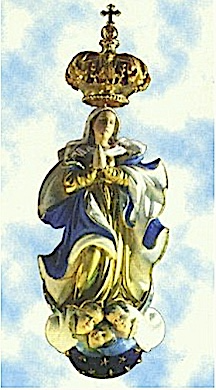
Pope Leo’s Sunday Homily for the land of Uruguay
Cathedral Basilica of Florida, National Shrine of Our Lady of the Thirty-Three (Florida)
Sunday, 8 November 2026
READING (Judith 15:8-10)
Joakim the high priest, and the senate of the people of Israel who lived at Jerusalem, came to witness the good things which the Lord had done for Israel, and to see Judith and to greet her. And when they met her they all blessed her with one accord and said to her, “You are the exaltation of Jerusalem, you are the great glory of Israel, you are the great pride of our nation!
You have done all this singlehanded; you have done great good to Israel, and God is well pleased with it. May the Almighty Lord bless you forever!” And all the people said, “So be it!”
SECOND READING (1 Timothy 2:1-6)
I urge that supplications, prayers, intercessions, and thanksgivings be made for all men, for kings and all who are in high positions, that we may lead a quiet and peaceable life, godly and respectful in every way. This is good, and it is acceptable in the sight of God our Savior, who desires all men to be saved and to come to the knowledge of the truth. For there is one God, and there is one mediator between God and men, the man Christ Jesus, who gave himself as a ransom for all, the testimony to which was borne at the proper time.
GOSPEL (Luke 1:39-47)
Mary arose and went with haste into the hill country, to a city of Judah, and she entered the house of Zechariah and greeted Elizabeth. And when Elizabeth heard the greeting of Mary, the babe leaped in her womb; and Elizabeth was filled with the Holy Spirit and she exclaimed with a loud cry, “Blessed are you among women, and blessed is the fruit of your womb! And why is this granted me, that the mother of my Lord should come to me? For behold, when the voice of your greeting came to my ears, the babe in my womb leaped for joy. And blessed is she who believed that there would be[a] a fulfilment of what was spoken to her from the Lord.” And Mary said,
My soul magnifies the Lord, 47 and my spirit rejoices in God my Savior,
Pope Leo’s Homily,
Dear brothers and sisters of this land of Uruguay,
I am here with you today with great enthusiasm, standing next to ‘Our Lady of the Thirty-Three’.
As a pilgrim, I have come to share in the faith and the tenderness with which the Uruguayan people have viewed the mother of God for generations.
To those who have come from different places, to those who have been making the pilgrimage here for years, and to those who are visiting for the first time today, I say:
“I embrace all of you with affection and entrust you to Mary’s protection”.
Today, we are introduced to two women from different eras who received the same blessing from the Word of God.
After her people were liberated, Judith was told, “Daughter, you are blessed by the Most High God above all other women on earth” (Judith 13:18).
Centuries later, Elizabeth welcomes Mary into her home and exclaims: “Blessed are you among women!” (Luke 1:42).
The Christian tradition recognized this connection very early on.
In the Book of Judith, she is portrayed as a woman who did not allow who did not allow fear to overcome her during a difficult time for her people.
Through prayer and fasting, she made a decision that led her to risk her own life.
When victory came, Judith did not take credit for it because she knew who had saved Israel. She said: “Begin a song to my God with tambourines; sing to my Lord with cymbals” (Judg. 16:1).
This explains why her people welcomed her with such majestic words: “You are the glory of Jerusalem, the great boast of Israel, the great pride of our nation!” (Judith. 15:9).
The people celebrated what God had done for them through her.
Hearing these words today, before the patron saint of this country, has a special significance.
This small image is linked to a pivotal moment in Uruguayan history.
In 1825, those fighting for the freedom of this land also turned to Mary, placing their efforts under her protection.
This gesture reminds us that the history of a people cannot be fully understood without reference to God.
Thus, since the nation’s earliest days, Uruguay has been closely tied to a mother figure. Since then, generations have come and gone and circumstances have changed – including the relationship of many Uruguayans to their faith.
Yet she has remained.
As Mary accompanied this people throughout their history, other women in many homes preserved the faith and passed it on to their children.
I think of the mothers who taught their children their first prayers, brought them to be baptized, prepared them to receive the sacraments, and instilled in them Christian charity.
I think of the grandmothers who maintained home altars, prayed for the living and the deceased, and brought God into ordinary life events.
Even in the early days of the Church, we find something similar.
The Apostle Paul fondly recalled that Timothy’s faith was rooted in two women: his grandmother Lois and his mother Eunice.
It was in them that “sincere faith” first took root, a faith that Paul also recognized in Timothy. Scripture tells us little about these women.
However, we know that Timothy, who would become a close collaborator of Saint Paul, was shaped by the faith he learned at home (Acts 16:1-3 — “Paul came also to Derbe and to Lystra. There was a disciple named Timothy, the son of a Jewish believer, but his father was Greek. He was highly regarded by the brethren in Lystra and Iconium. Paul wanted Timothy to accompany him, so he circumcised him because of the Jews in those places. They all knew that his father was a Greek”.
The history of faith in this land is also inscribed with the names of women.
One of them is Saint María Francisca Rubatto, who chose to stay here and serve the most vulnerable among you.
There are also the Blessed Martyrs Dolores and Consuelo Aguiar-Mella, two sisters born in Montevideo.
Though their lives were very different, all three are supreme examples of faithfulness.
Yet, much of the country’s history of faith was never written down in books.
However, it was quietly passed down from generation to generation within families.
When we wonder where our faith comes from, we often think of a specific woman
– either a mother, a grand-mother,a godmother, a religious sister, or a catechist.
We may not remember every word they said, but we remember how they prayed, how they spoke of the Lord, and how they lived out what they taught us with conviction.
Today I would like to thank all of those women.
Thank you for believing and keeping an open path to God for so many families.
Some were able to do so with the support of a long-standing family tradition, while others had to sustain their faith through greater effort, often without finding understanding or support within their own homes.
I know many of you carry a particular sorrow.
You taught your children to pray, yet today, they no longer do so.
You used to attend Mass together, yet it has been years since they have entered a church. You spoke to your grandchildren about God, and now you wonder if your words made an impact.
Sometimes you wonder if you did something wrong or if it was all futile.
Allow me to tell you about St. Monica, who experienced that pain.
She prayed for years for a son who seemed to be drifting further from God.
Yet she never stopped trusting in His grace.
Therefore, do not consider what you have sown to be lost. The Lord himself taught us that the seed can grow without the sower of seed knowing how! (cf. Mark 4:27).
Mothers and grandmothers: never tire of passing on the faith!
Preach with your lives as well as with your words.
Emphasize prayer, love, and hope in all circumstances.
(2 Timothy 4:2 – Preach the Word, be urgent in season and out of season, convince, rebuke, and exhort, be unfailing in patience and in teaching.).
Do so with patience, without harshness or discouragement.
Even if your loved ones seem far from God, continue to bring them before Him.
Never stop blessing them, accompanying them, and simply reminding them of what they once received. There are doors that you cannot open, but God can.
I would also like to address the men in the cathedral — including the fathers and grandfathers.
It is important for your children and grandchildren to see that faith plays a genuine role in the lives of the men in your family.
Follow Saint Joseph’s example.
He raised Jesus, brought him to the temple, taught him to work honestly, and showed him that God must come first in a person’s life.
Dear fathers and grandfathers, young people need to see you pray, receive the sacraments, treat your wives with respect, ask for forgiveness, and live with integrity, even when it requires sacrifice.
Children learn a great deal by seeing their father kneel before God and knowing he is no less of a man for doing so.
The Scriptures called on God’s people to keep His Words in their hearts, to teach them to their children and to speak of them “when you are at home and when you are away, when you lie down and when you rise” (Deuteronomy 6:7).
God was central to conversation, decision-making and daily family life.
Through this, children learned that the faith they received from their parents was also what their parents lived by.
Similarly, today, bishops, priests and consecrated persons are also called to support families in this task, by generously exercising their spiritual fatherhood and motherhood.
They can support those who falter and can help many rediscover the path to God.
Passing on the faith means introducing others to Christ, as we have encountered him ourselves.
Mary shows us precisely how to do this.
In the Gospel, Elizabeth welcomes her exclaiming: “Blessed are you among women, and blessed is the fruit of your womb” (Luke 1:42).
Mary does not keep that praise to herself.
When Elizabeth proclaims her blessed, Mary responds by singing of the Lord’s greatness.
At Cana, when others turn to her for help,, she directs them to her Son:
“His mother said to the servants, “Do whatever he tells you.” (John 2:5).
In the second reading, Saint Paul explicitly states a truth that that is proclaimed throughout Mary’s life: “There is one God and one mediator between God and humanity, Christ Jesus, himself who is human” (1 Timothy 2:5).
Mary’s greatness stems from her relationship with Christ.
She welcomes him, lives by him, and leads others to him.
An encounter with the Master is the goal of all evangelization and of all authentic Marian devotion.
The Son of God gave himself up for all, so no one can be excluded from the Church’s prayers.
This is why Saint Paul asks us to pray “for kings and all who are in high positions” (1 Timothy 2:2) and for everyone, because God “desires everyone to be saved.” (1 Timothy 2:4).
On this feast day honoring Uruguay’s patron saint, let us present the Uruguayan people to the Lord.
Let us pray for our leaders, so that they may govern with integrity and seek the well-being of all.
Let us pray for families, young people, the suffering, those who feel distant from God, and those in need of a spiritual renewal.
On this feast day honoring the patron saint of Uruguay, let us present the entire Uruguayan people before the Lord.
Let us pray for our leaders, so they may govern with integrity and seek the well-being of all.
Let us pray for families, young people, the suffering, those who feel far from God, and those who need to return to Him and change their lives.
Saint Luke shows us how that mission begins.
After conceiving the Son of God, Mary “set out and went with haste” (1:39).
Instead of waiting for Elizabeth to come to her, Mary goes out to meet her and enters her home, bringing the Lord with her.
There, the child leaps for joy and Elizabeth is filled with the Holy Spirit.
Mary’s actions also point the way for us.
We cannot always wait for those who have strayed to return on their own.
People of Uruguay, you must set out on the journey!
Enter people’s homes.
Draw near to them.
Listen to their questions.
Bring them to Christ!
Each of you knows someone toward whom you need to take that step: a child, a friend, a neighbor, or someone who stopped believing long ago or never had anyone close to them to speak to them about God.
May the Queen of Heaven support those who continue to spread the faith.
May she teach us to recognize Christ in the poor, the sick, and the lonely.
May she also teach us to bring him to places where he is not yet known.
I will soon place the Golden Rose before this image.
Through this gesture, I wish to honor the one who is truly “the great pride of our nation” (Judeth 15:9) and to demonstrate the fulfillment of her own words: “All generations will call me blessed” (Luke 1:48).
I consecrate this nation anew to Mary, commander and guide of this people,
I consecrate this nation anew.
I entrust this land and all who live in it to her protection.
Through her powerful intercession, I implore God to thwart the works of the evil one and preserve beloved Uruguay from anything that might lead it away from Christ.
May this golden rose, offered as a sign of veneration and filial love, remind her children that they are called to imitate her by loving and sharing Christ with others as she did/. Amen.