Pope Leo’s Homily at Holy Mass for the
Four hundredth anniversary of the Dedication of St. Peter’s Basilica
St. Peter’s Basilica – Wednesday, November 18, 2026
Matthew 16:13-19
When Jesus came into the district of Caesarea Philippi, he asked his disciples, “Who do people say that the Son of Man is?”
They replied, “Some say John the Baptist, some say Elijah, some say Jeremiah or one of the other prophets.” He asked them, “But who do you say that I am?”
Simon Peter replied, “You are the Christ, the Son of the living God.”
And Jesus answered him, “Blessed are you, Simon Bar-Jona! for flesh and blood has not revealed this to you, but my Father who is in heaven.
And I tell you that you are Peter, and on this rock, I will build my church, and the powers of death shall not prevail against it.
I will give you the keys of the kingdom of heaven, and whatever you bind on earth shall be bound in heaven, and whatever you loose on earth shall be loosed in heaven.”
________________________________________
Pope Leo’s Homily
Dear Brothers and Sisters!
Today’s celebration brings us together in joy and poses a question to each of us.
How did we feel when we entered St. Peter’s Basilica?
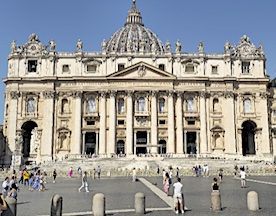
Visiting this majestic temple stirs up emotions and fills us with awe born from a sense of the holiness of faith, the power of history, and the beauty of art.
Yet at the heart of it all is a modest tomb—the tomb of Simon, son of Jonah, the fisherman of Galilee.
How did this burial place become one of the world’s most famous monuments, located in the heart of Catholicism?
The Gospel we just heard provides the answer: a man who becomes a new creation by the will of Jesus, his Master and Lord, has faith.
This evangelical event ignites our hearts today during the Solemn Eucharist, which is being celebrated in honor of the 400th anniversary of the dedication of the Vatican Basilica on November 18, 1626, by Pope Urban VIII.
The earthly remains of the Apostle Peter rest right here, next to the cathedral that bears his name.
This centuries-old prayer clearly shows us the meaning and value of the masterpiece that welcomes us.
The Holy See has surrounded it with special care through the activities of the Fabric of Saint Peter.
I gladly take this opportunity to express my heartfelt gratitude to His Eminence Cardinal Mauro Gambetti for his service as archpriest and president of the Fabric of Saint Peter.
This entire structure and all of its elements serve one purpose: faith.
Peter’s faith, the Catholic faith, and our faith.
Throughout the basilica, it seems as if Christ’s question to his disciples is resonating: “Who do you say I am?” (Matthew 16:15).
Hearing these words, we—from many different nations—allow St. Peter to lead us in a common confession of the saving truth: “You are the Messiah, the Son of the living God” (Matthew 16:16).
This is Peter’s confession—the truth to which he bore witness alongside the Roman martyrs. This confession enriched Vatican Hill, bearing the fruits of holiness for centuries.
Dearest ones,
Today, we are the fruit — living stones and the temple of the Holy Spirit built on the foundation of Christ.
For centuries, this fruit has been the uninterrupted apostolic succession and the living tradition of the Church with Jesus Himself as its beginning and criterion.
The words of the Lord were inscribed in Latin and Greek on the frieze that runs around the upper part of the basilica.:
“You are Peter [that is, the Rock], and on this rock I will build my Church” (Matthew 16:18).
Upon reflecting on these words, St. Leo the Great exclaimed: “ “Just as Peter’s confession of Christ endures, so too does what Christ established in Peter”.
In other words, it is ministry carried out for the good of the entire Church and for the salvation of the world. Therefore, it is not merely a thing of the past.
Like Simon of Galilee, each of us is called to discover our own mission through dialogue with Jesus.
The Lord continues the dialogue with his apostle: “Do you love me?” (John 21:17).
This question resonates in the heart of every pope, as my Predecessors reminded us.
The mission Peter received to care for his sheep and lambs is always connected to this selfless love, this love of friendship” (Christus Vivit, 250).
For Simon Peter, as for every disciple of Jesus, having faith means being friends with the Lord. Through his humanity, we recognize him as the true God.
The new name Simon receives testifies that “life in the proper sense is not ours nor do we have it solely from ourselves; it is a relationship. Life in its fullness is a relationship with the One who is the source of life.” (Benedict XVI).
Peter asks in his relationship with Jesus, which is marked by listening, trust, falling, and rising with Him: “Lord, to whom shall we go? You have the words of eternal life.”
We are all participants in this faith. Recognizing Jesus as Lord and Master reveals the truth about ourselves because Christ knows “what is in man.”
He is one with us.
Deep within us, in the inner sanctuary of our hearts, Jesus speaks the word of salvation, addressing each of us by name.
In a sense, the basilica that welcomes us today represents that sacred space of the human conscience where living faith matures through friendship with the Lord and service to the Church, even unto martyrdom.
This is why the Tomb of St. Peter is a place of faith and a reminder of redemption for us all, from the time of the ancient Roman necropolis until now.
Emperor Constantine ordered the construction of the first basilica above the tomb of the apostle.
Pope Clement VIII consecrated the altar in this church, where we still celebrate the holy mysteries today.
At the beginning of the sixteenth century, the Constantinian building required thorough reconstruction.
It was during this time that the idea was conceived, and its realization involved the greatest minds of the era—talented individuals and artists such as Bramante, Raphael, and Michelangelo.
Today, we honor all those who contributed to the creation of this temple by glorifying God with their talents, efforts, and material goods.
This house is truly a work of the Church!
The new building of St. Peter’s Basilica thus stands on the same foundation.
Its architecture reflects the history of the faith celebrated there, as well as the history of the Church as a living organism — the Body of Christ.
Significant examples of this are the two ecumenical councils that convened here: the First and Second Vatican Councils. They convey the words of faith that we are to proclaim to the world.
Christ, who was crucified and rose again, is the cornerstone of this mission.
He is the foundation rejected by the powerful of this world.
For the people, He remains “a chosen and precious stone, and whoever believes in Him will surely not be disappointed”
(1 Peter 2:6; Isaiah 28:16 > thus says the Lord God, “Behold, I am laying in Zion for a foundation a stone, a tested stone, a precious cornerstone, of a sure foundation: ‘He who believes will not be in haste.’).
In this sense, Peter’s new name reveals the apostle’s likeness to Christ and their deep communion, even unto death.
The dedication of the basilica that we commemorate today seals this relationship.
This solemn act concerns us all because Jesus’s life continually fills this temple through the most important thing in it: the Eucharistic celebration.
Whether in St. Peter’s Basilica or the world’s smallest church, this sacrament is the most magnificent masterpiece we can contemplate.
In the Eucharist, Jesus is always with us.
He is truly Emmanuel, the Lord of history who dwells in the “house of prayer for all nations” (Isaiah 56:7).
During the consecration of the bread and wine, our gazes and hearts will turn to the slain and risen Lamb. In this one act, the entire Church will be united.
This magnificent basilica was built to bear witness to Jesus, the Son of God.
The Church exists to serve Jesus in every person—every woman and every man—as we journey through history.
“The gates of hell will not prevail against him” (Matthew 16:18).
War will not prevail when we preach peace.
Poverty will not triumph when we bear witness to love.
Error will not triumph when we teach the truth.
Despair will not triumph when we proclaim salvation to all in Jesus’ name.
This is our mission—the same one that St. Peter received on the shore of the Sea of Galilee.
According to the unequivocal command of love, it has been passed on to his successors until the end of time: “Feed my sheep” (John 21:17).
To fulfill this ministry, our predecessors first recorded the Gospel in history and then carved it in stone.
The beauty of this apostolic work calls us all to live holy lives so that we may continue it zealously.
Dear friends,
Let’s take a look at the basilica’s vast portals, arches, balconies, and windows. They open wide onto the square, extending a universal invitation to the world: “Come in and experience it!”
In short, “Believe!”
Believe not because of the beautiful stones, which time relentlessly destroys, but because of the radiating faith. This faith reflects and reminds us of the spiritual edifice that is the Body of Christ.
Thus, the vastness of the Vatican Basilica reflects the Church’s enduring calling to welcome all so that as many people as possible may find their place within it.
In this spirit, we can also interpret the length markings of the world’s great temples placed on the floor of the main nave.
They testify to and remind us of Catholic hospitality, which finds its synthesis right here in Rome and becomes a sign of hope for the whole world.