Pope Leo’s General Audience
Saint Peter’s Square – Wednesday, 29 April 2026
The Apostolic Journey to Algeria, Cameroon, Angola and Equatorial Guinea
April 29. 2026
Matthew 28: 16-20
The eleven* disciples went to Galilee, to the mountain to which Jesus had ordered them.
When they saw him, they worshiped, but some doubted.
Then Jesus approached and said to them, “All power in heaven and on earth has been given to me.
Go, therefore, and make disciples of all nations, baptizing them in the name of the Father, and of the Son, and of the holy Spirit, teaching them to observe all that I have commanded you.
And behold, I am with you always, until the end of the age.”
Pope Leo’s General Audience
Dear brothers and sisters,
Today I would like to talk about the Apostolic Journey I made from 13 to 23 April, visiting four African countries: Algeria, Cameroon, Angola and Equatorial Guinea.
From the very beginning of my pontificate, I have thought about a journey in Africa.
I thank the Lord for granting me the opportunity to undertake this journey as the shepherd of the Church to meet and encourage the people of God.
I also thank Him for allowing me to bring a message of peace to a time in history marked by wars and frequent violations of international law.
I would also like to express my heartfelt thanks to the bishops and civil authorities who welcomed me and to all those who helped organize the visit.
The First Stop: Algeria
Providence had it that my first stop would be Algeria, the country where St. Augustine’s sites are located.
Thus, I found myself, on the one hand, revisiting the roots of my spiritual identity while and crossing and strengthening bridges that are very important for the world and the Church today:
(1) the bridge with the very fruitful age of the Fathers of the Church;
(2) the bridge with the Islamic world; and
(3) the bridge with the African continent.
I received a warm and respectful welcome to Algeria, and we experienced first-hand that people of different religions can live together as brothers and sisters, when we recognize ourselves as children of the same merciful Father.
Furthermore, it was a timely opportunity to learn from St. Augustine’s example.
Through his life, writings, and spirituality, he is a master of the search for God and truth.
This is a testimony that is more important than ever today for Christians and every person.
In the next three countries I visited, the population is predominantly Christian.
I therefore found myself immersed in an atmosphere of celebrating faith and receiving a warm welcome, which was enhanced by the African people’s characteristic traits.
Like my predecessors, I experienced what happened to Jesus with the crowds in Galilee.
He saw their thirst for justice and proclaimed: “Blessed are the poor, blessed are the meek, blessed are the peacemakers,” and recognizing their faith, he said, “You are the salt of the earth and the light of the world.”
The second stop: Cameroon
My visit to Cameroon allowed me to reiterate the importance of working together for reconciliation and peace. Unfortunately, that country is also marked by tensions and violence.
I am glad to have traveled to Bamenda, in the Anglophone region, where I encouraged people to work together for peace.
Cameroon is known as “Africa in miniature” because of the variety and richness of its natural environment and resources. However, we can also interpret this expression to mean that the great needs of the entire continent are found in Cameroon:
(1) the need for fair distribution of wealth;
(2) the need to provide opportunities for young people,
(3) overcoming endemic corruption;
(4) promoting integral and sustainable development,
(5) countering various forms of neo-colonialism through forward-thinking international cooperation.
I thank the Church in Cameroon and all the Cameroonian people who welcomed me with such love. I pray that the spirit of unity evident during my visit will be kept alive to guide future choices and actions.
The third stop: Angola,
Angola is a large country south of the equator with a centuries-long Christian tradition linked to Portuguese colonization.
Like many African countries, Angola experienced a troubled period after achieving independence, marked by a long and bloody civil war.
Throughout this tumultuous history, God has guided and purified the Church, transforming it into a force for the Gospel, human advancement, reconciliation, and peace.
A free church for a free people! At the Marian Sanctuary of Mamã Muxima, which means “Mother of the Heart,”
I felt the beating heart of the Angolan people. In the various meetings, I rejoiced to see so many religious men and women of all ages.
They are a prophecy of the Kingdom of Heaven among their people.
I saw catechists who dedicate themselves fully to the good of the community.
I saw many elderly people, weathered by toil and suffering, yet radiant with the joy of the Gospel.
I saw women and men dancing to songs praising the Risen Lord.
They have hope that withstands the disappointments caused by ideologies and empty promises of the powerful.
This hope requires a concrete commitment.
The Church is responsible for recognizing the rights of all and promoting their respect through the witness and courageous proclamation of the Word of God.
I assured the Angolan civil authorities, as well as those of other countries, of the Catholic Church’s willingness to continue making contributions, particularly in the fields of healthcare and education.
The Fourth Stop: Equatorial Guinea
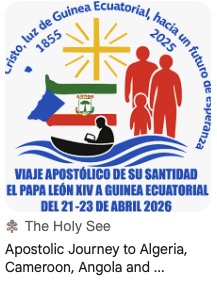
Equatorial Guinea was the last country I visited, 170 years after its first evangelization.
Guided by tradition and the light of Christ, the Guinean people have persevered through the vicissitudes of their history.
In the presence of the Pope, they recently renewed their commitment to moving forward together towards a hopeful future.
What happened in the Bata prison in Equatorial Guinea is unforgettable:
the prisoners sang a song of thanksgiving to God and the Pope at the top of their voices, asking the Pope to pray for their sins and freedom.
I had never seen anything like it.
Then, they prayed the “Our Father” with me in the pouring rain.
It was a genuine sign of the Kingdom of God!
Still in the rain, the large gathering with the young people began in the Bata stadium.
It was a celebration of Christian joy, with moving testimonies from young people who found the path to free and responsible growth in the Gospel.
The celebration culminated in the Eucharist the following day, which fittingly crowned the visit to Equatorial Guinea and the entire apostolic journey.
Dear brothers and sisters,
The Pope’s visit is an opportunity for the African people to express their joy in being God’s people and their hope for a better future with dignity for all.
I am happy to have given them this opportunity.
At the same time, I thank the Lord for what they have given me: an invaluable treasure for my heart and ministry.
_____________________________
Summary of the Holy Father’s words:
Dear brothers and sisters,
Today, I would like to speak about my recent apostolic journey to four countries: Algeria, Cameroon, Angola, and Equatorial Guinea.
Since the beginning of my pontificate, I have desired to embark on this journey, and I now express my heartfelt gratitude to the Lord for granting me the opportunity to meet with the people of God in Africa and confirm them in their faith as the successor of Saint Peter.
During my time there, I offered the world a message of peace during a time marked by conflicts and frequent violations of international law.
Along with calling for peace, I denounced the grave injustices in these resource-rich countries, urging the international community to overcome neo-colonial attitudes and engage in authentic collaboration.
At the same time, the apostolic journey gave Africans a chance to express their joy in being God’s people and to make their voices heard.
For this, I thank the Lord for the immeasurable gift of faith, hope, and charity that they have given me, which has greatly enriched my life and ministry.