 0
0
 0
0
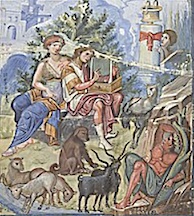
Illustration: David playing his harp (unknown artist, c. 960)
Pope Leo’s General Audience
St Peter’s Basilica – Wednesday, 19 August 2026
Catechesis. The Documents of the Second Vatican Council. III. Constitution Sacrosanctum Concilium. 7. Sacred Music
Dear brothers and sisters,
The sixth chapter of the Constitution Sacrosanctum Concilium (SC) of the Second Vatican Council is dedicated to sacred music.
The document states that
“The musical tradition of the universal Church is a treasure of inestimable value, greater even than that of any other art. The main reason for this pre-eminence is that, as sacred song united to the words, it forms a necessary or integral part of the solemn liturgy.” (SC, 112).
It specifies that “Sacred music is to be considered the more holy in proportion as it is more closely connected with the liturgical action, whether it adds delight to prayer, fosters unity of minds, or confers greater solemnity upon the sacred rites.
But the Church approves of all forms of true art having the needed qualities and admits them into divine worship.” (ibid.).
Here we find the core of the Council’s teaching, which confirms and deepens the ministerial function of music in the liturgy, which had already been highlighted by Saint Pius X in the Motu Proprio Inter sollicitudines (among worries) 22 November 1903).
Music is part of the liturgical action and is not merely a decorative part of the celebration.
In the liturgy, singing and playing music means praying.
It means attuning one’s heart to that of our sisters and brothers, as well as to God, through active participation in the celebrated mystery.
It is a lover’s song
In particular, music expresses the affective dimension of prayer, as St. Augustine says: “Cantare amantis est”, that is, “singing belongs to those who love” (Sermo 336, 1).
This is important because it helps us open our hearts to God’s grace and allows us to be molded by it.
Singing also fosters communion.
It fosters unity among people, transcending differences and uniting them in praise of God through a symphony of voices.
Thus, it becomes an epiphany of the Church—a tangible manifestation of the communion that is inherent to her nature.
The profound theological significance of sacred song as an integral part of the liturgical action gives rise to certain requirements.
First, it must respond appropriately to the liturgical moment, regardless of fashions or composers’ sensitivities.
Its form, especially in its melodic aspect, must be at once noble and simple, of high musical quality and easily performable, particularly when it is intended to be sung by the whole assembly (cf. SC, 121).
For the same reason, the Council recommends that the texts be suitable and profound yet readily understandable. They should be inspired mainly by Sacred Scripture, liturgical books, and the spiritual tradition of the Church.
Attention must be paid to this, so that the dynamic expressed in the ancient principle lex orandi, lex credendi, that is, the law of prayer is also the law of faith, may remain alive and continue to grow.
Sacrosanctum Concilium devotes considerable attention to the theme of the active participation of the faithful.
This “must be understood […] on the basis of a greater awareness of the mystery being celebrated and its relationship to daily life”, in a “spirit of constant conversion that should characterize the lives of all the faithful” (Benedict XVI, Apostolic Exhortation Sacramentum caritatis, 52).
The Constitution offers a clear answer as to how this can be achieved through the specific role of sacred music: “The people should be encouraged to participate through acclamations, responses, psalmody, antiphons, and songs,” and “reverent silence” should be encouraged (SC, 30).
The Constitution urges each person—minister or member of the faithful—to perform “all of, but only those parts which pertain to his office by the nature of the rite and the principles of liturgy” (SC, 28).
This is to be done in a harmonious balance between the different ministries, interventions, and moments of silence.
The Council then attributes great value to Gregorian chant, without excluding other genres of sacred music from the celebration.
Particular attention is also given to the organ (cf. SC, 120), while the use of other instruments is permitted “on condition that the instruments are suitable, or can be made suitable, for sacred use, accord with the dignity of the temple, and truly contribute to the edification of the faithful” (SC, 120).
A theme closely related to the Council’s reforms is inculturation, including in the field of sacred music.
The Council emphasizes the importance of taking the musical traditions of different cultures seriously into consideration because they are an integral part of people’s religious and social life.
Therefore, an “attitude toward religion” should be promoted in everyone (SC, 119).
On the other hand, every effort should be made to promote the traditional music of these peoples in schools and sacred services, as far as may be practicable.
A particular role in the liturgical context is given to the schola cantorum (school of singers).
The Council recommends the promotion of this pastoral instrument, to ensure the “proper performance of the parts which belong to it, according to the different kinds of music sung, and to encourage the active participation of the faithful in the singing” (Sacred Congregation of Rites, Instruction Musicam sacram, 19).
For this reason, the composer of sacred music is called to know and preserve the musical heritage of the Church, allowing it to inspire new compositions at the service of the liturgy, while respecting contemporary sensibilities and the different cultural traditions, so as “‘purify worship from ugliness of style, from distasteful forms of expression, from uninspired musical texts which are not worthy of the great act that is being celebrated’, to guarantee dignity and excellence to liturgical compositions”
(Saint John Paul II, Chirograph on Sacred Music, 22 November 2003, 3).
For all these reasons, the Council Fathers recommend promoting the formation and practice of sacred music “in seminaries, in the novitiates and houses of study of religious of both sexes, and also in other Catholic institutions and schools” (SC, 115), and ensuring that musicians and singers receive sound liturgical formation (SC, 115).
Dear brothers and sisters,
The Fathers of the Church held liturgical singing in high regard as a symbol of ecclesial communion.
We can therefore conclude with the words of Saint Ignatius of Antioch: “Let each of you become a choir, so that, in harmonious agreement and in unity with God, you may sing with one voice through Jesus Christ to the Father. May he hear you and, through your good works, recognize that you are members of his Son.” (Letter to the Ephesians, 4, 2).
_____________________________
Summary of the Holy Father’s words:
Dear brothers and sisters,
In our ongoing catechesis on the Second Vatican Council’s Constitution on the Sacred Liturgy (Sacrosanctum Concilium), we will now discuss the significance of sacred music.
Singing and playing a musical instrument are indeed acts of prayer.
Thus, music fosters our unity in praising God and opens our hearts to his grace.
Therefore, sacred music is a treasure of profound value, far from being merely decorative.
It should always be dignified and draw inspiration from Sacred Scripture, reflecting the grandeur of the celebrated mystery.
Sacred music should also reflect local cultures, expressing the authentic traditions of peoples while promoting the universal Church’s musical heritage.
The Council emphasized the need for solid liturgical formation and education in sacred music.
Dear brothers and sisters, in the liturgy, may we join together in love, and – in the words of Saint Ignatius of Antioch – “with one voice sing to the Father through Jesus Christ.”