Illustration:
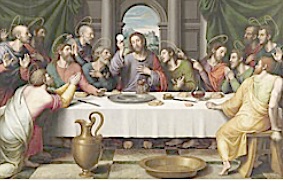
The Eucharist has been a key theme in the depictions of the Last Supper
as scene in this 16th-century Juan de Juanes painting,
after Leonardo da Vinci’s Last Supper.
Pope Leo’s General Audience
Saint Peter’s Square = Wednesday, 24 June 2026
________________
Catechesis. The Documents of the Second Vatican Council. III.
Constitution Sacrosanctum Concilium. 4. The Mystery of the Eucharist
“Now you are Christ’s body, and individually parts of it.” (1 Corinthians 12:27)
Scripture Reading: (1 Corinthians 12:12, 27)
Just as the body is one, though it is composed of many members,
and all the members of the body, though many, are one body, so it is with Christ. […]
Therefore, you are the Body of Christ and the individual members.
Pope Leo’s General Audience,
Dear brothers and sisters,
We will continue our catechesis on the documents of the Second Vatican Council, focusing particularly the Constitution “Sacrosanctum Concilium” (SC) on the Liturgy.
When St. Augustine wanted to explain the mystery of the Body of Christ to the newly baptized, he referenced the passage from St. Paul that we just heard:
“Now you are Christ’s body, and individually parts of it.” (1 Corinthians 12:27).
St. Augustine added: “It is your own mystery that you receive.
To what you are, you respond: Amen, and your response is like your signature.
You are told, ‘The Body of Christ,’ and you reply, ‘Amen.’
Be therefore members of the Body of Christ, so that your Amen may be true. […]
Be what you see and receive what you are” (Sermon 272: PL 38, 1247).
Immediately after describing the Last Supper, the Constitution on the Liturgy discussed the Eucharist using Augustinian terms.
For Christians, taking part at the Lord’s table means being instructed by God’s Word, being nourished … giving thanks to God” (SC, 48).
We become what we receive by receiving Him in His Word and in the Eucharist.
We become the Body of Christ, whose Head is the risen Christ, seated at the right hand of the Father, who prepares a place for us in heaven
(Colossians 1:18 – He is the head of the body, the church; he is the beginning, the first-born from the dead, that in everything he might be pre-eminent.),
John 14:3 – when I go and prepare a place for you, I will come again and will take you to myself, that where I am you may be also).
It is the bread that nourishes us on our journey to our heavenly homeland until the blessed day when “God will be all in all.”
(1 Corinthians 15:28 –When all things are subjected to him, then the Son himself will also be subjected to him who put all things under him, that God may be everything to everyone).
The liturgical assembly offers the sacrifice “not only through the hands of the priest, but also with him” (SC, 48).
From this perspective, the Eucharist is the spiritual sacrifice of Christians, path to union with God and one another.
(Hebrews 13:16 – Do not neglect to do good and to share what you have, for such sacrifices are pleasing to God.;
(Romans 12:1 – I appeal to you therefore, brethren, by the mercies of God, to present your bodies as a living sacrifice, holy and acceptable to God, which is your spiritual worship.),
Through it, they learn to offer themselves.
Through Christ the Mediator, they are drawn day by day into an ever-more-perfect union with God and with each other.
Thus, the Eucharist incorporates us into Christ and teaches us to adopt the Lord Jesus’s style of life, which was marked by freely giving Himself.
This gift brings us together, providing a powerful remedy for the forces of division that plague our world, communities, families, and hearts. (SC, 47).
Dear brothers and sisters,
When we participate in the Eucharist, we are invited to listen to the Word of God and to be nourished at the Lord’s table, where He offers himself to the Father.
The Liturgy of the Word and the Liturgy of the Eucharist are two parts of the Mass that are so closely connected with each other that they form one single act of worship. connected with each other that they form but one single act of worship” (SC, 56).
Regarding the Word of God, it’s important to remember that acquiring intellectual knowledge of the Scriptures is not the only goal.
Rather, the goal is to receive the “living and effective” Word spoken by God to everyone jointly and to each individual simultaneously.
This Word, together with the Eucharistic Bread, nourishes and sustains us, leading us from the decay of sin to new life in Christ.
“The Eucharist opens us to an understanding of Scripture, and Scripture, in turn, illuminates and explains the mystery of the Eucharist.” (Benedict XVI, Verbum Domini, 55).
The Second Vatican Council called for the treasures of the Bible to be made more accessible so that the faithful could enjoy a richer feast from the table of God’s Word. (cf. SC, 51).
The liturgical reform transformed this request into the Lectionary, a book containing all the biblical readings for liturgical celebrations.
This richness comes from the purest source of the living tradition, combining fidelity with tradition and openness to legitimate progress. (SC, 23).
The beginning of Chapter II of the Constitution on the Liturgy is woven with references Chapter II of the Constitution on the Liturgy begins with references to the great river of tradition that flows from the Fathers of the Church to us.
I will quote from it: “At the Last Supper, on the night when He was betrayed, our Saviour instituted the eucharistic sacrifice of His Body and Blood. He did this in order to perpetuate the sacrifice of the Cross throughout the centuries until He should come again, and so to entrust to His beloved spouse, the Church, a memorial of His death and resurrection: a sacrament of love, a sign of unity, a bond of charity, a paschal banquet in which Christ is eaten, the mind is filled with grace, and a pledge of future glory is given to us.” (SC, 47).
Dear brothers and sisters,
Let us draw from this source of divine life with faith and allow ourselves to be transformed by the mystery we celebrate.
_____________________________
Summary of the Holy Father’s words:
Dear brothers and sisters,
As we continue our series of catecheses on the Second Vatican Council, today we will consider the celebration of the Eucharist as presented by the constitution on the Liturgy, Sacrosanctum Concilium.
The document describes this sacred mystery in the second chapter “a sacrament of love, a sign of unity, a bond of charity, ‘a paschal banquet in which Christ is received, the mind is filled with grace, and a pledge of future glory is given to us’” (n. 47).
The Constitution also emphasizes that the faithful are not passive spectators at Mass. Instead, everyone is encouraged to offer themselves, in union with Jesus Christ, the spotless victim, to the Father through the priest and with him.
Participating in the Eucharistic sacrifice means being formed by God’s Word and nourished by the Lord’s body.
These two parts of the Mass, the Liturgy of the Word and the Eucharistic Liturgy, are so closely connected that they form one act of worship.
Brothers and sisters,
As we seek nourishment from this abundant source of divine life, let us allow the mystery we celebrate to transform us.