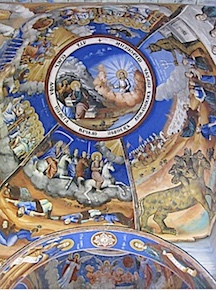
Illustration: Apocalypse depicted in Christian Orthodox traditional fresco scenes
in Osogovo Monastery, North Macedonia
LEO XIV GENERAL AUDIENCE
Saint Peter’s Square – Wednesday, 6 May 2026
Catechesis. The Documents of the Second Vatican Council.
II. Dogmatic Constitution Lumen gentium.
8. The Church, pilgrim in history towards the heavenly homeland
Revelations; 7:9-10
After this I looked, and there before me was a great multitude that no one could count, from every nation, tribe, people and language, standing before the throne and before the Lamb.
They were wearing white robes and were holding palm branches in their hands.
10 And they cried out in a loud voice: “Salvation belongs to our God, who sits on the throne, and to the Lamb.”
Pope Leo’s Catechesis
Brothers and sisters,
Today, as we focus on a section of Chapter VII of the Second Vatican Council’s Constitution on the Church, let us reflect on one of its defining characteristics: its eschatological dimension.
The Church journeys through earthly history, always looking toward her final destination: the heavenly homeland.
However, this essential dimension is often overlooked or downplayed because we are too focused on what is immediately visible and the more concrete dynamics of Christian community life.
The Church is God’s people journeying through history.
The purpose of all her actions is the Kingdom of God.
Jesus established the Church by proclaiming the Kingdom of love, justice, and peace.
Therefore, we are called to consider the community and cosmic dimensions of salvation in Christ, and to turn our eyes to this final horizon.
We must measure and evaluate everything from this perspective.
The Church exists within history, serving the coming of the Kingdom of God to the world.
She proclaims this promise to everyone, always.
She receives a pledge of it in the celebration of the sacraments, especially the Eucharist.
She puts its logic into practice and experiences it in relationships of love and service.
Furthermore, the Church knows that she is the place and means by which union with Christ is realized “more closely”, while recognizing that God can bestow salvation through the Holy Spirit beyond her visible boundaries.
In this regard, the Constitution Lumen Gentium (Light of the Nations) makes an important statement: the Church is the “universal sacrament of salvation” (LG 48), meaning it is the sign and instrument of the fullness of life and peace God promotes.
This means that the Church does not perfectly identify with the Kingdom of God; rather, it is the seed and beginning of the Kingdom, which will be fully realized only at the end of time.
Therefore, believers in Christ walk through earthly history, which is marked by the maturation of goodness, as well as injustices and sufferings.
They do so without being deluded or despairing.
They are guided by the promise received from the One who will “make all things new” (Rev. 21:5).
Thus, the Church carries out her mission between the “already” of the beginning of the Kingdom of God in Jesus and the “not yet” of its promised and anticipated fulfillment.
As the guardian of a hope that illuminates the path, the Church is also charged with the mission of clearly rejecting everything that mortifies life and prevents its development.
She must also take a position in favor of the poor, the exploited, the victims of violence and war, and all those who suffer in body and spirit.
As a sign and sacrament of the Kingdom, the Church is the pilgrim people of God on earth.
Drawing on the final promise, the Church reads and interprets the dynamics of history through the Gospel.
She denounces evil in all its forms and proclaims the salvation that Christ wishes to bring about for all humanity.
She proclaims the Kingdom of justice, love, and peace.
Therefore, the Church does not proclaim itself; rather, everything within the Church must point to salvation in Christ.
From this perspective, the Church is called to humbly recognize the human fragility and transience of her own institutions, which, despite being at the service of the Kingdom of God, bear the fleeting image of this world.
No ecclesial institution can be treated as absolute.
Indeed, since they exist within history and time, they must continually convert, renew their forms, reform their structures, and regenerate their relationships so that they may truly fulfill their mission.
Within the context of the Kingdom of God, we must understand the relationship between Christians carrying out their mission today and those who have completed their earthly existence, either undergoing purification or experiencing beatitude.
Lumen Gentium affirms that all Christians form one Church and share spiritual goods based on their union with Christ.
There is a fraternal solicitude between the earthly and heavenly Churches, which is experienced particularly in the liturgy.
By praying for the departed and following in the footsteps of Jesus’ disciples, we are also sustained on our journey and strengthened in our worship of God.
Marked by the same Spirit and united in the same liturgy as those who have gone before us in faith, we praise and give glory to the Most Holy Trinity.
We should be grateful to the Council Fathers for reminding us of this important and beautiful aspect of Christianity, and we should strive to cultivate it in our live
_____________________________
Summary of the Holy Father’s words:
Dear brothers and sisters,
In our ongoing catechesis on Lumen Gentium, we will focus on the eschatological dimension of the Church.
As the “universal sacrament of salvation,” the Church is a sign and instrument of the fulfillment of God’s promises.
As the pilgrim People of God, the Church interprets history through the lens of the Gospel, speaking decisively against all evil.
At the same time, the Church acknowledges the need for continual conversion to properly fulfill her mission.
As members of the same body, we too are called to renewal.
We do so by remaining in communion with Christ and with one another.
The entire Church is most closely united in praising God together in the liturgy.
There, we pray for the faithful departed and ask the saints to intercede for us, so that we may all receive God’s promises in the Kingdom of Heaven.