Homily of the Holy Father Leo XIV
at the ordination of four new auxiliary bishops of the Diocese of Rome.
Basilica of St. John Lateran – Saturday, 2 May 2026
Dear Brothers and Sisters,
By clinging to Christ, we become solid and welcoming homes.
We experience this joy, especially during the Easter season and today, as we celebrate the ordination of four new auxiliary bishops of the Diocese of Rome.
The Church has a unique vocation to universality and charity, thanks to her special bond with Christ—risen and alive—the foundation of the spiritual edifice of living stones, the holy people of God.
Drawing closer to Christ means drawing closer to one another and growing together in unity.
This mystery involves us and transforms the city from within.
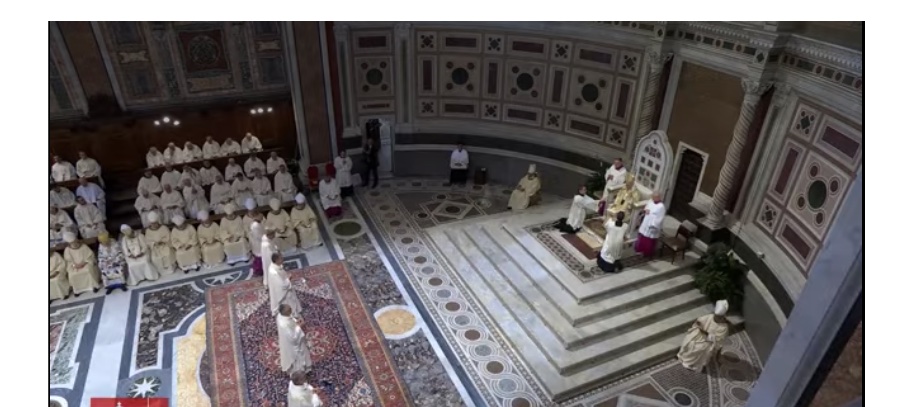
In service to this dynamism brought to Rome by the Apostles Peter and Paul, our brothers Andrew, Stephen, Mark, and Alexander were ordained bishops.
It is a feast for the people because the new bishops come from among them and from the presbyterate that lovingly cares for them.
Today, our diocesan community gathers in invocation of the Holy Spirit, who will anoint the new bishops so they may be fully consecrated to the service of the Gospel of Christ.
He is the rejected stone that has become the cornerstone, chosen by God. (1 Peter 2:4, 7; cf. Psalm 118:22).
To the first Christians, this familiar metaphor from a psalm must have seemed particularly revelatory.
The Messiah Jesus was rejected not only because he was not recognized as the Son of God, but also because he took on the form of a servant, which was considered unworthy of God.
Faithful to this merciful way of love, Jesus went in search of the discarded sheep.
He sat at table with them and disarmed those who wanted to stone them.
As the Gospel proclaimed in this liturgy says, in this way, the Son showed the face of the Father, and in him, his works are accomplished.
“I have been with you for a long time, and you have not known me, Philip?
Whoever has seen me has seen the Father.
How can you say, “Show us the Father”?
Do you not believe that I am in the Father, and the Father is in me?” (John 14:8-9).
In the Church in Rome, the discarded stone is at the heart of the messianic proclamation in the face of those whom society has discarded and continues to discard.
It is at the heart of our proclamation and our mission.
We have seen the Holy One touch the impure, the Just One forgive sinners, life heal the sick, and the Master wash the feet of his disciples, which were dirty and tired.
In this city, the capital of the great empire, the rejected stone became a symbol of new hope: the Kingdom of God, as sung in the Beatitudes and the Magnificat.
By reversing the logic of domination — the senseless ambition to determine the architecture of the Earth — Christ gives the rejected stones their dignity and makes them feel chosen for the Kingdom of God.
Jesus says to his disciples: “In my Father’s house are many rooms; Otherwise, would I ever have said to you: ‘I am going to prepare a place for you’? When I have gone and prepared a place for you, I will come again and take you to myself, so that where I am you may also be” (John 14:2-3).
Dear sisters and brothers,
This is why, even today, we are like stones that were rejected by humans but chosen by God.
We oppose projects that oppress the weak, disrespect the dignity of every person, and use conflicts to select the strongest while neglecting those left behind.
We consider those who succumb to be the garbage of history.
Jesus walked among us as an unarmed and disarming prophet.
Even when he was rejected, he did not change his style.
Now, I turn to you, my dear brothers, who, from this day forward, will be auxiliary bishops of this church.
I have received you as a gift, and with the cardinal vicar, you will help me reflect the good shepherd for the Roman people.
You will also preside over the charity of all the holy people of God scattered throughout the earth.
I encourage you to reach out to the discarded stones of this city and proclaim that, in Christ our Cornerstone, no one is excluded from becoming an active part of the holy edifice that is the Church, nor from the brotherhood of humanity.
This image echoes the message of Pope Francis’s apostolic exhortation Evangelii Gaudium: to be a “field hospital” church, to be street shepherds, and to embrace the material and existential peripheries.
As priests, you and the parish communities you accompany have accepted this invitation.
Now, a new call comes: a further vocation with the same heart.
No one—absolutely no one—must think himself discarded by God.
You will be heralds of this good news at the heart of the Gospel.
Let the Spirit of prophecy act in you.
Do not become complacent in the privileges your position offers. Do not follow worldly logic and strive for the top spots.
Be witnesses of Christ, who came not to be served, but to serve (Mark 10:45).
You will be prophets in your ministry if you are men of peace and unity.
With threads of grace and mercy, you will compose the wide and populous spaces of this diocese.
You will harmonize differences, welcome others, listen to them, and forgive them.
Don’t search; let yourself be found.
Make sure priests, deacons, religious men and women, and lay men and women engaged in the apostolate never feel alone.
Help them revive their hope in different ministries and feel part of the same mission.
May you always know how to motivate individuals and communities tirelessly, reminding them of the beauty of the Gospel with simplicity.
May the poor of Rome, the pilgrims, and the visitors from around the world find the motherhood of the Church in the inhabitants of this city, its institutions, and its pastors.
May Salus Populi Romani, our trusted Mother, always guide and protect us.