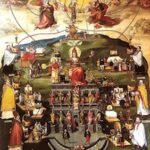
Illustration:“Charismata” by Wilhelm, Joseph (1908).
(A charism denotes any good gift that flows from God’s benevolent love
Pope Leo’s address to meeting with the moderators of associations of the faithful,
ecclesial movements, and new communities
promoted by the dicastery for laity, family and life
Synod Hall – Thursday, 21 May 2026
“God has appointed in the church first apostles, second prophets, third teachers:
then workers of miracles, then healers, helpers, administrators, speakers in various kinds of tongues”.
(1 Corinthians 12:28).
In the name of the Father, and of the Son, and of the Holy Spirit.
Peace be with you!
Dear brothers and sisters,
It is a pleasure to meet with you this morning this morning to share some thoughts and reflections.
Most importantly, I would like to discuss the significance of the gifts of the Holy Spirit, especially during this time before Pentecost.
I am delighted to welcome you once again at the start of your meeting this year.
You hold positions of responsibility within many different lay organizations at an international level, and the Dicastery for the Laity, Family, and Life has invited you to strengthen the bonds of communion among yourselves and reflect together on the theme of governing an ecclesial community.
Every social entity needs suitable people and structures to guide and coordinate communal life.
At its root, the term “govern” refers to the action of “holding the helm” or “steering a ship.”
Therefore, governance is a matter of providing a clear direction so that the community can be a place of growth for its members.
Thus, in the Church, some are also assigned to governance.
However, the need to coordinate the religious needs of its members is not the only reason for the Church’s governance.
Christ established the Church as a lasting sign of his universal salvific will.
It is the place willed by God where people of every age may receive the fruits of Redemption and experience the new life that Christ has given us.
In this sense, the Church’s nature is sacramental.
While it certainly has an external and institutional dimension with its structures, it is also an effective sign of communion through which we participate in the life of the Trinity.
These distinctive characteristics of the Church must also be present in its governance, which is never merely technical.
Rather, it has a salvific orientation, meaning it must be directed toward the spiritual well-being of the faithful.
Indeed, Saint Paul counts it among the charisms.
He wrote, “There are workers of miracles, then healers, helpers, administrators, and speakers in various kinds of tongues” (1 Corinthians 12:28).
Keeping these premises in mind, we will now turn our attention to associations of the faithful and ecclesial movements.
Here, governance is generally entrusted to laypeople, expressing participation in the threefold role as Prophet, Priest, and King (the triplex munus) Christ received in baptism.
This governance serves other faithful members and the life of the association.
It is the result of free elections and must be understood as an expression of common discernment, allowing everyone’s voice to be heard.
If, as we have said, governance is a particular gift of the Holy Spirit that members of a community recognize in some of their brethren in the faith, at least three consequences derive from this.
1. First, it must benefit all, promoting the good of the community, the association, and the entire Church.
Therefore, governance can never be exploited for personal interests, worldly prestige, or power.
(1 Corinthians 12:7 – To each is given the manifestation of the Spirit for the common good.)
2. Second, it can never be imposed from above.
Rather, it must be a gift recognized within the community and freely accepted.
Hence, the importance of free elections.
3. The third consequence is that, like every charism, the governance of an association is subject to the discernment of the pastors, who monitor the authenticity and orderly use of charisms. (cf. Lumen gentium, 12; Iuvenescit Ecclesia, 9 and 17).
The following characteristics must always be present in governance: mutual listening, shared responsibility, transparency, fraternal closeness, and communal discernment.
(cf. Address to the participants in the General Chapter of the Legionaries of Christ, 19 February 2026).
In addition to this, I would like to recall that “good governance, instead of focusing everything on itself, promotes subsidiarity and the responsible participation of all the members of the community” (ibid.).
These are simple guidelines, but they should always be kept in mind when exercising authority.
Dear friends,
Your associations and movements have different origins and possess well-defined histories, identities and ideals.
Those who govern them, therefore, undertake a delicate task.
On the one hand, they are called to safeguard and promote the memory of a living heritage.
On the other hand, they have a “prophetic” role that involves listening to current pastoral needs in order to understand how to respond to the new challenges, as well as to the cultural, social and spiritual sensibilities of our time.
Only in this way can one be a Christian, a disciple, and a missionary in today’s society and church.
Therefore, part of the prophetic task of those in leadership, therefore, is to promote the openness of the association or movement—and of each of its members—to historical situations.
Membership is authentic and fruitful not only when members participate in group activities, but also when they interpret the signs of the times, reach out to others, and address the culture and mission areas that have not yet been explored.
Another vital element is communion.
Those who govern are required to be particularly sensitive to safeguarding, growing, and consolidating communion.
This applies to life within the association or movement and to communion with other ecclesial realities and the Church as a whole.
Those who lead in the Church must learn to listen to and welcome different opinions, cultural and spiritual orientations, and personal temperaments. They must always seek to preserve the greater good of communion, especially when making difficult decisions.
This requires bearing witness to meekness, detachment, and selfless love for one’s brothers and sisters and for the community. This example serves as a model for everyone.
Here I would like to emphasize the importance of this dimension of communion with the Church as a whole.
Sometimes we encounter groups that isolate themselves and believe their particular situation is the only one.
They think they are the Church, but the Church is all of us—it is so much more!
Therefore, our movements must strive to live in communion with the entire Church at the diocesan level.
The bishop is a very important figure, so if a group says, “No, we are not in communion with this bishop; we want another one,” that will not do.
We must try to live in communion with the entire Church, both at the diocesan and universal levels.
In this light, we can better understand the meaning of fidelity to the founding charism.
This fidelity is an indispensable point of reference for governing an ecclesial community.
Every authentic charism contains fidelity and openness to the Church within itself.
Therefore, to govern in a manner faithful to the founding charism means finding inspiration in it to engage in the Church’s current journey, while avoiding becoming entrenched in past models, no matter how positive they may be.
It means allowing oneself to be challenged by new realities and engaging in dialogue with all members of the ecclesial body.
Dear friends,
Thank you for who you are and what you do.
Associations of the faithful and ecclesial movements are an invaluable gift to the Church.
There is great richness among you: many well-formed individuals, fine evangelizers, young people, and diverse vocations to the priesthood and married life.
Over the years, you have developed a variety of charisms, gifts, and methods of apostolate, allowing you to be present in the fields of culture, art, social life, and work.
You bring the light of the Gospel everywhere! Cherish and nurture these gifts with God’s grace!
The Church supports and accompanies you.
From the bottom of my heart, I bless all of you and invoke the intercession of the Virgin Mary, Mother of the Church, for you.