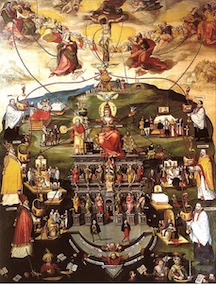
Illustration: Central panel of the Wrisberg epitaph in Hildesheim Cathedral,
showing distribution of the divine graces by means of the church and the sacraments, or mysteries. By Johannes Hopffe 1585.
Pope Leo’s General Audience
St. Peter’s Square Wednesday, May 20, 2026
A series of catecheses – Documents of the Second Vatican Council.
III. Constitution Sacrosanctum Concilium. 1. The liturgy in the mystery of the Church
_________________________________
From the Letter of St. Paul the Apostle to the Ephesians
God has revealed to us the mystery of his will in all wisdom and insight, according to his plan, which he established in Christ as a plan for the fullness of time: to unite all things in him,
whether in heaven or on earth. (Ephesians 1:9-10)
Pope Leo’s General Audience
Dear Brothers and Sisters,
Today we begin a new series of catecheses on the first document issued by the Second Vatican Council: the Constitution on the Sacred Liturgy, Sacrosanctum Concilium (SC).
In drafting this Constitution, the Council Fathers sought to reform the rites and lead the Church to contemplate and deepen the living bond that constitutes and unites her: the mystery of Christ.
The liturgy touches the heart of this mystery.
It is the space, time and context in which the Church receives her life from Christ.
In the liturgy, “the work of our redemption is accomplished” (SC, 2), making us a chosen lineage, a royal priesthood, a holy nation and a people acquired by God
(1 Peter 2:9 – you are a chosen race, a royal priesthood, a holy nation, God’s own people, that you may declare the wonderful deeds of him who called you out of darkness into his marvelous light.).
The threefold renewal — biblical, patristic, and liturgical — that the Church underwent in the twentieth century shows that the mystery in question is not an obscure reality, but rather God’s salvific plan.
This plan was hidden from all eternity and revealed in Christ, as Saint Paul affirms
(Ephesians 3:1-6 – For this reason I, Paul, a prisoner for Christ Jesus on behalf of you Gentiles — 2 assuming that you have heard of the stewardship of God’s grace that was given to me for you, 3 how the mystery was made known to me by revelation, as I have written briefly. 4 When you read this you can perceive my insight into the mystery of Christ, 5 which was not made known to the sons of men in other generations as it has now been revealed to his holy apostles and prophets by the Spirit; 6 that is, how the Gentiles are fellow heirs, members of the same body, and partakers of the promise in Christ Jesus through the gospel.).
The Christian Mystery is the Paschal event: the passion, death, resurrection, and glorification of Christ.
This event is made sacramentally present to us in the liturgy.
Therefore, every time we gather as a community “in his name” (Matthew 18:20 where two or three are gathered in my name, there am I in the midst of them.”), we are immersed in this Mystery.
Christ Himself is the inner source of the mystery of the Church – the holy people of God, born from His pierced side on the cross.
Through the power of His Spirit, He continues to act in the holy liturgy.
He sanctifies and unites the Church, his bride, to his offering to the Father.
He exercises His unique priesthood.
He is present in the proclaimed Word, the sacraments, the ministers who celebrate, the gathered community, and, to the highest degree, in the Eucharist (cf. SC, 7)
According to Saint Augustine (Sermon 277), the Church “receives the Body of the Lord and becomes what she receives” when she celebrates the Eucharist.
She becomes the Body of Christ, “a dwelling place of God in the Spirit” (Ephesians 2:22). This is the “work of our redemption,” which conforms us to Christ and builds us up in communion.
In the holy liturgy, this communion is achieved through “rites and prayers” (SC, 48). T
he rituality of the Church expresses her faith in accordance with the saying lex orandi, lex credendi – and smultaneously shapes ecclesial identity.
The proclaimed Word, the celebration of the Sacrament, gestures, silences, and space represent and give form to the people gathered by the Father—the Body of Christ and the Temple of the Holy Spirit.
Thus, every celebration becomes a true epiphany of the Church in prayer, as Saint John Paul II recalled.
If the liturgy serves the mystery of Christ, then it makes sense that it has been defined as “the summit toward which the activity of the Church is directed . . . the font from which all her power flows” (SC, 10).
While the Church’s activity is not limited to the liturgy, all of its actions (preaching, serving the poor, and accompanying human realities) converge towards this “summit.” Conversely, the liturgy sustains the faithful by immersing them ever anew in the Paschal Mystery of the Lord.
Through the proclamation of the Word, the celebration of the sacraments, and communal prayer, the faithful are refreshed, encouraged, and renewed in their commitment to the faith and their mission.
In other words, the faithful’s participation in liturgical action is both “internal” and “external.”
This also means that it must unfold tangibly throughout daily life in an ethical and spiritual manner.
The liturgy must be translated into life, demanding a faithful existence capable of making concrete what has been experienced in the celebration.
In this way, our life becomes a “living sacrifice, holy and acceptable to God,” fulfilling our “spiritual worship” (Rom. 12:1).
In this way, the liturgy builds up those within it “into a holy temple of the Lord” (SC, 2) and forms an open community that welcomes all.
It is inhabited by the Holy Spirit, introduces us to the life of Christ, makes us his body, and represents the unity of the entire human race in Christ in all its dimensions.
As Pope Francis said in his Apostolic Letter Desiderio Desideravi, “The world still does not know it, but everyone is invited to the supper of the wedding of the Lamb” (Revelations 19:9 – the angel said[a] to me, “Write this: Blessed are those who are invited to the marriage supper of the Lamb.” And he said to me, “These are true words of God.”).
Dear friends, let us allow the rites, symbols, and gestures of the liturgy, as well as the living presence of Christ, to shape us inwardly.
We will have the opportunity to explore this in the coming catecheses.
Summary of the Holy Father’s catechesis
Today we will begin our reflection on the Constitution on the Sacred Liturgy Sacrosanctum Concilium.
In undertaking the reform of rites, the Fathers of the Second Vatican Council primarily sought to deepen theological reflection on the liturgy.
They focused especially on the Paschal Mystery of Christ—His Passion, Death, Resurrection, and Praise—which, by the power of the Holy Spirit, is present in the liturgy, particularly in the sacraments.
The Council defines the liturgy as the summit to which the Church directs its activity and the source from which all its power flows.
St. John Paul II taught that, through words, rites, symbols, and gestures, every celebration becomes a true epiphany of the Church that perpetuates in prayer.