Pope Leo’s homily for 21st Sunday in Ordinary Time
Port of Rimini – Saturday, 22 August 2026
First Reading (Isaiah 22:1)
I will thrust you from your office, and you will be cast down from your station. 20 In that day I will call my servant Eliakim the son of Hilkiah, 21 and I will clothe him with your robe, and will bind your girdle on him, and will commit your authority to his hand; and he shall be a father to the inhabitants of Jerusalem and to the house of Judah. 22 And I will place on his shoulder the key of the house of David; he shall open, and none shall shut; and he shall shut, and none shall open. 23 And I will fasten him like a peg in a sure place, and he will become a throne of honor to his father’s house.
Second Reading (Romans 11:33.36)
O the depth of the riches and wisdom and knowledge of God! How unsearchable are his judgments and how inscrutable his ways! 34 “For who has known the mind of the Lord,
or who has been his counselor?” 35 “Or who has given a gift to him that he might be repaid?” 36 For from him and through him and to him are all things. To him be glory forever. Amen.
Sunday Gospel: Matthew 16:13-20
When Jesus arrived in Caesarea Philippi, he asked his disciples, “Who do people say that the Son of Man is?” They replied, “Some say John the Baptist, others say Elijah, and still others Jeremiah or one of the prophets.”
Then he asked them, “But who do you say that I am?”
Simon Peter replied, “You are the Christ, the Son of the living God.”
Jesus answered him, “Blessed are you, Simon Bar Jona! Flesh and blood has not revealed this to you, but my Father in heaven has. I also tell you that you are Peter.
On this rockI will build my church, and the gates of Hadeswill not overcome it. I will give you the keys of the kingdom of heaven, and whatever you bind on earth shall be bound in heaven, and whatever you loose on earth shall be loosed in heaven.”
Then he strictly charged the disciples not to tell anyone that he was the Christ.
Pope Leo’s Homily
Dear Brothers and Sisters,
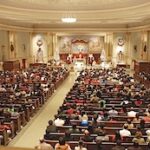
I am very happy to preside over this Eucharist with you and for you, the Church in Rimini.
I do so at the endof an intense day, in which I visited the Republic of San Marino and the “Meeting for Friendship among Peoples”.
Now, as we enter the Lord’s Day, it is time to celebrate the mystery that gives meaning to everything and is the source and summit of all our pastoral action.
In the Gospel we have heard, Jesus asks the disciples: “Who do you say that I am?”.
Peter answers, in the name of all: “You are the Christ, the Son of the living God”.
We too, after two millennia, are called to renew the same profession of faith:
we are here because we believe that Jesus is the Messiah, the eternal Son of the Father, consecrated and sent into the world “to serve and to give his life as a ransom for many”.
Yes, dear friends, we recognize the truth that fills us with joy and hope in Peter’s words, and we find the way that leads to life.
The way of God, who puts himself at the service of man; the way of the Master.
(Phil 2:5-8 – Have this mind among yourselves, which was in Christ Jesus, who, though he was in the form of God, did not count equality with God a thing to be grasped, but emptied himself, taking the form of a servant, being born in the likeness of men. And being found in human form he humbled himself and became obedient unto death, even death on a cross.),
– who bends down to wash the feet of the disciples
(John 13:12-15 – 12 When he had washed their feet, and taken his garments, and resumed his place, he said to them, “Do you know what I have done to you? 13 You call me Teacher and Lord; and you are right, for so I am. 14 If I then, your Lord and Teacher, have washed your feet, you also ought to wash one another’s feet. 15 For I have given you an example, that you also should do as I have done to you.),
– of the Shepherd who sacrifices himself for his flock (John 10:11 – I am the good shepherd. The good shepherd lays down his life for the sheep.).
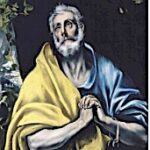
And it is in this light that we look at the gesture of Jesus who gives Peter the keys, because in the Church, at every level, authority is service.
The Pope, bishops, priests, and deacons must be the first to live this way. The whole People of God must join them, each according to their specific calling.
The Servant of God, Fr Oreste Benzi, testified to this very well, saying: “Our vocation consists […] in letting ourselves be conformed to the poor Christ, to Christ the servant, to Christ who expiates the sin of the world, to Christ, the incarnate Man God who lives among us in a form of direct sharing starting from the least” (Con questa tonaca lisa, edited by Valerio Lessi, Bologna 1991, p.42).
In the Church, the mission of “binding” and “loosening” concerns, on the one hand, the role of those who are called to exercise authority in the name of the Lord.
On the other hand, it describes a style and task that involves every baptized person: embracing, reuniting, welcoming, freeing, forgiving, and emancipating anyone who is a prisoner of sin and its consequences.
This makes us upright and wise administrators of the goods that God entrusts to us. In this way, everything contributes to the good of all in charity.
In the First Reading (Is 22:19-23) The prophet Isaiah spoke to us about Shebna, an official to whom King Hezekiah entrusted a significant project to renew Jerusalem and the Kingdom of Judah religiously, morally, and socially.
However, driven by ambition and greed, this powerful man began to abuse his authority, amassing wealth for himself and his friends and relatives while oppressing others.
He had forgotten that the most important aspect of the adventure his Lord had involved him in was not economic means and power, but rather the opportunity to promote a rebirth plan for the benefit of the entire community.
For this reason, he was dismissed, and his mission was entrusted to Eliakim. According to the Prophet, Eliakim was an honest man, free from conditioning and solid in his rectitude, like a peg driven into a wall.
The message is clear: Everything we are and have is a gift from God.
He entrusted these gifts to us so that we can be instruments of salvation and justice for one another, starting with the people and places with whom we live and work every day. With big, open hearts, we can address the whole world..
Saint Paul, in the Second Reading, speaks to us of God’s plans, saying that they are inscrutable not because of the complexity of His reasoning but because of the disarming immensity of His love, which surpasses all our capacities and expectations.
“For of Him, through Him, and to Him are all things” (Rom 11:36).
God is simple because he is pure charity. He also calls us to love with a heart like his, conforming our ways and thoughts to his. (cf. v. 33).
Honesty, generosity, and benevolence are values that are particularly dear to the people of Romagna, who are known for being straightforward, cheerful, hardworking, and supportive.
Consider the numerous saints and blesseds born here who exercised charity and lived the Gospel, sometimes even to the point of martyrdom.
This commitment is also evident in the various ecclesial realities, parishes, families, Catholic Action, movements, associations, and works of assistance and Christian formation.
Many people from Italy and around the world come here every year for their holidays, drawn by this richness as well as the natural and artistic beauty of the Adriatic coast and the hinterland.
In this regard, I encourage you to continue your commitment to ensuring that this territory is welcoming not only for refreshment and fun, but also for spiritual renewal. When he visited many years ago, Saint John Paul II emphasized that “resting does not mean separating oneself from oneself.”
Indeed, he said, “resting means encountering oneself and being reconciled with one’s innermost self” (Homily at Holy Mass in Rimini, 29 August 1982).
The world in which we live offers many forms of entertainment. However, some lead to dispersion and ruin rather than a true “coming to oneself” and leave emptiness in the heart.
Some call these forms of entertainment “escape,” as if ordinary life were a prison from which to escape.
We know that the truest place to find refreshment and encounter God is within us, in the depths of the soul, not outside in chaos.
As a Christian community, we are called to cultivate and pass on this experience through the openness and hospitality of our people and churches, and our willingness to help and show charity.
This applies to those who seek rest after a year of work and to those wounded in body and spirit who ask for refuge, food, and assistance far from their homeland.
In one of his letters to the diocese, your bishop wrote, “Prayer, unity, listening, courage, simplicity, gratitude, beauty… These are attitudes that should always be present in every aspect of life” (Mons. Nicolò Anselmi, Lett. past.
You will love, be happy, and enjoy all that is good now and forever” (October 14, 2024).
Dear brothers and sisters,
As I extend this significant invitation to you for reflection and commitment, I thank you again for your warm welcome and faithful participation.
I entrust you to the intercession of Mary Most Holy, St. Gaudentius, and your patron saints.