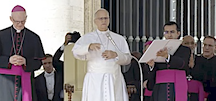
Pope Leo’s General Audience
Wednesday, 21 October 2026
Catechesis. The Documents of the Second Vatican Council. IV.
Constitution Gaudium et Spes. 6. Commitment to the family in today’s society (GS, 47–52)
Scripture reading: Ephesians 5: 31-33
“For this reason a man will leave his father and mother and be united to his wife, and the two will become one flesh.”
This is a profound mystery—but I am talking about Christ and the church.
However, each one of you also must love his wife as he loves himself, and the wife must respect her husband.
Dear brothers and sisters,
First, I would like to thank you for the support of your prayers.
Thanks be to God for his generosity.
Let us all renew our trust in God’s goodness and mercy.
The Pastoral Constitution Gaudium et Spes (GS) of the Second Vatican Council, illustrates the dignity of the person and his or her vocation in the world in the first part.
In the second part, it considers some of the most pressing contemporary issues “in the light of the Gospel and of human experience.”
The document primarily focuses on marriage and the family, based on the belief that “the well-being of the individuals and of human and Christian society is closely tied to the well-being of the community formed by marriage and family.” (GS, 47).
In this regard, it not only reaffirms their values and goals, but also proposes a new understanding of marriage as an “intimate partnership of married life and love” (GS, 48).
By incorporating the legal dimension of marriage as a contract this union’s foundation is recognized in the “conjugal covenant”, which is understood as the “human act whereby spouses mutually give and receive each another”.
This mutual self-giving of man and woman, such that ‘they are no longer two but one flesh’ (Matthew 19:6), underlies the requirement of “total fidelity” and the “unbreakable oneness” between spouses. This is vividly expressed through the procreation and raising of children. (GS, 48).
Through the Sacrament of Marriage, conjugal and parental love reflects the Divine Trinity. It is “governed and enriched by Christ’s redeeming power”, so that spouses can love each other “just as He loved the church and gave himself up for her.
After shedding light on the reality of marriage in the context of Christ’s love — the truth of both human and divine love — Gaudium et Spes turns its attention to conjugal love and marital fruitfulness.
Conjugal love is not limited to erotic attraction, though it encompasses that as well.
It involves the entire will of the spouses, enlivening the affections of their hearts and expressing itself through sentiments and gestures of tenderness (GS, 49).
Embracing the whole person of both man and woman, who are equal in dignity, this love pervades the spouses’ entire lives, finding expression in acts exclusive to marriage. While signifying integral love from person to person, the unique intimacy between spouses fosters their mutual self-giving and enriches their shared joy.
Furthermore, the fruitfulness of conjugal love is expressed through the procreation of children, “the supreme gift of marriage” (GS, 50).
Through transmitting and educating human life, which must never be rejected, spouses become “cooperators with the love of God the Creator, and are, so to speak, the interpreters of that love”.
Called to this human and Christian responsibility, spouses are bound to allow themselves to be guided by a sound judgment regarding their own well-being and that of their children, whether already born or yet to be born.
In the final analysis, spouses must form such a judgment before God.
This requires their conscience to conform to divine law as interpreted by the Magisterium of the Church in the light of the Gospel.
The emphasis on loving communion and procreative fruitfulness within marriage leads the Council to rule out the possibility of there being “a true contradiction … between the divine laws pertaining to the transmission of life, and those pertaining to authentic conjugal love” (GS, 51) and to affirm, instead, that “when there is question of harmonizing conjugal love with the responsible transmission of life”, one must “preserve the full sense of mutual self-giving and human procreation in the context of true love”.
From this it follows both that “from the moment of its conception life must be guarded with the greatest care”, renouncing “abortion and infanticide”; and that “the acts themselves which are proper to conjugal love and which are exercised in accord with genuine human dignity must be honored with great reverence”.
Gaudium et Spes’s teaching on the conjugal and family community highlights the family’s social function, defining it as “a school of deeper humanity” and “the foundation of society” (GS 52).
It calls upon those with social responsibilities, especially in political and cultural spheres, to fulfill their duty to “work efficiently for the welfare of marriage and the family.”
Dear friends, this task is more urgent than ever before.
The Church is well aware of this, as evidenced by the pastoral concern of the popes who have succeeded one another since the last council.
This concern was evident again in recent days at the two synodal assemblies convened by Pope Francis and addressed by the heads of the Eastern Catholic churches and the presidents of the episcopal conferences.
May the Holy Family of Nazareth enlighten us on our journey and protect families worldwide.
Summary of the Holy Father’s words:
Dear brothers and sisters,
In our ongoing catechesis on Gaudium et Spes, today we consider the dignity of marriage and the family in the context of contemporary challenges.
The Council Fathers recognized the close link between the well-being of society and the health of marriage and the family.
They presented a renewed vision of conjugal love as an intimate partnership reflecting the life of the Trinity and rooted in and enriched by the redemptive power of Christ. Therefore, let us pray for God’s blessing and protection upon all families.