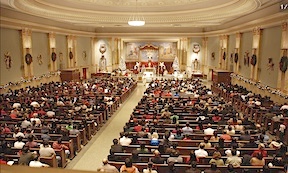
Illustration: Christmas Midnight Mass, St Sebastian Parish, Woodside NY 2008
Pope Leo’s Catechesis on Second Vatican Council
St Peter’s Basilica – Wednesday, 26 August 2026
Catechesis. The Documents of the Second Vatican Council. III.
Sacrosanctum Concilium. 8. The motivations of the liturgical reform
Pope Leo’s Catechesis,
Dear brothers and sisters,
In this final catechesis on the constitution Sacrosanctum Concilium, I will discuss the reasons why the council fathers sought to promote a reform of the liturgy.
The third Letter from the Council, sent by Cardinal Montini, (then archbishop of Milan), on October 28, 1962 to the faithful of his church, is particularly enlightening in this regard.
He wrote, “ The liturgy is an authentic expression of both the divine and the human.
It is a form of language.
On the one hand, it conveys divine teachings, and on the other, it engages in dialogue with God. Clearly, it cannot renounce its didactic function, nor can it fail to provide an opportunity for faith and piety to be expressed spontaneously and intelligibly.
Motivated by these convictions, the future Pope St. Paul VI declared
“The faithful cannot and must no longer remain silent and passive.
Their physical presence cannot be reconciled with their spiritual absence”.
The similarity between these statements and those in No. 48 of the conciliar constitution is clear.
“The Church … earnestly desires that the faithful, when present at this mystery of faith, should not be there as strangers or silent spectators.
Rather, through a good understanding of the rites and prayers, they should actively participate in the sacred action, being conscious of what they are doing with devotion and full collaboration.
They should be instructed by God’s Word and be nourished by the Lord’s body.
They should give thanks to God by offering the immaculate Victim through the priest and with him.
They should learn also to offer themselves.
Through Christ the Mediator they should grow, day by day, into ever more perfect union with God and with each other, so that finally God may be all in all”.
These words convey a renewed appreciation for the value of the liturgy.
Through the Church’s ritual actions, the work of salvation is memorialized and the opportunity to experience a true relationship with God is provided. This allows one to come into contact with the salvific event.
Since gestures and words are essential to this experience, the faithful cannot participate passively.
The gestures and words of the sacred liturgy are critical to this realization, so the participation of the faithful cannot be passive.
The conciliar reform aimed to highlight the liturgy by placing the heart of the ecclesial experience at the center.
“the primary source of that divine exchange in which the life of God is communicated to us”.
This conviction led to the desire to make the richness of biblical texts and prayers more accessible to all the faithful, as well as the desire to simplify the order of celebration compared to that set out in the liturgical books of the time.
Indeed, since the liturgy is a living entity, it has always been subject to development and change throughout the centuries.
The Magisterium has adapted its forms to the needs of different eras.
Therefore, it is not surprising that, with the utmost respect for the heritage of tradition, the Second Vatican Council considered it necessary to revise the liturgical books to make them more accessible.
The aim of the Fathers is explained in the Constitution Sacrosanctum.
Concilium no. 21: “In order that the Christian people may more certainly derive an abundance of graces from the sacred liturgy, holy Mother Church desires to undertake with great care a general restoration of the liturgy itself.
For the liturgy is made up of immutable elements divinely instituted, and of elements subject to change.
These not only may but ought to be changed with the passage of time if they have suffered from the intrusion of anything out of harmony with the inner nature of the liturgy or have become unsuited to it.
In this restoration, both texts and rites should be drawn up so that they express more clearly the holy things which they signify; the Christian people, so far as possible, should be enabled to understand them with ease and to take part in them fully, actively, and as befits a community”. The distinction, within the liturgy, between divine, immutable elements, and human elements, which instead “admit of various modifications, as the needs of the age, circumstance and the good of souls may require, and as the ecclesiastical hierarchy, under guidance of the Holy Spirit, may have authorized”,
(Pope Pius XII’s Encyclical Mediator Dei (Acta Apostolicae Sedis 39, 1947, 541–542).
Moreover, the desire for a “general reform” was not a sudden development, but rather a continuation of the actions of successive popes since the beginning of the twentieth century, in keeping with the demands of the liturgical movement.
Pope Pius XI’s Apostolic Constitution Divini Cultus already asserted that the faithful should not attend celebrations “as strangers or silent spectators.”
Furthermore, one may recall Pius XII’s interventions regarding the scheduling of Holy Week rites, which he changed to correspond to the events of Easter after they had been moved to the morning hours for centuries.
It is also important to note that St. John XXIII deemed it necessary to simplify the rubrics of the Breviary and the Missal. He approved this with the motu proprio Rubricarum instructum on July 25, 1960, in which he presented fundamental principles for reforming the liturgy.
Therefore, the liturgical reform promoted by the Second Vatican Council is firmly rooted in the Church’s living tradition.
A correct understanding of it also enables us to reject the abuses that occurred in certain sectors of the Church during the post-conciliar period and still occur today.
Some of the principles underlying the reform have been taken to extremes or misunderstood.
In this regard, it is worth recalling that the conciliar constitution affirms that “liturgical services are not private functions, but are celebrations of the church, the ‘sacrament of unity’, namely, the holy people united and ordered under their bishops.
Therefore, liturgical services pertain to the entire Church; they manifest and affect it.” (Sacrosanctum Concilium, no. 26).
Therefore, it is the primary responsibility of pastors and bishops, as well as each individual priest, to safeguard and promote a liturgy that shines with noble simplicity while respecting liturgical norms (cf. no. 34).
This liturgy will manifest the one, holy, catholic, and apostolic Church.
Such a liturgy is also a fundamental vehicle for evangelization and an instrument of grace. As the Council teaches, it enables us to offer ourselves and be perfected in unity with God and with one another through Christ’s mediation (cf. no. 48).
_________________________________
Summary of the Holy Father’s words:
Dear brothers and sisters,
In this final catechesis on the Second Vatican Council’s Constitution on the Sacred Liturgy (Sacrosanctum Concilium), we will recall why the Council Fathers promoted liturgical reform.
When the Church carries out a liturgical reform — an ongoing process throughout the centuries — it is important to distinguish between the divine, immutable elements and the human elements, which may undergo various modifications.
There was a need for the faithful to celebrate liturgies more consciously and actively. They should not be “strangers and silent spectators,” but rather participate fully in the salvific mystery.
Through this practice, the Christian faithful learn to recognize sacred realities,
offer themselves through the priest’s hands,
and become more open to receiving God’s grace.
During every celebration of the sacraments, especially the Eucharist,
let us ask God for help in strengthening us on our journey and in deepening our relationship with the Lord.