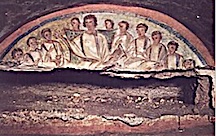
Illustration: Early Christian Catacomb painting of Jesus and disciples, pre-third century
Pope Leo’s Angelus Reflection on 22nd Sunday in Ordinary Time
Piazza della Libertà (Castel Gandolfo) = Sunday, 30 August 2026
Jesus began to show his disciples that he must suffer and be killed,
and on the third day be raised
Sunday Gospel:
Matthew 16:21-27
From that time Jesus began to show his disciples that he must go to Jerusalem and suffer many things from the elders and chief priests and scribes, and be killed, and on the third day be raised.
And Peter took him and began to rebuke him, saying, “God forbid, Lord! This shall never happen to you.” But he turned and said to Peter, “Get behind me, Satan! You are a hindrance[a] to me; for you are not on the side of God, but of men.”
Then Jesus told his disciples, “If any man would come after me, let him deny himself and take up his cross and follow me. For whoever would save his life will lose it, and whoever loses his life for my sake will find it.
For what will it profit a man, if he gains the whole world and forfeits his life? Or what shall a man give in return for his life?For the Son of man is to come with his angels in the glory of his Father, and then he will repay every man for what he has done.
Pope Leo’s Angelus Reflection
Dear Brothers and Sisters,
Today’s Gospel tells us how Jesus revealed the Mystery of his impending passion to his disciples.
He tells that the Messiah must “go to Jerusalem and undergo great suffering at the hands of the elders and chief priests and scribes, be killed, and on the third day be raised”.
This is very different from their expectations of a triumphant and powerful Messiah, who would help them to defeat and trample down their enemies
It is he who will tread down our foes. (Psalm 108:14 – ‘With God we shall do valiantly’.
Earlier, when they were with him, they had the opportunity to marvel at his actions and words.
However, this last message goes beyond anything they had ever predicted.
Peter, in particular, expresses his opposition and admonishes Jesus, saying:
“God forbid, Lord! This will never come upon you” (v. 22).
Shortly before, Peter had identified Jesus as “the Messiah, the Son of the living God” (v. 16).
Now, though, surprised and perhaps disappointed by what he hears, Peter rebukes Jesus.
This contrasts with the beautiful profession of faith Peter had just made.
It’s as if he’s saying, “Yes, I believe you are the Messiah, but that’s not how the world is saved.” Peter’s outburst is certainly motivated by sincere love, and yet it gives us something to consider.
It is not always easy for us, either, to understand and accept God’s ways, especially when they differ greatly from our own.
Then, against all reasoning of faith, the temptation arises to think that the Lord is wrong or, worse yet, that he is not listening to us or concerned about us.
Faced with this uncertainty, Peter teaches us two important things, even in his impulsiveness.
First, we should never cease our dialogue with the Lord, even in such moments. Instead, we should confidently tell him that we are having difficulty understanding what he is asking of us.
Second, we should never judge God’s work. Instead, we should humbly and prayerfully listen to what he reveals to us through his actions, even when they do not meet our expectations.
Peter’s greatness as the first of the apostles is evident in this as well.
Jesus replied, “Get behind me, Satan!” (v. 23) and tells him and the other disciples that to follow him, they must deny themselves, take up their crosses, and follow him.
Peter does just that.
After listening to Jesus, Peter accepts the challenge and remains faithful to Christ’s words for the rest of his life, even unto martyrdom.
Therefore, let us ask the Lord that we, too, may have the same sincerity as Peter in our life of faith and in our prayer, humbly telling Jesus what we truly feel, even when our hearts are confused.
At the same time, may we cultivate Peter’s docility in accepting what Jesus asks of us, even when it exceeds our expectations.
May Mary help us, for she remained obedient to God’s will even at the foot of her Son Jesus’s cross.